적요
‘색소4호’는 종실 안토시아닌 함량과 수량성이 높은 자색옥수수 신품종으로 자식계통 HA7과 HA8을 각각 종자친과 화분친으로 사용하여 교잡된 단교잡종이다. 출사일수는 71일로 대조품종 ‘색소2호’보다 2일 빨랐으며, 간장은 276 cm, 착수고율은 55%로 ‘색소2호’와 비슷한 생육 특성을 보였다. 이삭 길이는 18.6 cm로 대조품종 대비 길고 100립중은 32.4 g으로 종실 비대가 우수하며 도복 저항성이 강하였다. 옥수수 알곡의 안토시아닌 함량은 170 mg/100g으로 ‘색소2호’(278 mg/100g)보다 낮았으나, 종실 수량은 832 kg/10a로 ‘색소2호’ 대비 약 49% 크게 증수되었다. 그린바이오 산업에서 상용화되기 위한 가장 핵심적인 조건은 안정적인 원물 수급과 원료 단가 절감이다. 기존 ‘색소2호’는 함량이 높으나 수량성이 낮아 재배를 기피하거나 수매 단가가 상승하는 한계가 있었으나, ‘색소4호’는 종실 수량과 100립중이 크게 증가하여 원료 수급의 불안정성을 해결하고 산업적 활용도를 높일 수 있는 우수한 다수성 소재용 품종이라 평가된다. ‘색소4호’의 적응지역은 강원특별자치도이며 1대 교잡종이므로 매년 갱신된 종자를 이용해야 하고, 습해에 다소 약하므로 재배 시 배수 관리에 유의해야 한다. 종실, 포엽, 속대 모두에 자색이 발현되고 수량성이 획기적으로 개선된 ‘색소4호’의 보급은 천연 건강기능성 식품 및 가공 소재용 원료의 대량 확보를 가능하게 하여 국내 그린바이오 산업 발전과 농가 소득 증대에 크게 기여할 것으로 사료된다(품종보호 등록번호: 제8985호).
Abstract
‘Saekso 4’ is a high-yielding, anthocyanin-rich purple corn variety developed by the Gangwon State Agricultural Research and Extension Services for health functional food and processing materials. It was registered for variety protection in 2022. It is bred by crossing the inbred lines ‘HA7’ and ‘HA8’. ‘Saekso 4’ has a silking date of 71 days (2 days earlier than that of ‘Saekso 2’) and exhibits strong lodging resistance with an ear length of 18.6 cm. The grain is a bluish-black semi-flint with purple husks and cobs, making it highly suitable for biomaterial extraction. Notably, its grain yield reaches 832 kg/10a, a 49% increase compared with that of ‘Saekso 2’, exhibiting exceptional high-yielding capacity. Its grain anthocyanin content (170 mg/100 g) and absolute pigment yield were lower than those of ‘Saekso 2’. However, its superior overall productivity ensures a more reliable and consistent material supply for the bio-industry. Adapted to the Gangwon region, this F1 hybrid needs annual seed renewal and proper drainage management to prevent moisture damage. The dissemination of ‘Saekso 4’ is expected to markedly contribute to establishing a stable supply system for domestic green bio-materials and enhancing the incomes of farmers (Registration No. 8985).
-
Key words: maize, corn, purple corn, Greenbio, anthocyanins
서언
옥수수(
Zea mays L.)는 세계 3대 식량작물로 식용, 사료용, 공업용 등 산업 전반에 걸쳐 다양한 용도로 활용되는 핵심 자원이다(
Baek et al. 2020). 최근 한국농촌경제연구원(KREI)의 ‘2026 농업전망’에 따르면 기후변화, 지정학적 리스크, 그리고 주요국의 바이오연료 생산 확대 등으로 인하여 국제 곡물 시장의 수급 불안정성과 가격 변동성이 심화되고 있다(
KREI 2026). 반면 대한민국의 전체 곡물 자급률은 20% 내외로 지속적인 하락 추세에 있으며, 특히 옥수수의 곡물자급률은 0.8%, 식량자급률은 4.3~4.5%로 낮아 대부분의 소비량을 해외 수입에 의존하고 있어 국가 식량안보가 크게 위협받고 있는 실정이다(MAFRA 2025). 수입 의존적인 국내 옥수수 산업의 체질 개선과 농가소득 증대를 위해 부가가치가 높은 국내 고유의 기능성 천연물 소재 품종 개발이 요구되어 왔다.
강원특별자치도농업기술원 옥수수연구소에서는 국내 기후에 적응성이 뛰어나면서도 안토시아닌을 고농도로 함유한 가공용 옥수수 품종 개발에 매진해 왔다. 그 결과, 포엽과 속대에 안토시아닌 색소가 발현되는 ‘색소1호(
Kim et al. 2021)’와 종실 자체에 안토시아닌 함량이 높은 품종인 ‘색소2호(
Choi et al. 2017)’를 개발하여 자색옥수수의 천연물 소재화 기반을 마련하였다. 특히 ‘색소2호’는 종실용 자색 일반옥수수로서 가공용 원료로 높은 가치를 지니고 있으나, 기능성 옥수수의 본격적인 산업화와 농가 보급 확대를 위해서는 단위 면적당 종실 수량을 더욱 향상시켜 경제성을 극대화한 신품종의 개발이 필수적인 과제로 남아있었다. 이에, 기존 ‘색소2호’ 품종의 한계를 보완하고 그린바이오 가공용 옥수수의 원료 생산성을 높이고자 종실과 포엽, 속대 모두에 안토시아닌이 발현되는 단교잡종 자색옥수수 신품종 ‘색소4호’를 육성하였다. ‘색소4호’는 기존 ‘색소2호’ 대비 숙기가 빠르면서도 월등히 우수한 종실 수량성을 확보하여, 추출용 및 가공용 원료의 대량 생산 등 산업적 활용 가치를 크게 높인 품종이다.
따라서 본 연구에서는 건강기능성 식품 소재화에 적합한 다수성 신품종 ‘색소4호’의 육성 경위와 주요 농업적 특성, 수량성 및 색소 함량 등의 검정 결과를 보고하여, 국내 그린바이오 산업의 원료 공급 안정화와 재배 농가의 소득 증대에 기여하고자 한다.
재료 및 방법
재배 방법
자색옥수수 신품종 ‘색소4호’의 생육 및 수량특성 평가를 위한 생산력검정 예비시험을 2014년에 수행하였으며, 본시험은 2015년부터 2016년까지 2년간 강원특별자치도 홍천군에 위치한 옥수수연구소 시험연구포장에서 수행하였다. 대조품종으로는 기존 육성 품종인 ‘색소2호’를 사용하였다. 시비량은 표준시비법을 적용하여 10 a당 N-P2O5-K2O로 17.4-3-6.9 kg으로 시용하였고, 이 중 질소는 기비와 추비(본엽 7~8엽기)로 각각 50%씩 나눠 처리하였다. 퇴비는 10 a당 1.5톤을 시용하였다. 재식밀도는 10 a당 5,500주(60×30 cm)로 평휴재배하였으며, 시험구 배치는 난괴법 3반복으로 하였다. 파종은 매년 4월 하순에 2립씩 파종 후 2~3엽기에 1주를 남기고 솎아주었다. 기타 재배 방법은 농촌진흥청 옥수수 표준재배법에 준하여 실시하였다.
생육특성 및 수량성
생육특성 및 수량성 조사는 농촌진흥청의 농업과학기술연구조사분석기준(RDA 2012)에 따라 수행하였다. 생육특성 중 출사일수는 시험구별 전체 개체 중 50% 이상에서 수염이 출현한 날을 기준으로 파종일부터의 일수를 산정하였다. 간장, 착수고는 시험구별 생육이 균일한 곳에서 10주를 임의로 선정하여 측정하였고, 착수고율은 간장에 대한 착수고의 비율로 산출하였다. 수량 및 이삭특성은 출사기 이후 약 50일경 수확기에 시험구별 20주씩 수확하여 포엽을 제거한 뒤 조사하였다.
안토시아닌 함량 측정
안토시아닌 함량 측정은
Ryu et al. (2003)의 방법으로 분석하였다. 알곡 건조분말시료 0.1 g에 1% citric acid가 들어있는 60% ethanol을 40 mL 첨가하여 90분 동안 교반하여 추출하였다. 추출액은 0.45 µm 멤브레인 필터로 여과하여 나온 여과액을 Evolution 201 UV-VIS spectrophotometer (Thermo Fisher Scientific, Madison, WI, USA)를 사용하여 535 nm에서 흡광도를 측정하였다. 표준원액은 표준물질 Cyanidin3-O-glucoside chloride (Sigma-Aldrich, St. Louis, MO, USA)을 1% citric acid가 들어있는 60% ethanol에 녹여 조재하여 검량선을 작성하여 총 안토시아닌 함량을 정량하였다.
모든 통계분석은 R 통계 소프트웨어(version 4.5.1, R Core Team, 2025)를 이용하여 수행하였다. 육성품종과 대비품종 간 주요 농업적 특성의 평균 차이 검정은 Student’s t-test를 실시하여 유의수준 p<0.05 수준에서 판단하였다.
결과 및 고찰
육성경위
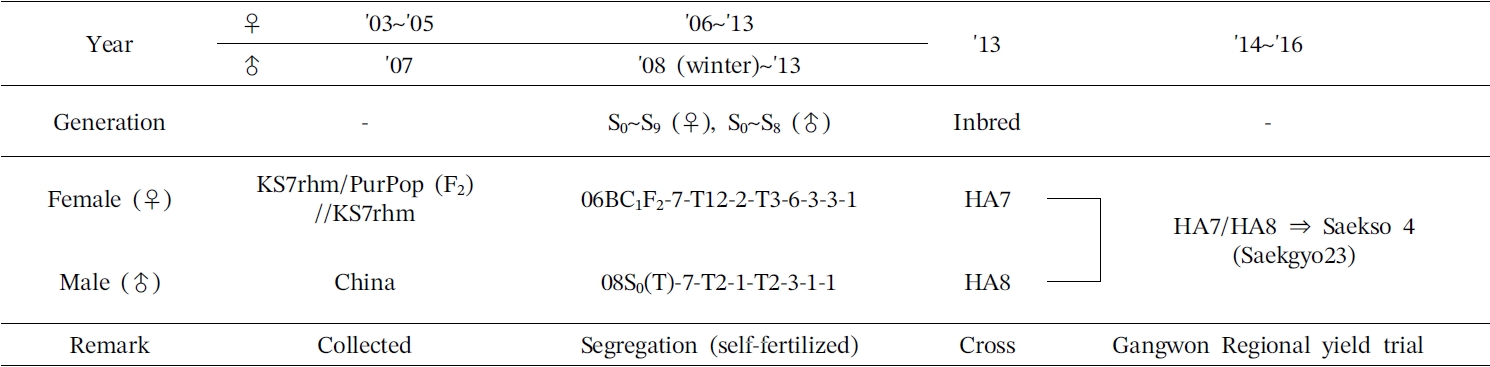
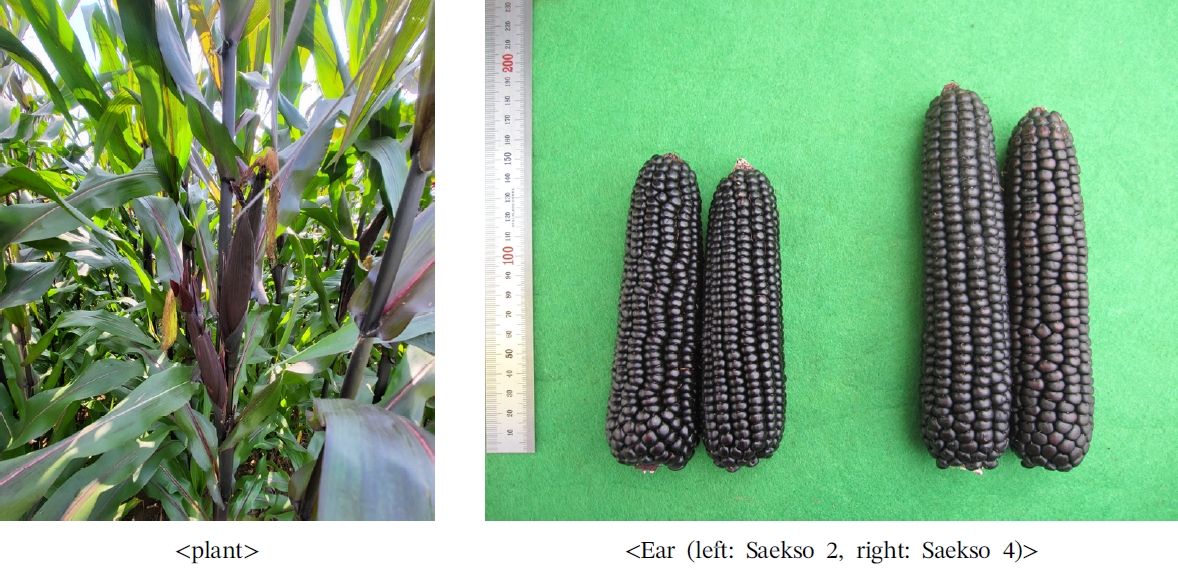
‘색소4호’는 그린바이오 산업의 기능성 소재로 활용하기 위해 개발된 자색옥수수이다. 모본 ‘HA7’은 농촌진흥청에서 개발한 KS7rhm과 색소모집단을 교배하여 1회 자식과 KS7rhm으로 1회 여교잡을 하여 2006년 100번으로 공시하였다. 2013년까지 8회 분리육종을 통해 선발된 계통을 ‘HA7’로 계통명을 부여하였다. 부본 ‘HA8’은 2007년 중국에서 수집한 자원을 2008년 동계기간 0세대로 공시하여 7회의 자식과 선발을 통해 2013년 7세대 1번으로 선발 계통을 ‘HA8’로 명명하였다. 2013년 두 개의 계통을 교배한 교잡종을 2014년 강원특별자치도 홍천에서 생산력검정 예비시험을 수행하였다. 이어 2015년부터 2016년까지 2년간 ‘색교23호’로 생산력검정 본시험 수행 결과, 수량성과 안토시아닌 함량의 우수성이 인정되어 2016년 강원특별자치도농업기술원 신품종선정심의회에서 ‘색소4호’로 선정되었다(
Figs. 1,
2).
‘색소4호’는 잡종강세를 이용한 단교잡종이다. 제1엽의 엽끝 모양은 타원형을 띤다. 제1엽 엽초의 안토시아닌 색소 발현 정도는 중간으로 대조품종인 ‘색소2호’보다 다소 옅었으나, 생육기 잎집에서는 대조품종 대비 상대적으로 강하게 발현되었다. 또한, 속대의 안토시아닌 발현이 강하고, 종실은 청흑색을 띠는 고유특성을 지니고 있다(
Table 1).
자색옥수수 ‘색소4호’는 ‘색소2호’ 대비 출사일수가 2일 빠른 71일이였으며, 간장은 276 cm로 다소 낮았으나 착수고율은 55%로 대조품종과 유사한 수준을 보였다. 이삭특성 조사결과 ‘색소4호’의 이삭길이는 18.6 cm, 이삭폭은 4.4 cm로 ‘색소2호’ 대비 큰 특징을 보였고, 백립중도 32.4 g으로 대조품종(22.2 g) 대비 우수한 특징을 보였다(
Table 2).
2015년부터 2016년까지 홍천에서 실시한 생산력 검정 평가결과는
Table 3과 같다. ‘색소4호’는 평균 종실중은 832 kg/10a으로 대조품종인 ‘색소2호’ 557 kg/10a 대비 49% 크게 증수하였다. 종실의 총 안토시아닌 함량은 ‘색소4호’가 170 mg/100g으로 ‘색소2호’ 278 mg/100g에 비해 다소 낮아 절대적인 색소 생산량은 대조품종에 미치지 못하였다(
Table 2).
‘색소4호’의 재배 적응지역은 강원특별자치도 내에서만 평가를 수행하여 강원 지역에서만 재배가 가능하고 1대 단교잡종(F1)이므로, 품질과 수량성 유지를 위해 매년 갱신된 종자를 사용해야 한다. 또한, ‘색소4호’는 타 옥수수 품종에 비해 습해에 다소 약한 특성이 관찰되어 포장 배수관리가 필요하다. 이삭썩음병을 예방하기 위해 출사 후 45일에서 50일 사이 조기 수확하여야 하며, 수확 후 건조 및 관리에 각별한 주의가 필요하다.
Notes
-
사사
본 연구는 강원특별자치도농업기술원 기본과제(LP001817)의 지원으로 수행되었습니다.
Fig. 1.Pedigree diagram of ‘Saekso 4’.
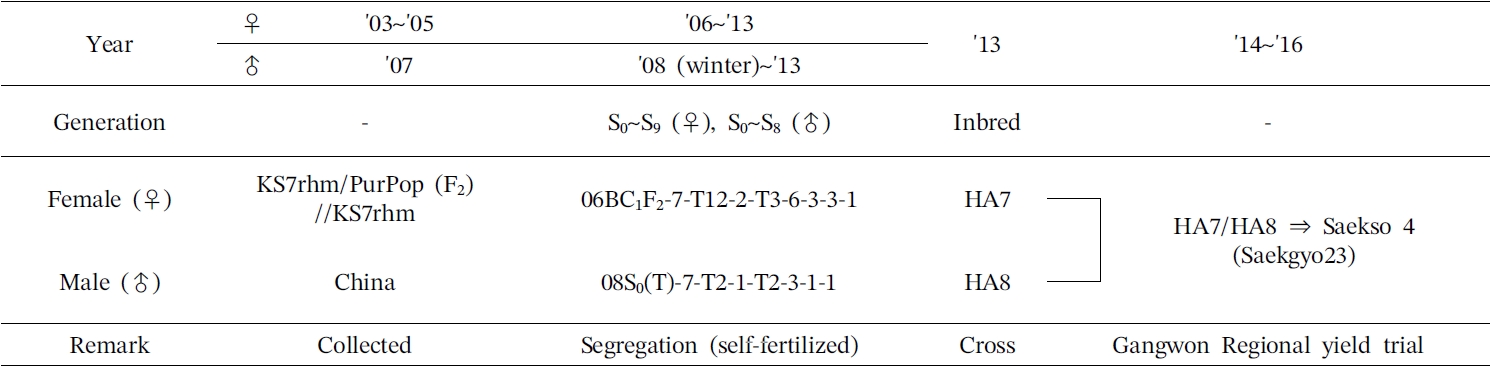
Fig. 2.Plant and ear characteristics of ’Saekso 4’.
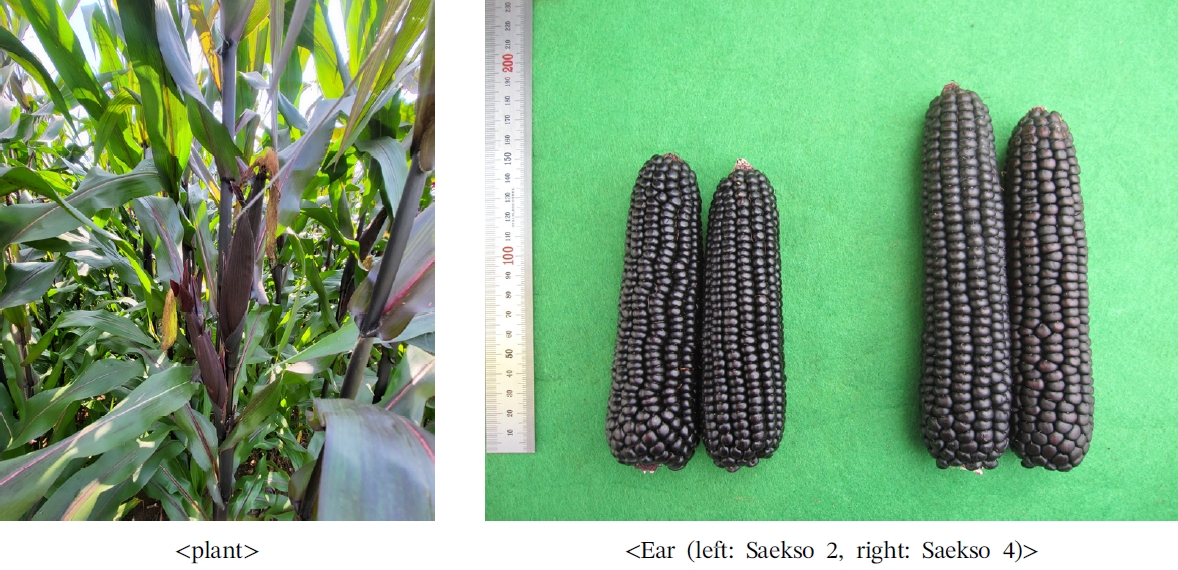
Table 1.Inherited characteristics of ‘Saekso 4’.
Table 1.
|
Hybrid |
Type |
First leaf: Shape of apex |
Anthocyanin coloration
|
Seed coat |
|
1st leaf |
Leaf sheath |
Cob |
|
Saekso 4 |
Single cross |
Spatulate |
Medium |
Medium |
Strong |
Bluish black |
|
Saekso 2 |
Single cross |
Rounded to spatulate |
Strong |
Weak |
Strong |
Bluish black |
Table 2.Agronomic characteristics of ‘Saekso 4’.
Table 2.
|
Hybrid |
Days to silking |
Plant height (cm) |
Ear height ratio (%) |
Lodging (1-9)z
|
Ear
|
Seed
|
|
Length (cm) |
Diameter (cm) |
100-kernel weight (g) |
Anthocyanins (mg/100g) |
|
Saekso 4 |
71±5.3 |
276±5.6 |
55±2.0 |
1 |
18.6±1.3 |
4.4±0.4 |
32.4±2.1 |
170 |
|
Saekso 2 |
73±6.2 |
282±23.3 |
55±1.6 |
1 |
15.6±1.1 |
4.0±1.3 |
22.2±1.3 |
278 |
|
tsy
|
-0.503ns
|
-0.581ns
|
0.000ns
|
- |
4.378**
|
2.228ns
|
9.986***
|
- |
Table 3.Grain yields of ‘Saekso 4’ in yield trials for 2 years.
Table 3.
|
Location |
Saekso 4 (kg/10a) (A)
|
Index (A/B) (%) |
Saekso 2 (kg/10a) (B)
|
|
2015 |
2016 |
Mean |
2015 |
2016 |
Mean |
|
Hongcheon |
883±80.9 |
781±27.6 |
832±77.6 |
149 |
592±7.6 |
521±30.6 |
557±43.9 |
|
tsz=-7.559***
|
References
- 1. Baek SB, Son BY, Kim JT, Bae HH, Go YS, Kim SL. 2020. Changes and prospects in the development of corn varieties in Korea. Korean Journal of Breeding Science 52(S):93-102.
- 2. Choi JK, Park JY, Park KJ, Kim HY, Ryu SH, Seo YH. 2017. Anthocyanin-rich grain corn hybrid variety ‘Saekso 2’. Korean Journal of Breeding Science 49: 289-293.
- 3. Choung MG, Lim JD. 2012. Antioxidant, anticancer and immune activation of anthocyanin fraction from Rubus coreanus Miquel fruits (Bokbunja). Korean Journal of Medicinal Crop Science 20: 259-269.
- 4. Duan X, Jiang Y, Su X, Zhang Z, Shi J. 2007. Antioxidant properties of anthocyanins extracted from litchi (Litchi chinenesis Sonn.) fruit pericarp tissues in relation to their role in the pericarp browning. Food Chemistry 101: 1365-1371.
- 5. Kim HY, Park JY, Park KJ, Ryu SH, Chang EH, Goh BD, Yoon BS, Yong WS, Choi JK. 2021. Major characteristics of anthocyanin-rich purple corn hybrid variety: ‘Saekso 1’. Korean Journal of Breeding Science 53: 534-538.
- 6. Korea Rural Economic Institute (KREI). 2026. Agricultural outlook conference 2026. Chaper 3: pp. 1-24.
- 7. Lee KY, Kim JE, Hong SY, Kim TH, Noh HS, Kim SC, Park JY, Ahn MS, Kim HY. 2016. Effect of Saekso 2 corn kernels and cobs extracts on antioxidant activity in rats fed high fat-cholesterol diet. Journal of Food Hygiene and Safety 31: 399-405.
- 8. Ministry of Agriculture, Food and Rural Affairs (MAFRA). 2025. Statistical yearbook of agriculture, food and rural affairs. pp. 202-205.
- 9. Oki T, Masuda M, Furuta S, Nishiba Y, Terahara N, Suda I. 2002. Involvement of anthocyanins and other phenolic compounds in radical-scavenging activity of purple-fleshed sweet potato cultivars. Journal of Food Science 67: 1752-1756.
- 10. Rural development administration (RDA). 2012. Agricultural science technology standards for investigation of research. pp. 366-385.
- 11. Ryu SN, Park SZ, Kang SS, Han SJ. 2003. Determination of C3G Content in Blackish Purple Rice using HPLC and UV-Vis Spectrophotometer. Korean Journal of Crop Science 48: 369-371.
- 12. Tsuda T, Horio F, Uchida K, Aoki H, Osawa T. 2003. Dietary cyanidin 3-O-β-D-glucoside-rich purple corn color prevents obesity and ameliorates hyperglycemia in mice. The Journal of Nutrition 133: 2125-2130.
- 13. Wallace TC, Giusti MM. 2015. Anthocyanins. Advances in Nutrition 6: 620-622.
Citations
Citations to this article as recorded by