적요
밀 알레르기 저감과 제빵 품질 향상을 동시에 달성하기 위하여, 알레르기 저감 밀 품종 오프리를 모본으로 하고 국내 대표 제빵용 품종 금강을 부본으로 한 F10 재조합 근교계통(recombinant inbred line, RIL) 1,780 계통을 대상으로 글리아딘 및 글루테닌 품질 관련 분자표지 분석을 수행하였다. 분석에는 ω-5 gliadin 관련 Gli-B1 및 Gli-D1 유전자좌 표지, α-gliadin epitope 관련 Gli-D2 표지, 제빵 품질 관련 Glu-D1 표지, 종실경도 관련 Pinb-D1 표지, 총 글리아딘 함량 관련 AX-108761918 SNP 표지 및 글루테닌/글리아딘 비율 관련 TaIAA10-6D 표지를 이용하였다. 분석 결과, Gli-B1 deletion 기반 ω-5 gliadin 결핍 유전자형은 전체 집단의 18%에서 확인되었으며, Gli-D1 유래 ω-5 gliadin 결핍 계통과 α-gliadin 결핍 계통은 확인되지 않았다. 총 글리아딘 함량 관련 AX-108761918 SNP 표지에서는 글리아딘 함량 감소와 연관된 TT 유전자형과 증가와 연관된 GG 유전자형이 각각 48%와 52%로 분리되었다. 제빵 품질 관련 분석에서는 Glu-D1d, Pinb-D1b 및 TaIAA10-6D Hap II 유전자형을 동시에 보유한 11 계통이 빵용 후보 계통으로 선발되었으며, Gli-B1 deletion과 Glu-D1d 및 Pinb-D1b를 동시에 보유한 9 계통이 알레르기 저감 및 제빵 품질 관련 후보 계통으로 선발되었다. SDS-PAGE 분석 결과, 선발 계통들은 분자표지 분석 결과와 일치하는 저장단백질 발현 양상을 나타내었다. 본 연구에서는 Gli-B1 deletion 기반 알레르기 저감 관련 유전자형과 우수한 제빵 품질 관련 유전자형의 동시 선발 가능성을 대규모 RIL 집단에서 확인하였으며, 선발된 계통들은 국내 밀 육종에서 알레르기 저감 및 고품질 밀 품종 개발을 위한 유용한 육종 소재로 활용될 수 있을 것으로 기대된다.
Abstract
An important objective in wheat breeding is the development of cultivars with reduced allergenicity and enhanced bread-making quality. In this study, we conducted molecular marker analysis using 1,780 F10 recombinant inbred lines derived from a cross between the hypo-allergenic cultivar Ofree and the Korean bread wheat cultivar Keumgang, and assessed the genotypes associated with ω-5 gliadin, α-gliadin epitopes, bread-making quality, grain hardness, total gliadin content, and the glutenin/gliadin ratio. A Gli-B1 deletion-based ω-5 gliadin-deficient genotype was detected in 18% of the population, whereas no lines lacking Gli-D1-derived ω-5 gliadin or α-gliadin epitopes were identified. The AX-108761918 marker was found to have segregated into TT and GG genotypes at frequencies of 48% and 52%, respectively. Eleven lines carrying favorable combinations of Glu-D1d, Pinb-D1b, and TaIAA10-6D Hap II were selected as promising bread wheat candidates, and a further nine lines combining the Gli-B1 deletion with Glu-D1d and Pinb-D1b were identified as candidates with both reduced-allergenicity and enhanced bread-making quality genotypes. SDS-PAGE analysis confirmed patterns of storage proteins consistent with the results obtained for marker genotyping. These selected lines may provide valuable breeding material for the development hypo-allergenic wheat cultivars with enhanced bread-making quality in Korea.
-
Key words: hypoallergenic wheat, recombinant inbred lines, ω-5 gliadin, bread-making quality, marker-assisted selection
서언
밀의 종자 저장단백질은 주로 글리아딘(gliadin)과 글루테닌(glutenin)으로 구성되며, 이들의 조성과 축적 비율은 반죽의 점탄성, 신장성 및 최종 가공품의 품질을 결정하는 핵심 요인이다(
Shewry & Halford 2002). 일반적으로 글리아딘은 단량체 형태로 존재하면서 반죽의 점성과 신장성에 기여하는 반면, 글루테닌은 고분자 중합체를 형성하여 반죽의 강도와 탄성을 부여한다. 특히 고분자량 글루테닌 서브유닛(high-molecular-weight glutenin subunit, HMW-GS)의 조성은 제빵 품질과 밀접하게 연관되며,
Glu-1 Payne quality score가 10점인 유전자형은 우수한 제빵 적성을 나타내는 것으로 알려져 있다(
Ganbaatar et al. 2025,
Payne et al. 1987). 또한 종실경도에 관여하는
Pina-D1/Pinb-D1 조성은 제분 특성 및 손상전분 함량과 밀접하게 관련되며, 경질밀(
Pina-D1b 또는
Pinb-D1b 보유)은 제빵용 밀가루에 적합한 것으로 보고되었다(
Morris 2002).
밀 저장단백질은 밀가루 반죽의 점탄성과 가공 품질에 영향을 미치는 동시에, 일부 글루텐 단백질은 밀 관련 면역반응의 주요 원인 단백질로 작용할 수 있다(
Scherf et al. 2016). 글리아딘 가운데
ω-5 글리아딘은 wheat-dependent exercise-induced anaphylaxis (WDEIA)의 주요 알레르겐으로 알려져 있으며, 글루타민이 풍부한 반복서열 내 특정 에피토프가 IgE 결합에 핵심적인 역할을 한다(
Matsuo et al. 2004,
Matsuo et al. 2005).
ω-5 글리아딘을 암호화하는 유전자는 주로 1B 염색체의
Gli-B1 유전자좌에 위치하며, 이 유전자좌의 결손은
ω-5 글리아딘뿐 아니라 일부
γ-,
β-글리아딘 및 저분자량 글루테닌(low-molecular-weight glutenin subunit, LMW-GS)의 동시 소실을 초래하여 저장단백질 조성 전반에 영향을 미친다(
Payne et al. 1984,
Singh & Shepherd 1988). 알레르기 저감 밀 품종 오프리(Ofree)는 이러한
Gli-B1 유전자좌 결손에 따른
ω-5 글리아딘 소실을 특징으로 하는 품종으로 보고되었으며(
Lee et al. 2017,
Lee et al. 2018), 알레르기 저감 밀 품종 개발의 유용한 육종 소재로 주목받고 있다.
그러나 오프리는 제빵에 불리한 Glu-D1f (1Dx2.2+1Dy12) 대립유전자와 연질 종실경도 유전자형(Pina-D1a/Pinb-D1a)을 가지므로, 알레르기 저감 특성을 유지하면서도 우수한 제빵 품질을 동시에 갖춘 품종으로의 개량이 필요하다. 국내에서 널리 재배되는 다용도 품종 금강은 우수한 글루텐 강도 및 제빵 적성과 연관된 Glu-D1d (1Dx5+1Dy10) 대립유전자와 경질 종실경도 유전자형(Pinb-D1b)를 보유한다. 따라서 오프리와 금강의 교배 집단에서는 오프리 유래의 ω-5 글리아딘 결핍 특성과 금강 유래의 제빵 품질 관련 대립유전자를 동시에 선발할 수 있어, 저알레르기⋅제빵 적성을 겸비한 계통 육성이 가능하다.
본 연구에서는 오프리 유래
Gli-B1 결손 기반의 알레르기 저감 관련 유전자형과 금강 유래의 제빵 품질 관련 유전자형 선발을 주요 목적으로 하였다. 이와 함께 교배 후대 집단 내 추가적인 알레르기 저감 관련 유전자형의 존재 여부를 확인하기 위해, D 게놈의
ω-5 글리아딘 관련 유전자좌인
Gli-D1과
α-글리아딘 에피토프 관련 유전자좌인
Gli-D2에 대한 marker 분석을 수행하였다(
Altenbach et al. 2018,
Park 2024). 한편 국내 밀 재배환경에서는 등숙기가 짧고 등숙 후반기에 기온이 빠르게 상승하여 글리아딘이 글루테닌에 비해 상대적으로 과다 축적되고, 이로 인해 제빵 품질이 저하될 수 있다(
Blumenthal et al. 1995,
Corbellini et al. 1997). 이러한 환경적 특성을 고려할 때, 제빵 품질 관련 계통 선발에서는 HMW-GS 조성과 종실경도뿐 아니라 총 글리아딘 함량 및 글루테닌/글리아딘 비율과 관련된 유전자형을 함께 검토할 필요가 있다. 총 글리아딘 함량과 연관된 KASP 표지 AX-108761918은 6D 염색체의 글리아딘 함량 관련 QTL cluster와 연관된 marker로, T 대립유전자는 상대적으로 낮은 글리아딘 함량과 관련된 것으로 보고되었다(
Zhou et al. 2022).
TaIAA10-6D의 Hap II 유전자형은 상대적으로 높은 글루테닌 비율과 우수한 제빵 품질에 유리한 것으로 알려져 있어, 글루테닌/글리아딘 비율을 고려한 선발 표지로 활용될 수 있다(
Liu et al. 2025).
본 연구에서는 알레르기 저감 특성을 갖는 밀 품종 오프리를 모본으로 하고 국내에서 널리 재배되는 다용도 품종 금강을 부본으로 한 F10 재조합 근교계통(recombinant inbred line, RIL) 1,780계통을 대상으로 글리아딘 및 글루테닌 품질 관련 분자표지 분석을 수행하였다. 이를 통해 ω-5 글리아딘 결핍 기반의 알레르기 저감 밀 관련 유전자형과 우수한 제빵 품질 관련 유전자형을 동시에 보유한 계통의 선발 가능성을 평가하고, 국내 밀 육종 프로그램에 활용할 수 있는 기초 자료를 제공하고자 하였다.
재료 및 방법
공시재료
ω-5 글리아딘 저감 특성이 있는 오프리를 모본, 금강을 부본으로 하여 교배 후 육성된 F
10 RIL 1,780 계통을 공시하였다. 공시재료는 전북대학교 부속 실험포장에서 2024년 10월 25일에 1열(plot size: 0.25 m×2.0 m)로 파종하였으며, 재배 관리는 농촌진흥청 표준재배법(
RDA 2012)에 따라 수행하였다. 수확은 2025년 6월 20일에 실시하였으며, 수확한 종실은 2.0 mm 체로 정선한 후 실온에서 자연 건조하였으며, 건조 후 종실은 10℃에서 저장하였다. 생육 기간(2024년 10월~2025년 6월) 동안 평균 기온은 9.8℃로 평년(8.8℃)보다 1.0℃ 높았으며, 총강수량은 723.6 mm로 평년(459.9 mm)보다 많았다.
유전자형 분석
분자표지 분석을 위한 genomic DNA는 온실에서 3주간 생육한 유묘의 제3엽에서 추출하였다. 채취한 조직은 액체질소로 급속 냉동한 후 미세 분말로 분쇄하여 -70℃에 보관하였다. DNA 추출은 Solg™ Genomic DNA Prep Kit (SolGent Co., Ltd., Daejeon, Korea)를 이용하여 제조사 프로토콜에 따라 수행하였으며, 분말 시료 100 mg에서 genomic DNA를 분리하였다. 추출된 DNA의 농도와 순도는 NanoDrop 1000 spectrophotometer (Thermo Scientific, USA)를 이용하여 측정하였고, 분석 전까지 -20℃에 보관하였다.
Kompetitive Allele-Specific PCR (KASP) 마커 분석을 위하여 대립유전자 특이적 primer의 5′ 말단에 각각 FAM (5′-GAAGGTGACCAAGTTCATGCT-3′) 및 HEX (5′-GAAGGTCGGAGTCAACGGATT-3′) 형광 서열을 추가하였다. KASP 반응액은 genomic DNA 5 μL, 2× KASP Master Mix 5 μL 및 assay mix 0.14 μL로 조성하였다. 반응은 CFX96 Real-Time PCR System (Bio-Rad Laboratories, USA)을 이용하여 제조사 권장 touchdown PCR 조건으로 수행하였으며, 유전자형 판독은 CFX Maestro Software 2.0 (Bio-Rad Laboratories, USA)을 이용하였다. Sequence-tagged site (STS) 마커의 PCR 증폭은 Veriti Dx 96-Well Thermal Cycler (Applied Biosystems, USA)를 이용하여 수행하였다. 증폭 산물은 1.5% agarose gel에서 135 V 조건으로 1시간 전기영동한 후 UV transilluminator를 이용하여 확인하였다.
HMW-GS 조성 분석
HMW-GS 조성 분석을 위하여 분쇄된 종실 40 mg으로부터 저장단백질을 추출하였다. 단백질 추출은 extraction buffer [0.125 M Tris-HCl (pH 6.8), 1% (w/v) SDS, 24% (v/v) glycerol, 0.003% (w/v) bromophenol blue, 5% (v/v)
β-mercaptoethanol] 500
μL를 추가하고 95℃ 5분 처리 후 SDS-PAGE를 수행하였다. SDS-PAGE 분리겔은 13% polyacrylamide로 제조하였다. 전기영동은 120 V 조건에서 6시간 수행하였다. 전기영동 후 겔은 Coomassie Brilliant Blue R-250으로 염색한 뒤 10% trichloroacetic acid 용액으로 탈색하였다. HMW-GS 조성은
Payne & Lawrence (1983)의 명명법에 따라 분류하였다.
각 분자표지의 유전자형 분포는 계통 수와 백분율로 나타내었다. Gli-B1 표지의 존재형과 결손형 유전자형 분포가 F10 RIL 집단에서 기대되는 1:1 분리비에 부합하는지 평가하기 위해 카이제곱 적합도 검정을 수행하였으며, 모든 통계분석은 SAS software version 9.4 (SAS Institute Inc., Cary, NC, USA)를 이용하여 수행하였다.
결과 및 고찰
글리아딘 관련 유용자원 선발
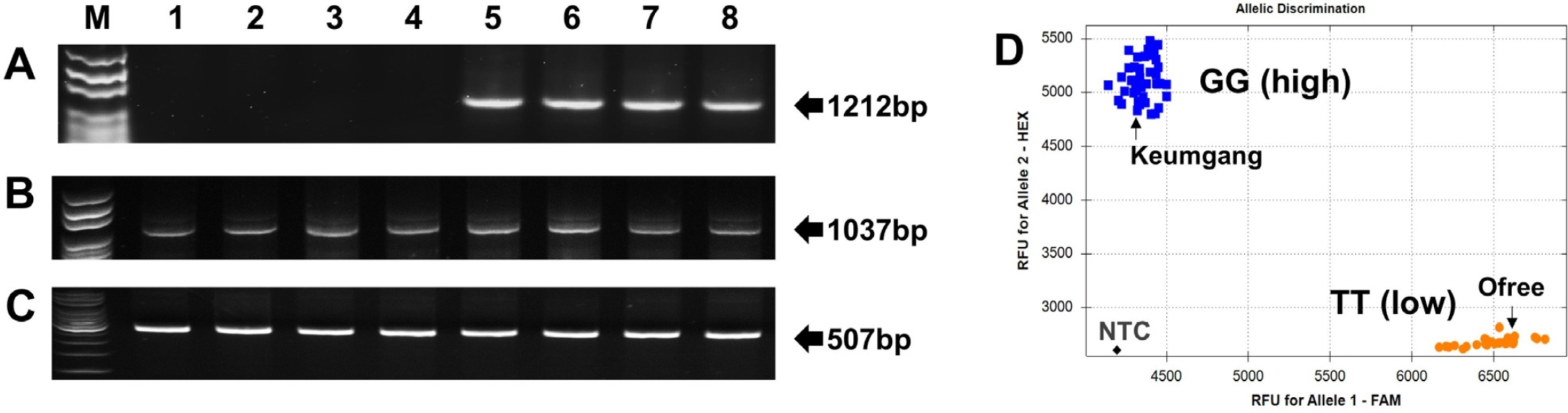
오프리×금강 RIL 집단(n=1,780)을 대상으로 글리아딘 조성 관련 분자표지의 유전자형 분포를 분석한 결과를
Table 2 및
Fig. 1에 나타내었다.
ω-5 글리아딘 관련
Gli-B1 표지 분석에서는 존재형 유전자형이 1,461계통(82%), 결손형 유전자형이 319계통(18%)으로 나타나, 오프리 유래
Gli-B1 결손형 유전자좌가 교배 후대 집단에서 분리되고 있음을 확인하였다. 반면
Gli-D1 표지에서는 전체 집단이 존재형 유전자형을 나타내어
Gli-D1 유래
ω-5 글리아딘 결핍 계통은 확인되지 않았다. 또한
Gli-D2 유전자좌의
α-글리아딘 에피토프 관련 표지에서는 전체 계통이 기능형 유전자형을 나타내어 결핍형 계통은 관찰되지 않았다. 총 글리아딘 함량과 연관된 AX-108761918 표지에서는 TT 유전자형이 860계통(48%), GG 유전자형이 920계통(52%)으로 비교적 균등하게 분리되었다.
Gli-B1 결손형 유전자형의 빈도가 F
10 RIL 집단에서 기대되는 1:1 분리비에서 벗어나는지 확인하기 위해 카이제곱 적합도 검정을 수행하였다. 존재형과 결손형의 관찰 빈도는 기대 분리비에서 유의하게 벗어났으며(
χ2=732.68, df=1, p<0.001), 본 집단의
Gli-B1 표지에서 통계적으로 유의한 분리왜곡이 발생했음을 확인하였다. 밀 RIL 집단에서도 특정 유전자좌 또는 염색체 구간에서 이와 같은 분리왜곡이 보고된 바 있다(
Li et al. 2015). 그러나 본 연구에서는 초기 세대의 유전자형 분포, 세대 진전 과정의 선발 이력 및
Gli-B1 주변 유전자좌를 분석하지 않았으므로, 관찰된 분리왜곡의 원인을 명확히 특정하기는 어렵다. 향후
Gli-B1 주변 인접 marker 분석 및 독립적인 교배집단에서의 재현성 검증이 필요할 것으로 판단된다.
Gli-B1 결손형 계통은 저장단백질 조성 개량을 위한 중요한 후보 유전자원으로 평가될 수 있다. 밀의 글리아딘 유전자는 1번 및 6번 염색체의 여러 유전자좌에 군집되어 있으며, 특히
Gli-1 유전자좌는 LMW-GS 유전자좌와 밀접하게 연관되어 블록 단위로 유전되는 것으로 알려져 있다(
Galili & Feldman 1984,
Singh & Shepherd 1988). 오프리의 알레르기 저감 관련 형질은
Gli-B1 유전자좌의 결손과 관련되며, 이에 따라
ω-5 글리아딘뿐 아니라 일부
γ- 및
β-글리아딘과 LMW-GS의 동시 소실이 나타나는 것으로 보고되었다(
Payne et al. 1984,
Singh & Shepherd 1988). 다만
Gli-B1 결손이 밀 알레르기 유발 인자를 완전히 제거하는 것은 아니며,
γ-글리아딘, 일부
α-글리아딘 및 비글루텐 단백질 역시 알레르기 반응에 관여할 수 있는 것으로 보고되었다(
Palosuo et al. 2001,
Scherf et al. 2016). 따라서 본 연구에서 선발된 계통에 대해서는 향후 immunoblot 또는 enzyme-linked immunosorbent assay (ELISA) 기반의 면역학적 검증이 추가로 필요하다.
본 연구에서는
Gli-D1 유래
ω-5 글리아딘 결핍 계통과
α-글리아딘 결핍 계통은 확인되지 않았다. 이는 오프리의 알레르기 저감 특성이 B 게놈의
Gli-B1 결손에 기인하는 만큼, D 게놈 유전자좌의 추가 결손이 교배 후대에서 함께 나타날 가능성이 낮기 때문이다. 또한
α-글리아딘은 여러 유전자좌에 다수의 복사본이 존재하는 다중 유전자족(multigene family)으로 구성되어 있어, 일반 교배집단에서 해당 분획 전반의 결실이 나타날 가능성은 매우 낮은 것으로 알려져 있다(
Kasarda et al. 1983). 따라서 본 결과는 교배육종 기반 알레르기 저감 밀 육종에서
Gli-B1 결손 기반 선발 전략이 가장 현실적인 접근 방법임을 시사한다.
AX-108761918 SNP 표지는 총 글리아딘 함량과 연관된 간접 선발 지표로 보고되었으며(
Zhou et al. 2022), 본 연구에서는 TT 유전자형이 전체 집단의 48%를 차지하였다. 글리아딘은 반죽의 점성과 신장성에 기여하는 주요 저장단백질이지만, 과다 축적되면 글루텐 강도와 반죽 안정성을 저하할 수 있다(
Uthayakumaran et al. 2001).
Zhou et al. (2022)에 따르면 AX-108761918의 G 대립유전자는 총 글리아딘 함량을 유의하게 증가시키는 대립유전자로 보고되었으며, 반대로 T 대립유전자는 글리아딘 함량 감소와 연관된 대립유전자로 확인되었다. 따라서 본 연구에서 확인된 TT 유전자형 보유 계통은 상대적으로 낮은 글리아딘 함량을 나타낼 것으로 예측되며, 글루테닌/글리아딘 비율 개선을 통한 제빵 품질 향상 측면에서 유용한 육종 소재로 활용될 가능성이 있다. 다만 AX-108761918은 간접 선발 지표이므로, 실제 글리아딘 함량 변화는 RP-UPLC 기반 단백질 정량 분석을 통해 추가로 검증할 필요가 있다.
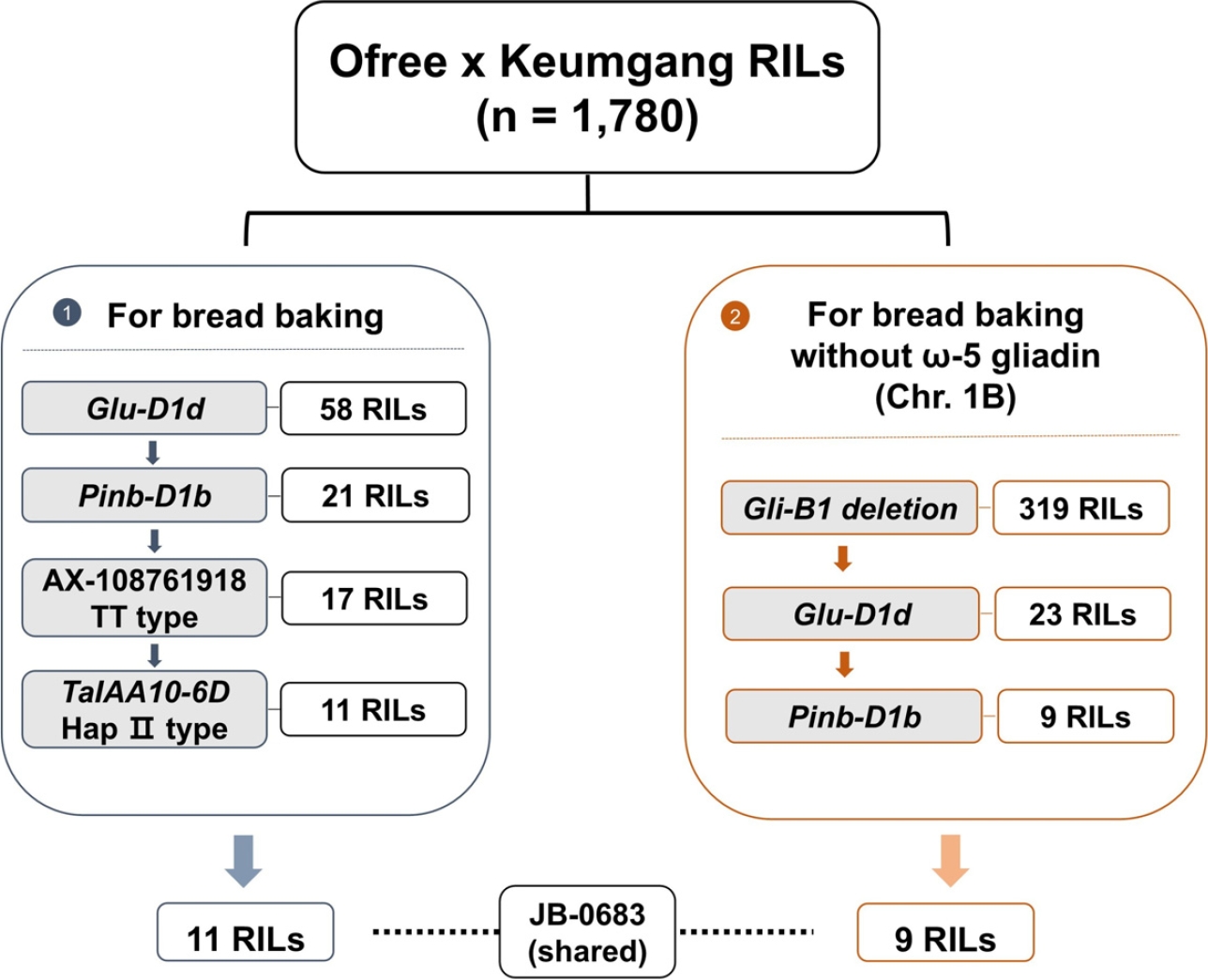
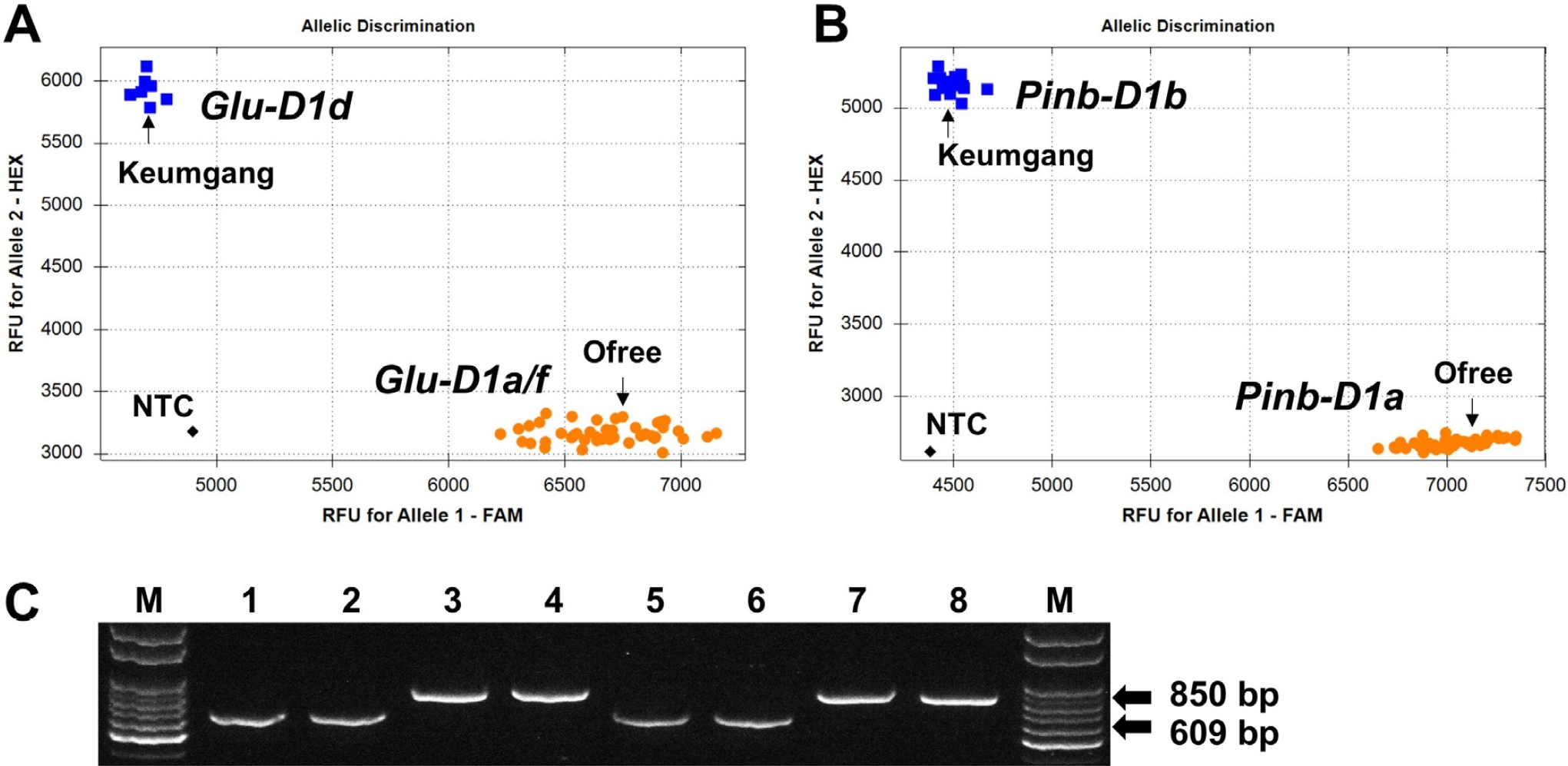
제빵 품질 관련 유전자원의 선발을 위하여
Glu-D1, Pinb-D1, AX-108761918 및
TaIAA10-6D 등 4종의 분자표지를 이용하여 유전자형 분석을 수행하였으며, 그 결과를
Table 2 및
Figs. 2,
3에 나타내었다.
Glu-D1 유전자좌 분석 결과, 우수한 제빵 적성과 연관된
Glu-D1d 대립유전자를 보유한 계통은 58계통(3%)으로 나타났다(
Table 2). 이들 가운데 경질 입질과 연관된
Pinb-D1b 유전자형을 동시에 보유한 계통은 21계통으로 선발되었다. 이후 총 글리아딘 함량과 연관된
AX-108761918 SNP 표지를 이용하여 TT 유전자형을 보유한 계통을 추가 선발한 결과 17계통이 확인되었으며, 최종적으로 글루테닌/글리아딘 비율과 관련된
TaIAA10-6D Hap II 유전자형을 동시에 보유한 11계통이 빵용 후보 계통으로 선발되었다.
ω-5 글리아딘 결핍(
Gli-B1 deletion) 배경을 가진 319계통 중
Glu-D1d 유전자형을 보유한 계통은 23계통이었으며, 이 가운데
Pinb-D1b를 동시에 보유한 9계통이 알레르기 저감 및 제빵 품질 관련 후보 계통으로 선발되었다(
Fig. 2). 이 중 JB-0683 계통은
Gli-B1 deletion,
Glu-D1d,
Pinb-D1b 및
TaIAA10-6D Hap II 유전자형을 동시에 보유하여 두 선발 그룹에 공통으로 포함되었다.
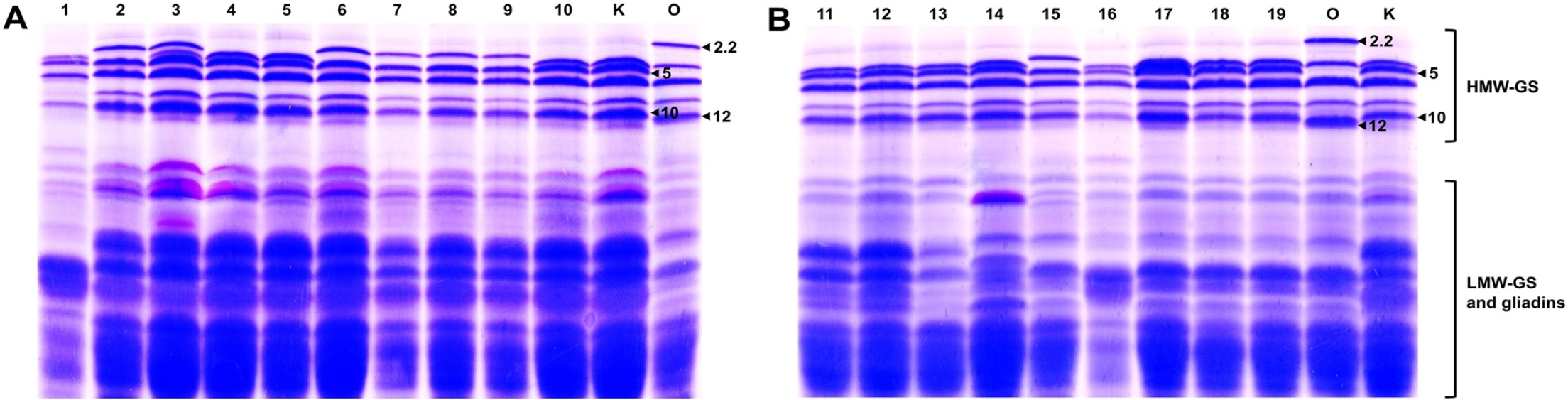
최종 선발된 계통의 저장단백질 조성을 SDS-PAGE로 분석한 결과를
Fig. 4에 나타내었다. 선발 계통들은 모두
Glu-D1d 유전자형에 해당하는 HMW-GS band pattern을 나타내었으며,
Pinb-D1b 유전자형을 보유한 것으로 분자표지 분석에서 확인되었다.
Gli-B1 deletion 기반 알레르기 저감 관련 선발 계통에서는
ω-5 gliadin band의 소실이 확인되어 분자표지 분석 결과와 일치하는 단백질 발현 양상을 보였다. 최종 선발 계통의 유전자형 정보는
Table 3에 제시하였다.
Glu-D1 유전자좌는 밀의 제빵 품질과 밀접하게 연관된 대표적인 저장단백질 유전자좌이며, 특히
Glu-D1d (1Dx5+1Dy10) 대립유전자는 우수한 글루텐 강도와 제빵 적성과 관련되는 것으로 알려져 있다(
Payne et al. 1987,
Shewry and Halford 2002). 본 연구에서
Glu-D1d 유전자형이 선발된 계통은 전체 집단의 3% 수준으로 나타났으며, 이는 집단 내
Glu-D1d 유전자형의 빈도가 낮음에도 불구하고, 분자표지 기반 선발을 통해 해당 유전자형을 효율적으로 발굴할 수 있음을 보여준다. 또한
Pinb-D1b 유전자형은 경질 입질과 관련되며, 제분 시 높은 손상전분 함량과 수분흡수율 특성을 나타내어 제빵용 밀 품질과 밀접하게 연관되는 것으로 보고되었다(
Morris 2002). 따라서
Glu-D1d와
Pinb-D1b를 동시에 보유한 계통은 국내 빵용 밀 육종에서 유용한 소재로 활용될 가능성이 크다.
본 연구에서는 글루테닌/글리아딘 비율과 연관된
TaIAA10-6D Hap II 유전자형을 추가로 고려하여 선발을 수행하였다. 최근
Liu et al. (2025)은
TaIAA10-6D가 글루테닌 관련 유전자의 발현 조절에 관여하며, Hap II 유전자형이 상대적으로 높은 글루테닌/글리아딘 비율과 우수한 반죽 특성에 유리하다고 보고하였다.
그러나 HMW-GS 조성이 우수하더라도 재배환경에 따라 실제 제빵 품질은 크게 달라질 수 있다. 밀의 등숙 기 온도와 기간은 글리아딘과 글루테닌의 상대적 축적에 직접적인 영향을 미치며, 등숙기간이 짧고 고온인 환경에서는 글리아딘이 글루테닌에 비해 과다하게 축적되는 경향이 있다(
Blumenthal et al. 1995). 국내 밀 재배환경은 등숙기가 짧고 기온이 빠르게 상승하는 특성을 가지므로,
TaIAA10-6D Hap II 유전자형은 이러한 환경적 제약을 보완할 수 있는 유용한 품질 관련 유전자형으로 판단된다. 특히 AX-108761918 TT 유전자형과
TaIAA10-6D Hap II 유전자형을 동시에 보유한 계통은 글루테닌/글리아딘 비율 개선 측면에서 상호 보완적인 효과를 나타낼 가능성이 있다.
Gli-B1 deletion 기반 알레르기 저감 관련 유전자형과 우수한 제빵 품질 관련 유전자형이 동시에 선발된 것은 본 연구의 중요한 결과 중 하나이다. 일반적으로
Gli-B1 deletion은
ω-5 gliadin뿐 아니라 일부 저분자량 글루테닌의 동시 소실을 수반할 수 있어(
Payne et al. 1984), 글루텐 품질 저하 가능성이 우려됐다. 그러나 본 연구에서는
Glu-D1d,
Pinb-D1b 및
TaIAA10-6D Hap II를 동시에 보유한 계통이 확인되어, 알레르기 저감 관련 유전자형과 제빵 품질 관련 유전자형의 결합 가능성을 확인할 수 있었다. 이는 국내 밀 육종에서 알레르기 저감 특성과 제빵 품질을 동시에 개선하기 위한 분자표지 기반 선발 전략의 활용 가능성을 보여주는 결과로 판단된다.
본 연구는 분자표지 기반 조기 선발 가능성 평가에 초점을 두었으므로, 실제 제빵 품질과 알레르기 저감 효과에 대한 추가적인 검증이 필요하다. 앞으로는 믹소그래프, 패리노그래프 및 시험 제빵을 통한 반죽 특성 평가와 함께, RP-UPLC 기반 저장단백질 정량 분석 및 WDEIA 환자 혈청을 이용한 immunoblot 또는 ELISA 분석이 수행되어야 할 것으로 판단된다. 또한 국내 주요 재배지역의 다양한 환경 평가를 통해 수량성, 출수기 및 품질 안정성을 종합적으로 검토할 필요가 있다.
Notes
-
사사
본 연구는 농촌진흥청 국립식량과학원의 공동연구사업(RS-2025-02214999)과 전북대학교 연구기반 조성비 지원으로 수행되었습니다.
Fig. 1.Genotyping results for gliadin composition-related markers in the Ofree × Keumgang RIL population. (A-C) Agarose gel electrophoresis for STS marker analysis: (A) ω-5 gliadin (Chr. 1B); (B) ω-5 gliadin (Chr. 1D); (C) α-gliadin (Gli-D2). M, size marker; lanes 1-8 represent individual RIL lines: 1, JB-0006; 2, JB-0019; 3, JB-0166; 4, JB-0660; 5, JB-0023; 6, JB-0390; 7, JB-0079; 8, JB-0105. (D) KASP genotyping result for AX-108761918. The X-axis indicates FAM fluorescence and the Y-axis indicates HEX fluorescence, with each dot representing a single RIL line (n=1,780). Clusters correspond to homozygous parental alleles (Ofree-type and Keumgang-type), while samples with low fluorescence signals were classified as no calls. The genotype distribution for each marker is presented in Table 2.
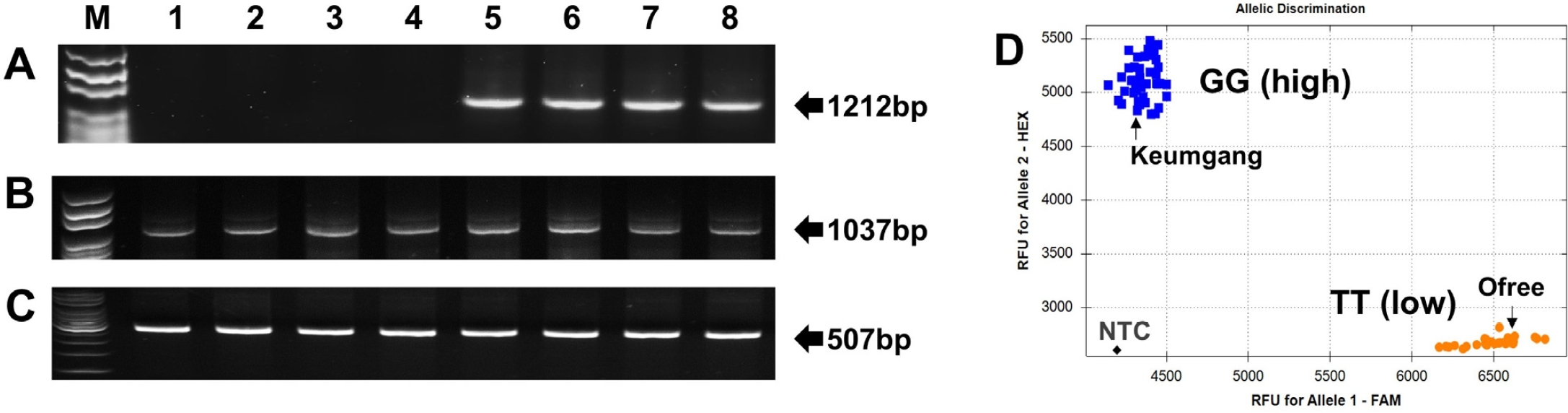
Fig. 2.Schematic diagram of the stepwise marker-assisted selection strategy for RIL lines with favorable bread-making quality and low-allergenicity in the Ofree × Keumgang RIL population (n=1,780). Lines were selected based on two independent criteria. For bread-making quality, lines carrying Glu-D1d, Pinb-D1b, AX-108761918 TT, and TaIAA10-6D Hap II were sequentially filtered (58 → 21 → 17 → 11 lines). For bread-making quality without ω-5 gliadin (Chr. 1B), lines carrying Gli-B1 deletion were first screened, followed by Glu-D1d and Pinb-D1b (319 → 23 → 9 lines). JB-0683 satisfies both criteria (Gli-B1 deletion + Glu-D1d + Pinb-D1b + TaIAA10-6D Hap II) and is therefore included in both groups. Details of all selected lines are shown in Table 3.
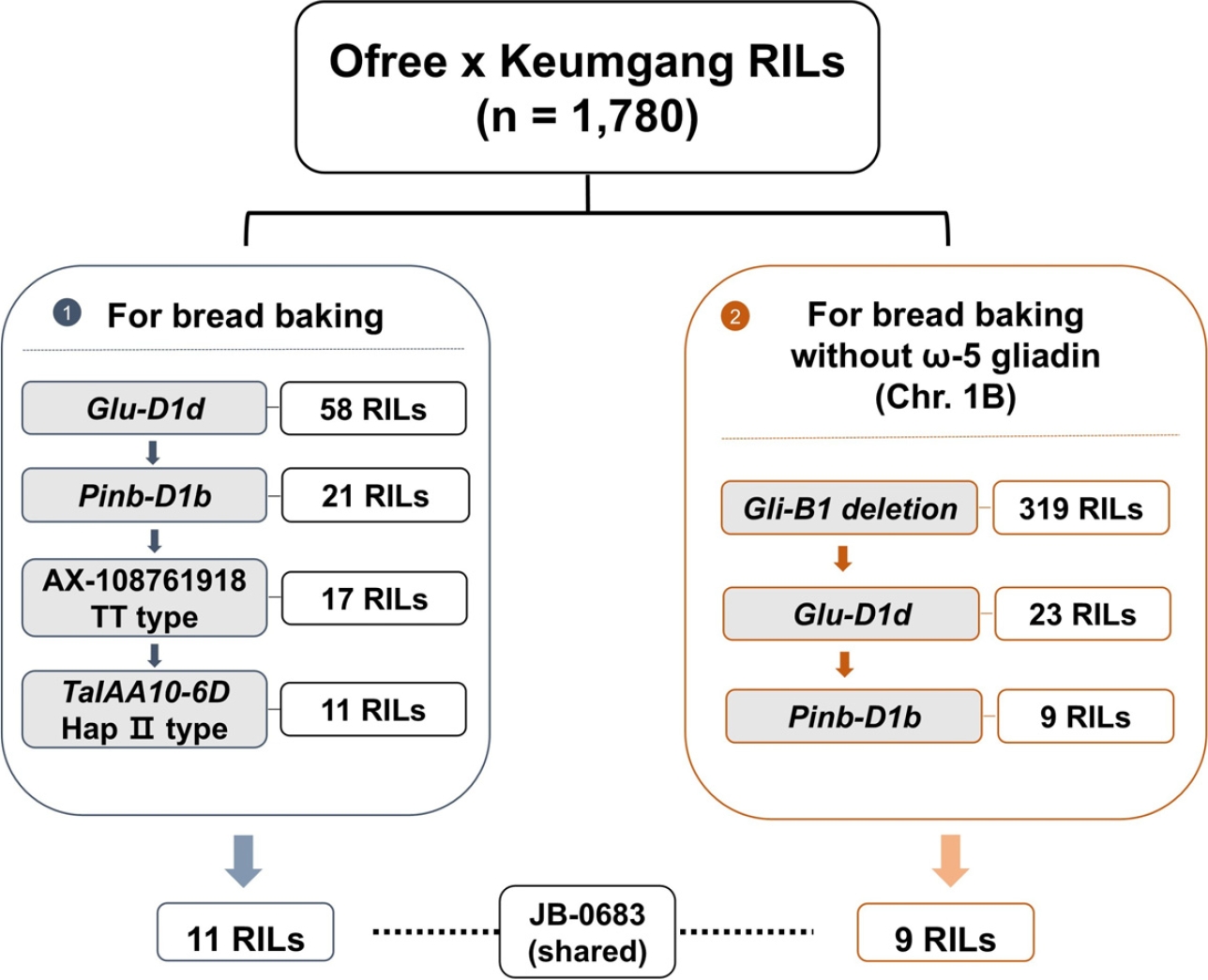
Fig. 3.KASP genotyping and agarose gel electrophoresis results for gluten quality-related markers in selected RIL lines. (A) KASP allelic discrimination plot for Glu-D1; clusters correspond to Glu-D1d (Keumgang-type, blue squares) and Glu-D1a/f (Ofree-type, orange circles). (B) KASP allelic discrimination plot for Pinb-D1; clusters correspond to Pinb-D1b (Keumgang-type, blue squares) and Pinb-D1a (Ofree-type, orange circles). In both panels, the X-axis indicates FAM fluorescence (Allele 1) and the Y-axis indicates HEX fluorescence (Allele 2); NTC, no-template control. (C) Agarose gel electrophoresis for InDel marker analysis of TaIAA10-6D; the 609 bp and 850 bp bands correspond to Hap I and Hap II, respectively. M, size marker; 1, JB-0006; 2, JB-0019; 3, JB-0166; 4, JB-0660; 5, JB-0023; 6, JB-0390; 7, JB-0079; 8, JB-0105.
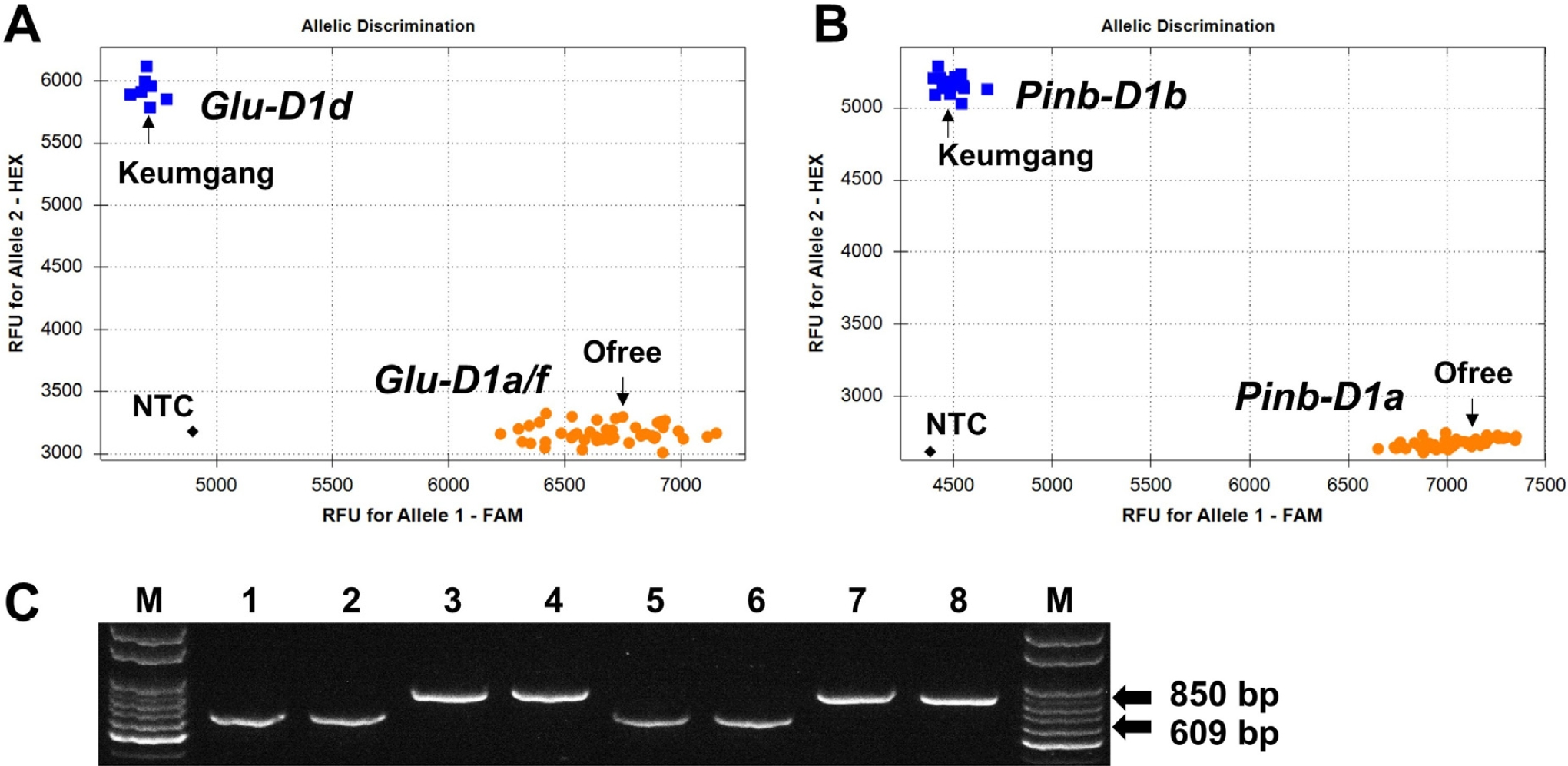
Fig. 4.SDS-PAGE profiles of storage proteins in selected RILs and parental cultivars. (A) Bread-making quality candidate lines and (B) reduced-allergenicity and bread-making quality candidate lines. The HMW-GS bands corresponding to Glu-D1f in Ofree (1Dx2.2 + 1Dy12) and Glu-D1d in Keumgang (1Dx5 + 1Dy10) are indicated. All selected lines showed the Glu-D1d-type HMW-GS pattern, consistent with the marker genotyping results. Lanes: 1, JB-0483; 2, JB-0674; 3, JB-0688; 4, JB-0719; 5, JB-0720; 6, JB-1222; 7, JB-1225; 8, JB-1226; 9, JB-1231; 10, JB-1733; 11, JB-0127; 12, JB-0143; 13, JB-0151; 14, JB-0182; 15, JB-0683; 16, JB-0918; 17, JB-0929; 18, JB-0930; 19, JB-0931; O, Ofree; K, Keumgang.
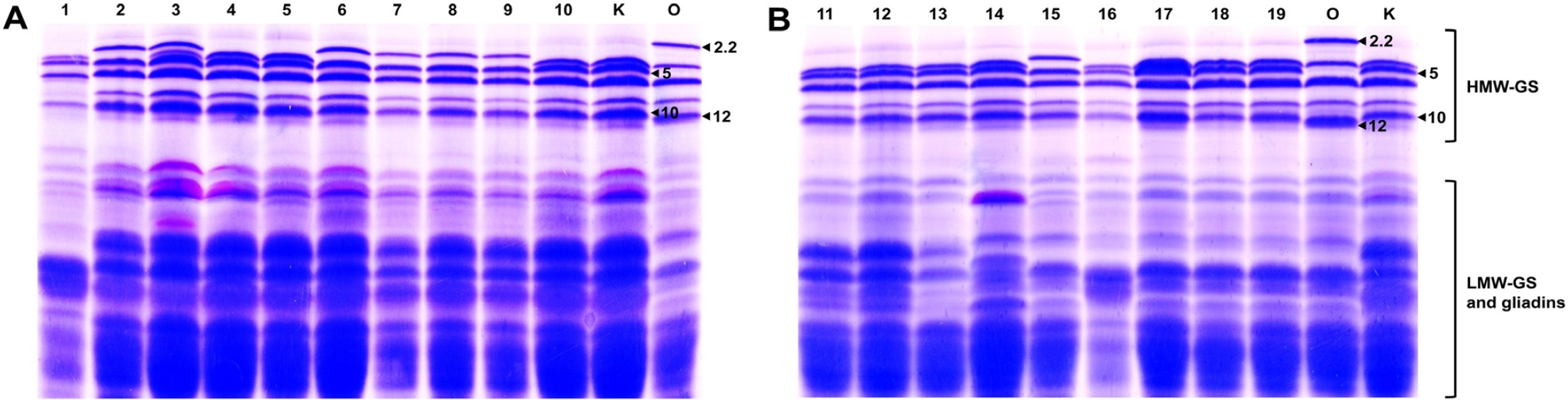
Table 1.Molecular markers used for genotyping reduced-allergenicity-related and bread-making-quality-related loci in the Ofree × Keumgang RIL population.
Table 1.
|
Target trait |
Locus |
Chr |
Primer sequence (5'-3') |
Marker typey
|
Reference |
|
Low-allergenicity |
|
α-gliadin epitope |
Gli-D2
|
6D |
TAGCAACCACCGCCACAATT |
STS |
Park 2024
|
|
|
|
GCAAAACTTGTGAGCTTCCATACGC |
|
|
|
ω-5 gliadin |
Gli-B1
|
1B |
AGTAGGCTGCTAAGCCCTAGA |
STS |
Altenbach et al. 2018
|
|
|
|
ATATTGTTGGTATGGGGAAGG |
|
|
|
ω-5 gliadin |
Gli-D1
|
1D |
ACTAGGCAACTAAGCCCTAGA |
STS |
Altenbach et al. 2018
|
|
|
|
GCTTCTTGCGATTGTTGTTGG |
|
|
|
Bread-making quality |
|
Total gliadin content |
AX-108761918 |
6D |
CCGGAGTGTGGCTCATTGTGAAATT |
KASP |
Zhou et al. 2022
|
|
|
|
CCGGAGTGTGGCTCATTGTGAAATG |
|
|
|
|
|
GTAGTACTTGCCTAACCACACCTCTA |
|
|
|
HMW-GSz composition |
Glu-D1
|
1D |
ATAGTATGAAACCTGCTGCGGAG |
KASP |
Shin et al. 2020
|
|
|
|
ATAGTATGAAACCTGCTGCGGAC |
|
|
|
|
|
TACTAAAAAGGTATTACCCAAGTGTAACTT |
|
|
|
Grain hardness |
Pinb-D1
|
5D |
CTCATGCTCACAGCCGCC |
KASP |
Choi et al. 2022
|
|
|
|
CTCATGCTCACAGCCGCT |
|
|
|
|
|
CGTGATGGAGCGATGTTTCAC |
|
|
|
Glutenin/gliadin ratio |
TaIAA10-6D
|
6D |
CCTTCGGCTCACTCTAGTGCATG |
STS |
Liu et al. 2025
|
|
|
|
CTGCGCTCGCGTGTCTGAG |
|
|
Table 2.Genotypic distribution of reduced allergenicity-related and bread-making quality-related markers in the Ofree × Keumgang RIL population (n=1,780).
Table 2.
|
Target trait |
Locus |
Ofree |
Keumgang |
Genotypey
|
No. of lines |
Frequency (%) |
|
α-gliadin epitope |
Gli-D2
|
Functional |
Functional |
Functional |
1780 |
100 |
|
|
|
|
Non-functional |
0 |
0 |
|
ω-5 gliadin |
Gli-B1
|
Absent |
Present |
Present |
1461 |
82 |
|
|
|
|
Absent |
319 |
18 |
|
ω-5 gliadin |
Gli-D1
|
Present |
Present |
Present |
1780 |
100 |
|
|
|
|
Absent |
0 |
0 |
|
Total gliadin content |
AX-108761918 |
TT |
GG |
TT |
860 |
48 |
|
|
|
|
GG |
920 |
52 |
|
HMW-GSz composition |
Glu-D1
|
Glu-D1f
|
Glu-D1d
|
Glu-D1d
|
58 |
3 |
|
|
|
|
Glu-D1a/f
|
1722 |
97 |
|
Grain hardness |
Pinb-D1
|
Pinb-D1a
|
Pinb-D1b
|
Pinb-D1a
|
1521 |
85 |
|
|
|
|
Pinb-D1b
|
259 |
15 |
|
Glutenin/gliadin ratio |
TaIAA10-6D
|
Hap I |
Hap II |
Hap I |
1078 |
61 |
|
|
|
|
Hap II |
702 |
39 |
Table 3.Selected 19 RILs with favorable allele combinations for bread-making quality. Lines were selected based on the stepwise filtering criteria shown in Fig. 2. Eleven lines carrying Glu-D1d, Pinb-D1b, and TaIAA10-6D Hap II were classified as bread-type candidates with a high glutenin proportion. Nine other lines, lacking ω-5 gliadin (Chr. 1B) and carrying Glu-D1d and Pinb-D1b were classified as low-allergenicity bread-making candidates.
Table 3.
|
No |
Line ID |
ω-5 gliadin (Chr. 1B) |
Glu-D1
|
Pinb-D1
|
TaIAA10-6D
|
|
For bread-making quality |
|
1 |
JB-0483 |
Present |
d
|
b
|
Hap II |
|
2 |
JB-0674 |
Present |
d
|
b
|
Hap II |
|
3 |
JB-0683 |
Absent |
d
|
b
|
Hap II |
|
4 |
JB-0688 |
Present |
d
|
b
|
Hap II |
|
5 |
JB-0719 |
Present |
d
|
b
|
Hap II |
|
6 |
JB-0720 |
Present |
d
|
b
|
Hap II |
|
7 |
JB-1222 |
Present |
d
|
b
|
Hap II |
|
8 |
JB-1225 |
Present |
d
|
b
|
Hap II |
|
9 |
JB-1226 |
Present |
d
|
b
|
Hap II |
|
10 |
JB-1231 |
Present |
d
|
b
|
Hap II |
|
11 |
JB-1733 |
Present |
d
|
b
|
Hap II |
|
For bread-making quality without ω-5 gliadin (1B) |
|
1 |
JB-0127 |
Absent |
d
|
b
|
Hap I |
|
2 |
JB-0143 |
Absent |
d
|
b
|
Hap I |
|
3 |
JB-0151 |
Absent |
d
|
b
|
Hap I |
|
4 |
JB-0182 |
Absent |
d
|
b
|
Hap I |
|
5 |
JB-0683 |
Absent |
d
|
b
|
Hap II |
|
6 |
JB-0918 |
Absent |
d
|
b
|
Hap I |
|
7 |
JB-0929 |
Absent |
d
|
b
|
Hap I |
|
8 |
JB-0930 |
Absent |
d
|
b
|
Hap I |
|
9 |
JB-0931 |
Absent |
d
|
b
|
Hap I |
References
- 1. Altenbach SB, Chang HC, Simon-Buss A, Jang YR, Denery-Papini S, Pineau F, Gu YQ, Huo N, Lim SH, Kang CS, Lee JY. 2018. Towards reducing the immunogenic potential of wheat flour: Omega gliadins encoded by the D genome of hexaploid wheat may also harbor epitopes for the serious food allergy WDEIA. BMC Plant Biol 18: 291.
- 2. Blumenthal CS, Barlow EWR, Wrigley CW. 1995. Growth environment and wheat quality: The effect of heat stress on dough properties and gluten proteins. J Cereal Sci 21: 149-160.
- 3. Choi R, Yu J-H, Hong S-M, Kim K-M, Jung H-Y, Mo Y, Park CS. 2022. Identification of Korean wheat cultivars using multiplex STS-SSR markers. Korean J Breed Sci 54: 119-129.
- 4. Corbellini M, Mazza L, Ciaffi M, Lafiandra D, Borghi B. 1997. Effect of heat shock during grain filling on protein composition and technological quality of wheat. Euphytica 95: 177-184.
- 5. Galili G, Feldman M. 1984. Mapping of glutenin and gliadin genes located on chromosome 1B of common wheat. Mol Gen Genet 193: 293-298.
- 6. Ganbaatar U, Bodisad G, Jambal T, Noov B, Dorjgotov D, Subedi M. 2025. Allelic variation in HMW-GS of Mongolian wheat varieties using KASP molecular marker. Plant Breed Biotech 13: 5-14.
- 7. Kasarda DD, Autran JC, Lew EJL, Nimmo CC, Shewry PR. 1983. N-terminal amino acid sequences of ω-gliadins and ω-secalins: Implications for the evolution of prolamin genes. Biochim Biophys Acta 747: 138-150.
- 8. Lee JY, Altenbach SB, Kim KH, Seabourn BW, Park CS. 2017. Development of hypoallergenic wheat lines lacking ω-5 gliadin. Theor Appl Genet 130: 121-131.
- 9. Lee YG, Choi SC, Kang Y, Kang C-S, Kim C. 2018. Genomics Approach to identify the cause of the missing omega-5 gliadin protein in O-Free wheat. Plant Breed Biotech 6: 413-425.
- 10. Li C, Bai G, Chao S, Wang Z. 2015. A high-density SNP and SSR consensus map reveals segregation distortion regions in wheat. Biomed Res Int 2015: 830618.
- 11. Liu S, Xie L, Wu H, Xu D, Che R, Tian W, Liu B, Chao Y, Xia X, He Z, Cao S. 2025. TaIAA10-6D orchestrates processing quality and grain yield by modulating glutenin/gliadin ratio. Crop J 13: 1460-1469.
- 12. Matsuo H, Kohno K, Morita E. 2005. Molecular cloning, recombinant expression and IgE-binding epitope of ω-5 gliadin. FEBS J 272: 4431-4438.
- 13. Matsuo H, Morita E, Tatham AS, Morimoto K, Horikawa T, Osuna H, Ikezawa Z, Kaneko S, Kohno K, Dekio S. 2004. Identification of the IgE-binding epitope in ω-5 gliadin. J Biol Chem 279: 12135-12140.
- 14. Morris CF. 2002. Puroindolines: The molecular genetic basis of wheat grain hardness. Plant Mol Biol 48: 633-647.
- 15. Palosuo K, Varjonen E, Kekki OM, Klemola T, Kalkkinen N, Alenius H, Reunala T. 2001. Wheat ω-5 gliadin is a major allergen in children with immediate allergy to ingested wheat. J Allergy Clin Immunol 108: 634-638.
- 16. Park EJ. 2024. Development and characterization of wheat lines missing Gli-D2 locus by proton beam irradiation Master's thesis. Jeonbuk Natl Univ.
- 17. Payne PI, Holt LM, Hutchinson J, Bennett MD. 1984. Development and characterisation of a line of bread wheat lacking the Gli-B1 locus. Theor Appl Genet 68: 327-334.
- 18. Payne PI, Lawrence GJ. 1983. Catalogue of alleles for the complex gene loci, Glu-A1, Glu-B1 and Glu-D1 which code for high-molecular-weight subunits of glutenin in hexaploid wheat. Cereal Res Comm 11: 29-35.
- 19. Payne PI, Nightingale MA, Krattiger AF, Holt LM. 1987. The relationship between HMW glutenin subunit composition and the bread-making quality of British-grown wheat varieties. J Sci Food Agric 40: 51-65.
- 20. RDA. 2012. Standard of research and analysis for agricultural technology. pp. 339-365.
- 21. Scherf KA, Koehler P, Wieser H. 2016. Gluten and wheat sensitivities - An overview. J Cereal Sci 67: 2-11.
- 22. Shewry PR, Halford NG. 2002. Cereal seed storage proteins: Structure and role. J Exp Bot 53: 947-958.
- 23. Shin D, Cha JK, Lee SM, Ko JM, Lee JH. 2020. Validation of functional allele-specific molecular markers for glutenin subunits. Korean J Breed Sci 52: 235-243.
- 24. Singh NK, Shepherd KW. 1988. Linkage mapping of genes controlling endosperm storage proteins in wheat. Theor Appl Genet 75: 628-641.
- 25. Uthayakumaran S, Tömösközi S, Tatham AS, Savage AWJ, Gianibelli MC, Stoddard FL, Bekes F. 2001. Effects of gliadin fractions on functional properties of wheat dough. Cereal Chem 78: 138-141.
- 26. Zhou Z, Geng S, Guan H, Liu C, Qin M, Li W, Shi X, Dai Z, Yao W, Lei Z, Wu Z, Hou J. 2022. Dissection of the genetic architecture for quantities of gliadins fractions in wheat (Triticum aestivum L.). Front Plant Sci 13: 826909.