적요
본 연구는 국내 밀 품종 42점을 활용하여 수발아율을 평가하고, 알파-아밀라아제 활성도를 수발아 정도를 정량적으로 평가하기 위한 생화학적 지표로 활용할 수 있는지 검토하고자 수행하였다. 개화 후 38일에 이삭을 수확하였으며, 탈곡한 종자를 수발아 처리하여 수발아율과 알파-아밀라아제 활성도를 평가하였다. 수발아 저항성이 서로 다른 ‘우리’, ‘조은’, ‘금강’ 및 ‘조경’의 수발아율을 7일간 조사한 결과, 품종 간 수발아 처리에 대한 반응의 차이가 뚜렷하게 나타났다. 수발아 처리 4일 후 국내 밀 42품종의 수발아율과 알파-아밀라아제 활성도를 측정한 결과, 수발아율과 알파-아밀라아제 활성도 간에는 높은 양의 상관관계가 확인되었으며(r=0.90, p<0.001), 알파-아밀라아제 활성도에 대한 수발아율의 선형회귀분석에서도 높은 결정계수(R2=0.82)가 나타났다. 이러한 결과는 알파-아밀라아제 활성도가 국내 밀 품종의 수발아 정도를 정량적으로 평가하고, 육안평가를 보완할 수 있는 생화학적 지표로 활용될 가능성을 보여준다. 알파-아밀라아제 활성도는 국내 밀 품종 및 육종 집단의 수발아 저항성 선발에 유용하게 활용될 수 있을 것으로 기대된다.
Abstract
In wheat, pre-harvest sprouting (PHS) is the premature germination of seeds in the spike that occurs before harvest under prolonged wet and humid conditions, causing substantial losses in yield and quality. Moreover, climate change may increase the risk of PHS in wheat production in Korea. In this study, using 42 Korean wheat cultivars, we sought to determine whether the activity of α-amylase could serve as a biochemical indicator of PHS. Spikes were harvested 38 days after anthesis and treated to induce PHS, and after 4 days, we determined the rates of PHS and α-amylase activity among the assessed cultivars. The rates of PHS and activity of α-amylase ranged from 0% to 84.17% and 0.52 to 56.40 SD units/10 g, respectively, and we detected a strong positive correlation between the rate of PHS and α-amylase activity (Pearson’s r=0.90, p<0.001). Simple linear regression further revealed that the activity of α-amylase explained 82% of the variation in the rate of PHS (R2=0.82). These finding indicate that the activity of α-amylase can serve as a quantitative index of PHS severity and complement visual assessments. Consequently, the activity of α-amylase could represent a useful selection criterion for screening PHS resistance among Korean wheat cultivars and in breeding programs.
-
Key words: pre-harvest sprouting, PHS, α-amylase, α-amylase activity, Korean wheat
서언
수발아는 종실의 휴면과 발아 사이의 불균형에 의해 발생하게 된다(
Tai et al. 2021). 또한, 수발아는 식물 호르몬, 탄수화물 대사산물(carbohydrate metabolites), 활성산소(reactive oxygen species) 등에 의해 큰 영향을 받는다(
Deepika et al. 2025,
Tai et al. 2021,
Xu et al. 2019). 종실의 휴면과 발아는 식물 호르몬 앱시스산(abscisic acid, ABA)과 지베렐린(gibberellin, GA)에 의해 조절된다(
Deepika et al. 2025,
Gubler et al. 2005). ABA는 휴면을 조절하는 주동 인자이며, GA는 휴면 종자의 발아를 촉진시킨다(
Gubler et al. 2005). 알파-아밀라아제(
α-amylase) 활성은 GA 그리고 당 결핍에 의해 유도되며(
Appleford et al. 2007,
Hong et al. 2012), 알파-아밀라아제 활성도는 종자의 발아와 직접적으로 연관되어 있다(
Tai et al. 2021). 알파-아밀라아제는 종실 전분의 분해를 담당하고, 전분은 단순당으로 분해되어 배가 발아하는 데 필요한 에너지를 제공한다(
Karrer et al. 1992). 알파-아밀라아제는 발아에 핵심적인 역할을 담당하여 높은 알파-아밀라아제 활성도는 수발아된 곡물의 두드러진 특징으로 알려져 있다(
McKie & McCleary 2015,
Tai et al. 2021). 또한, 알파-아밀라아제는 전분 입자의 호화 온도 이상에서 활성을 유지하여 전분을 분해하기 때문에 빵의 부피를 감소시키고, 빵을 자를 때도 문제를 유발하기 때문에 알파-아밀라아제 함량이 높은 밀가루는 제빵에 적합하지 않다(
McKie & McCleary 2015).
본 연구는 전 세계적인 이상 기후로 인해 국내에서 재배되는 밀의 수발아 위험성이 증가함에 따라, 국산 밀 품종을 대상으로 수발아를 평가할 수 있는 지표로서 알파-아밀라아제 활성도의 활용 가능성을 평가하고자 한다. 알파-아밀라아제 활성도를 수발아 지표로 활용하면 상대적으로 적은 양의 시료를 활용하여 정확하고 정량적으로 수발아 발생 정도를 평가할 수 있을 것으로 기대된다. 본 연구 결과는 국내 밀의 수발아 저항성 육종을 위한 선발 지표 개발과 밀가루의 품질 평가에 기초자료로 활용될 수 있을 것이다.
재료 및 방법
식물 재료 및 수발아 처리
국내 밀 품종 42점을 초화박스에 심어 공주대학교 예산캠퍼스 내 밀 실험포장에서 2024 - 2025년에 재배하였다(
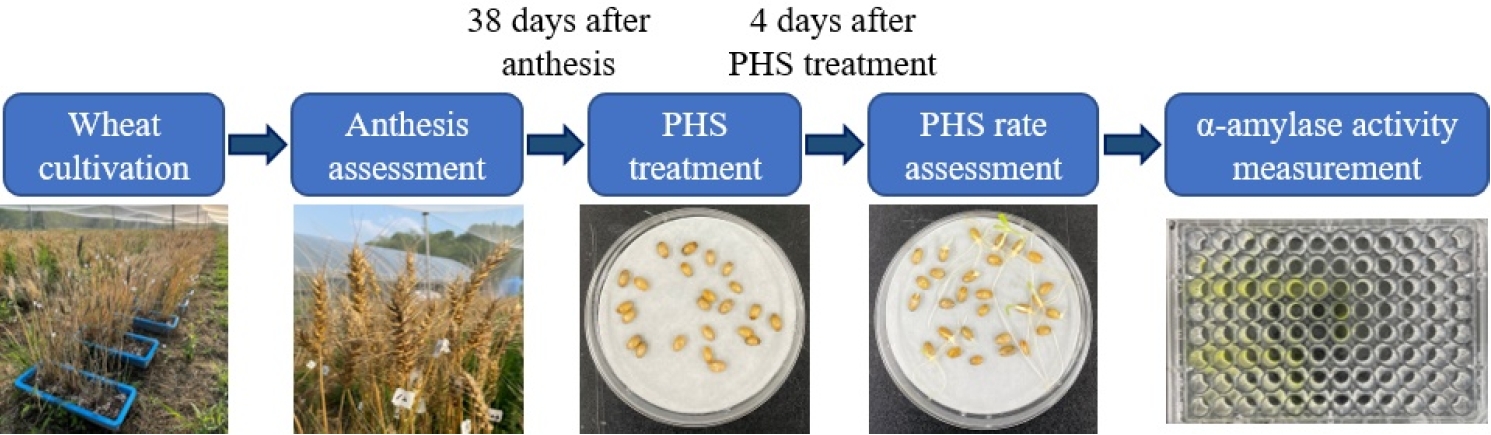
Fig. 1). 각 품종 이삭의 개화일을 체크하고, 개화 후 38일에 이삭을 수확하였다. 수확 직후 각 이삭을 탈곡하고 종자 표면을 소독하였다. 멸균처리한 Whatman No. 1 필터페이퍼(Cytiva, Maidstone, United Kingdom)를 지름 150 mm, 높이 20 mm 페트리 디쉬에 깔고, 종자를 치상한 후 증류수 약 30 mL를 처리하였다. ‘우리’, ‘조은’, ‘금강’, ‘조경’ 4품종을 수발아 처리하여 매일 발아율을 평가하였다. 앞서 기술된 4개 품종을 포함한 국내 밀 42개 품종을 동일한 방법으로 수발아 처리하고 수발아 처리 후 4일 차에 수발아율을 측정하였다. 각 품종에서 3 - 5개의 이삭을 수확하여 개별적으로 수발아 실험에 활용하였다. 수발아 처리 후 4일 차에 수발아율을 측정한 후 종자의 물기를 제거하고, 종자가 발아한 경우 해당 종자의 뿌리와 초엽을 제거한 후 알파-아밀라아제 활성도 측정을 위해 deep freezer에 보관하였다.
알파-아밀라아제 활성도 측정은 Megazyme사에서 제공하는 ALPHA-AMYLASE ASSAY PROCEDURE (AMYLASE SD METHOD) kit (Megazyme, Bray, Ireland)를 활용하였으며, Megazyme사에서 제공하는 프로토콜을 일부 수정하여 실시하였다. 동결된 종자를 Mixer Mill MM 400 (RETSCH, Haan, Germany)을 활용하여 제분하였다. 분쇄된 밀가루 100 mg을 1.6 mL Extraction Buffer solution에 첨가하고 격렬히 vortexing하였다. 40℃로 설정된 항온수조에서 10분 이상 알파-아밀라아제를 추출한 후 11,000 g에서 3분간 원심분리한 후 상등액을 확보하였다. 0.05 mL Amylase SD Reagent solution과 추출물을 40℃로 설정된 항온수조에 pre-incubation하였다. 0.2 mL 추출물을 Amylase SD Reagent solution에 첨가하고 40℃ 항온수조에서 10분간 반응시켰다. 10분 후 1 mL Stopping Reagent를 첨가하였다. Microplate reader를 활용하여 400 nm에서의 흡광도를 측정하고, 반응물과 reaction blank의 흡광도 차이를 알파-아밀라아제 활성도 계산에 활용하였다.
통계 분석
국내 밀 42품종의 수발아율과 알파-아밀라아제 활성도 간의 관계를 평가하기 위해 Pearson 상관관계 분석 및 단순 선형회귀분석을 수행하였다. Pearson 상관관계 및 회귀분석의 통계적 유의성은 p<0.05 수준에서 검정하였다. 단순 선형회귀분석에서는 알파-아밀라아제 활성도를 독립변수로, 수발아율을 종속변수로 설정하여 분석을 실시하였다. 회귀모형의 적합도는 결정계수(R2)로 평가하였다. 품종 간 수발아율과 알파-아밀라아제 활성도의 차이는 일원분산분석을 통해 분석하였으며, 사후검정은 Tukey’s honestly significant difference (HSD) test를 p<0.05 수준에서 적용하여 R software version 4.2.2를 이용하여 수행하였다.
결과 및 고찰
한국 밀 품종의 수발아율과 알파-아밀라아제 활성도
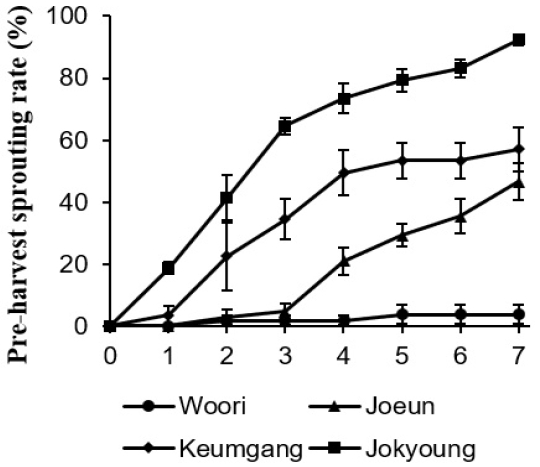
한국 밀 품종 42점의 수발아율을 측정하기에 앞서 수발아 저항성 및 감수성 품종을 활용하여 수발아 처리 후 매일 수발아율을 측정하였다(
Fig. 2).
Kim et al. (2012)을 참고하여 수발아 저항성 품종 ‘우리’, 중도저항성 ‘조은’, ‘금강’, 감수성 품종 ‘조경’을 선정하였다. 수발아 처리 7일차의 수발아율은 ‘우리’가 3.70%, ‘조은’이 46.44%, ‘금강’이 57.03%, ‘조경’이 92.45%를 기록하였다.
Kim et al. (2012)에서는 모래묻이법과 인공강우 처리를 통해 수발아율을 측정하여 본 연구와 수발아 처리 방법이 다르나, 인공강우 처리 후 수발아율과 본 연구의 수발아율이 유사하게 나타났다.
Kim et al. (2012)의 인공강우 후 수발아율은 ‘우리’가 3.79%, ‘조은’이 26.33%, ‘금강’이 54.24%, ‘조경’이 92.75%를 기록하였다. 또한, 품종 별 수발아 저항성 정도는 ‘우리’가 저항성이 가장 높고, ‘조경’이 가장 낮았으며 이러한 경향은
Kim et al. (2012)과 일치하였다. 한편, 본 연구에서는 수발아 처리 후 4일 차에 ‘우리’, ‘조은’, ‘금강’, ‘조경’의 수발아율이 명확하게 구분이 되는 것이 목격되었으며 국내 밀 42점의 수발아율 평가를 수발아 처리 후 4일 차에 실시하였다(
Fig. 2).
수발아 처리 4일 차의 수발아율은 0% - 84.17%까지 넓은 범위에서 다양하게 나타났다(
Table 1). ‘다홍’, ‘조광’, ‘진품’은 수발아율 0%를 기록하였다. 반면 ‘조한’의 수발아율은 79.8%였으며, ‘적중’은 84.17%를 기록하여 높은 수발아 감수성을 보였다. 분산분석 및 Tukey’s HSD 사후검정 결과 수발아율에 대해 품종 간 유의한 차이가 확인되었다. ‘적중’은 ‘조한’, ‘조경’과 a 그룹에 속하여 서로 통계적으로 유의한 차이가 나지 않았으나, a를 공유하지 않는 품종들과는 통계적으로 유의한 차이를 보였다. 또한, ‘적중’은 a 그룹에만 속하여 수발아 감수성이 명확히 드러났으며, ‘다홍’과 ‘우리’는 i 그룹에만 속하여 수발아 저항성이 명확히 나타났다. 수발아율 측정에 활용한 각 이삭에서 회수한 종자들은 알파-아밀라아제 활성도 측정에 활용하였다. 발아한 종자의 뿌리와 초엽은 제거하였다. 알파-아밀라아제 활성도는 0.52 SD units/10 g - 56.40 SD units/10 g의 범위를 기록하였다(
Table 2). 수발아율 0%를 기록했던 ‘다홍’, ‘조광’, ‘진품’은 각각 1.44 SD units/10 g, 0.54 SD units/10 g, 0.52 SD units/10 g를 기록했으며, ‘진품’은 가장 낮은 값을 기록하였다. 반면, 수발아율 79.8%를 기록한 ‘조한’의 알파-아밀라아제 활성도는 53.97 SD units/10 g를 기록했고, 수발아율 84.17%를 기록한 ‘적중’은 56.07 SD units/10 g을 기록하였다. 국내 밀 품종 중 수발아율이 낮은 품종에서는 대체로 알파-아밀라아제 활성도 값도 낮은 수치를 기록하였으며, 반대로 수발아율이 높은 품종에서는 높은 알파-아밀라아제 활성도를 기록하였다(
Table 2). 또한 일부 예외가 있지만 수발아율을 10% 이상 기록한 품종에서 알파-아밀라아제 활성도 수치도 10 SD units/10 g 이상을 기록하였다. 알파-아밀라아제 활성도는 품종 간 유의한 차이를 나타냈다. Tukey’s HSD 사후검정 결과, 수발아율이 높았던 ‘적중’, ‘조한’ 및 ‘조경’은 a와 b를 공유하여 서로 통계적으로 유의한 차이를 보이지 않았다. 반면, 수발아율이 낮았던 ‘다홍’과 ‘우리’는 모두 f 그룹에 속하여 통계적으로 유의한 차이를 보이지 않았다. 수발아율 평가에 활용한 이삭에서 회수한 종자를 알파-아밀라아제 활성도 측정에 활용하였기 때문에 수발아율과 알파-아밀라아제 활성도 사이의 연관 관계가 더욱 명확히 드러난 것으로 평가된다. 한편, 알파-아밀라아제 활성도 측정 시 시료 추출물 자체의 색에 오차를 줄이기 위해 추출물을 활용한 보정 적용한다면, 알파-아밀라아제 활성도에 대한 품종 간 차이를 좀 더 정확하게 평가할 수 있을 것으로 사료된다.
종자 발아 과정에서 알파-아밀라아제는 저장 전분을 가수분해하여 발아와 초기 생장에 필요한 당을 공급하므로, 높은 알파-아밀라아제 활성은 수발아가 발생한 종실의 주요 생화학적 특징으로 볼 수 있다(
Karrer et al. 1992,
Zhang et al. 2021). 따라서 추가적으로 알파-아밀라아제 활성도를 국내 밀 품종의 효과적인 수발아 판별 지표로 활용할 수 있는지 그 가능성을 검토하였다.
국내 밀 품종의 수발아 지표로서 알파-아밀라아제 활성도의 활용 가능성을 평가하기 위해 Pearson 상관관계 분석을 실시하였다. 국내 밀 42품종의 수발아율과 알파-아밀라아제 활성도 사이에는 강한 양의 상관관계가 나타났으며(Pearson’s r= 0.90), 이는 통계적으로 매우 유의하였다(
p=2.43×10
-16,
Table 3). 수발아율과 알파-아밀라아제 활성도 사이에 강한 양의 상관관계가 확인된 것은 알파-아밀라아제 활성도가 국내 밀 품종의 수발아 정도를 평가하는 유용한 지표가 될 수 있음을 시사한다.
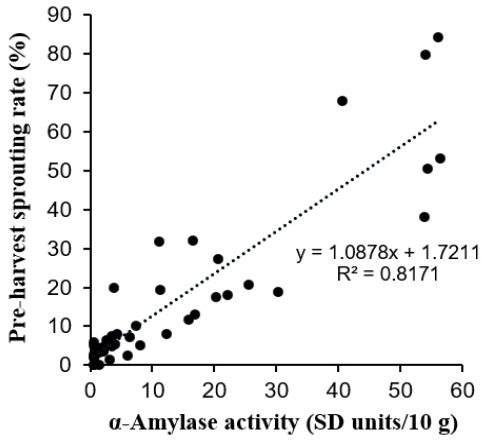
알파-아밀라아제 활성도를 독립변수로 수발아율을 종속변수로 설정하고 수행한 회귀분석에서도 알파-아밀라아제 활성도와 수발아율 사이의 뚜렷한 양의 선형 관계가 확인되었다(
R2=0.82,
Fig. 3). 알파-아밀라아제 활성도가 낮은 품종들은 전반적으로 낮은 수발아율을 보인 반면, 알파-아밀라아제 활성도가 높은 품종들은 높은 수발아율을 보였다. Pearson 상관관계 분석과 회귀분석 결과 알파-아밀라아제 활성도는 국내 밀 품종의 수발아 정도를 정량적으로 반영할 수 있는 유용한 지표로 활용될 수 있을 것으로 판단된다.
이처럼 본 연구에서 확인된 수발아율과 알파-아밀라아제 활성도 간의 높은 양의 상관관계는 알파-아밀라아제 활성도가 국내 밀 품종의 수발아 정도를 평가하는 생화학적 지표로 활용될 수 있음을 보여준다. 이러한 결과는 알파-아밀라아제 활성도의 수발아 평가지표로서의 활용 가능성을 보고한 선행 연구와도 일치한다(
Brown et al. 2018,
Lamichaney et al. 2018).
Brown et al. (2018)은 soft winter wheat을 대상으로 2014년과 2015년 포장에서 육안으로 평가한 수발아율과 알파-아밀라아제 활성도 간의 Pearson 상관분석을 수행한 결과, 두 형질 사이에 통계적으로 유의한 양의 상관관계가 나타났으며, 특히 white wheat 계통들에서 상관관계가 더욱 높았다고 보고하였다. 또한 알파-아밀라아제 활성도 분석이 연도에 따른 차이에도 불구하고 일관되고 신뢰할 수 있는 결과를 보여주었으므로, 대규모 밀 육종 집단의 수발아 저항성 선발에 활용될 수 있다고 제안하였다.
Lamichaney et al. (2018) 역시 녹두 유전자형들을 대상으로 수발아율과 알파-아밀라아제 활성을 조사한 결과, 발아 처리 후 48시간과 72시간에 알파-아밀라아제 활성도가 크게 증가하였으며, 이를 수발아 정도를 평가하는 생화학적 지표로 활용할 수 있다고 보고하였다. 한편,
Simsek et al. (2014)은 high performance size exclusion chromatography를 이용하여 수발아한 밀의 전분이 수발아하지 않은 밀의 전분보다 낮은 분자량을 나타낸다는 사실을 확인하였다. 이는 수발아 과정에서 증가한 알파-아밀라아제 활성이 전분을 가수분해하여 밀 종실의 이화학적 특성을 변화시킨다는 것을 의미한다. 나아가 수발아에 취약한 계통에서 알파-아밀라아제 활성도가 수발아 육안평가보다 나은 지표일수 있다고 주장하였다.
본 연구는 단일 연도에 수행되어 연차에 따른 환경 변이가 국내 밀 품종의 수발아율에 미치는 영향을 평가하지 못했다는 한계가 있다. 그러나 동일한 조건에서 처리한 시료를 대상으로 수발아율과 알파-아밀라아제 활성도를 함께 측정하였으며, 두 형질 간에 높은 양의 상관관계가 확인되었다. 이는 연차 반복의 부재에도 불구하고 알파-아밀라아제 활성도가 수발아 정도를 반영하는 생화학적 지표로 활용될 가능성을 뒷받침한다. 특히 알파-아밀라아제 활성도 측정은 육안으로 명확하게 구분하기 어려운 수발아 피해를 정량적으로 평가할 수 있다는 점에서 육안평가를 보완하는 유용한 방법이 될 수 있다. 또한, Falling Number에 비해 알파-아밀라아제 활성도 측정은 적은 시료양이 요구되기 때문에 육종 프로그램에서 다양한 계통에 동시에 적용하기에 유리한 점이 있다(
McKie & McCleary 2015,
Perten 1964). 따라서, 알파-아밀라아제 활성도는 국내 밀 품종 및 육종 집단의 수발아 저항성을 평가하기 위한 선발 지표로 활용될 수 있을 것으로 기대된다.
Notes
-
사사
본 연구는 농촌진흥청 연구개발사업(데이터 기반 밀 품종 조기 선발 기술 고도화, Project No. RS-2025-02223124)의 지원으로 수행되었습니다.
Fig. 1.Workflow for examination of pre-harvest sprouting and α-amylase activity. PHS: pre-harvest sprouting.
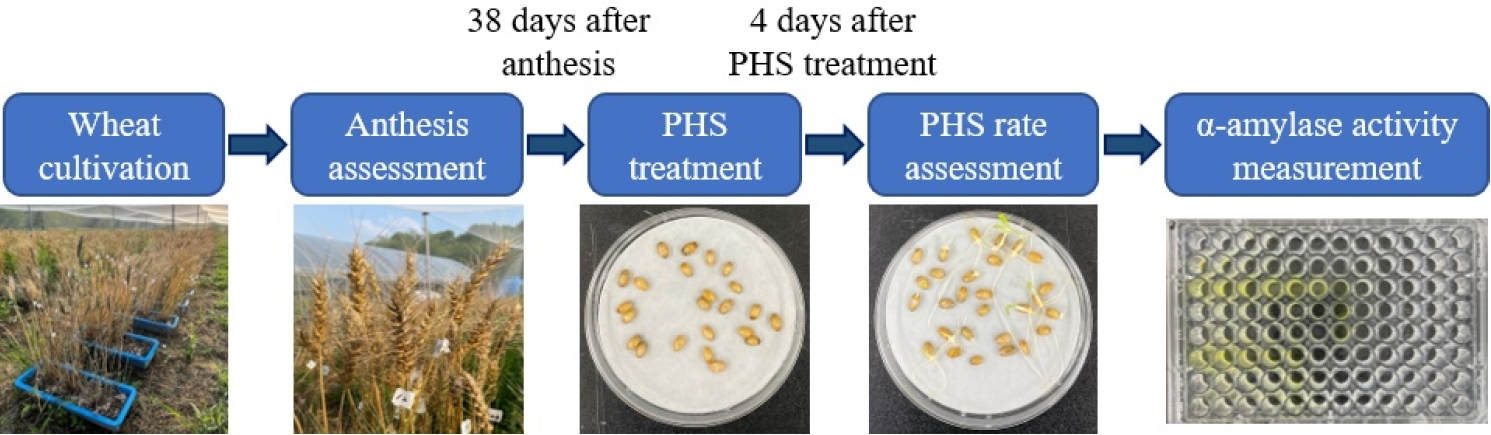
Fig. 2.Pre-harvest sprouting rates of ‘Woori’, ‘Joeun’, ‘Keumgang’, and ‘Jokyoung’.
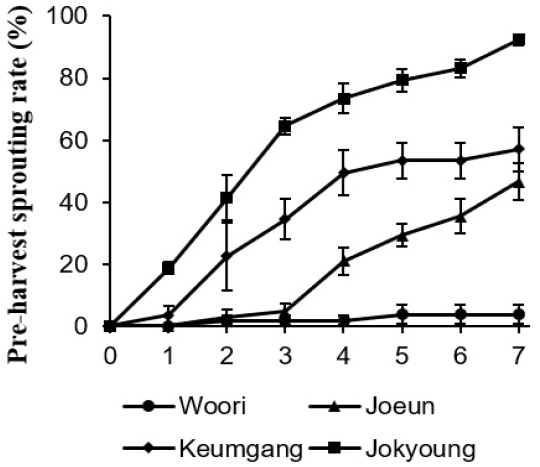
Fig. 3.Linear regression analysis between α-amylase activity and pre-harvest sprouting rate in Korean wheat cultivars. The dashed line represents the fitted linear regression.
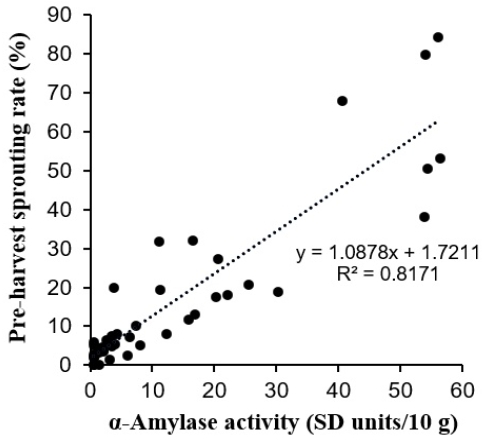
Table 1.Pre-harvest sprouting rates of Korean wheat cultivars.
Table 1.
|
Cultivar |
Pre-harvest sprouting rate (%) |
SEMz
|
Cultivar |
Pre-harvest sprouting rate (%) |
SEM |
|
Gobun |
10.20 |
ghiy
|
3.50 |
Younbaek |
53.19 |
bcd |
7.66 |
|
Goso |
6.35 |
ghi |
3.83 |
Youngkwang |
32.00 |
def |
4.27 |
|
Geuru |
5.41 |
fghi |
2.26 |
Olgeuru |
2.38 |
hi |
1.19 |
|
Keumgang |
31.72 |
de |
6.97 |
Ol |
19.28 |
efghi |
3.05 |
|
Namhae |
3.43 |
hi |
1.92 |
Woori |
1.31 |
i |
0.82 |
|
Dabun |
20.00 |
efghi |
9.64 |
Eunpa |
7.50 |
efghi |
3.12 |
|
Dajung |
7.89 |
hi |
3.03 |
Jeokjoong |
84.17 |
a |
3.79 |
|
Dahong |
0.00 |
i |
0.00 |
Jokyoung |
67.91 |
abc |
4.93 |
|
Milsung |
11.70 |
efghi |
5.16 |
Chokwang |
0.00 |
hi |
0.00 |
|
Baekgang |
38.10 |
cdefg |
3.37 |
Jonong |
7.08 |
ghi |
2.07 |
|
Backjung |
50.61 |
cd |
9.17 |
Joah |
27.32 |
defgh |
4.52 |
|
Baekchal |
20.62 |
efghi |
6.13 |
Joeun |
17.55 |
efghi |
2.64 |
|
Saekeumkang |
1.98 |
hi |
1.10 |
Jojoong |
18.85 |
efghi |
2.22 |
|
Saeol |
5.76 |
ghi |
2.22 |
Jopum |
5.15 |
hi |
3.02 |
|
Seodun |
4.79 |
hi |
2.76 |
Chohan |
79.80 |
ab |
2.84 |
|
Sugang |
2.64 |
hi |
1.62 |
Jinpoom |
0.00 |
hi |
0.00 |
|
Sooan |
8.00 |
ghi |
1.75 |
Cheonggye |
3.29 |
hi |
1.22 |
|
Shinmichal |
5.00 |
ghi |
2.08 |
Topdong |
2.12 |
hi |
1.24 |
|
Shinmichal 1 |
3.90 |
hi |
1.51 |
Taejoong |
12.96 |
efghi |
1.52 |
|
Anbaek |
4.62 |
ghi |
0.06 |
Hojoong |
4.32 |
hi |
2.41 |
|
Alchan |
2.56 |
hi |
2.09 |
Hwanggeumal |
18.10 |
efghi |
1.56 |
Table 2.Alpha-amylase activity of Korean wheat cultivars.
Table 2.
|
Cultivar |
α-Amylase activity (SD units/10 g) |
SEMz
|
Cultivar |
α-Amylase activity (SD units/10 g) |
SEM |
|
Gobun |
7.40 |
efy
|
2.80 |
Younbaek |
56.40 |
a |
1.36 |
|
Goso |
2.54 |
f |
1.32 |
Youngkwang |
16.45 |
def |
0.40 |
|
Geuru |
3.92 |
f |
2.69 |
Olgeuru |
0.72 |
f |
0.10 |
|
Keumgang |
11.18 |
ef |
2.57 |
Ol |
11.25 |
ef |
1.68 |
|
Namhae |
2.13 |
f |
0.89 |
Woori |
3.09 |
f |
2.01 |
|
Dabun |
3.74 |
f |
2.58 |
Eunpa |
3.53 |
f |
1.54 |
|
Dajung |
4.28 |
f |
3.10 |
Jeokjoong |
56.07 |
ab |
0.15 |
|
Dahong |
1.44 |
f |
0.31 |
Jokyoung |
40.56 |
abcd |
5.27 |
|
Milsung |
15.86 |
def |
8.65 |
Chokwang |
0.54 |
f |
0.00 |
|
Baekgang |
53.80 |
abc |
1.36 |
Jonong |
6.28 |
ef |
2.33 |
|
Backjung |
54.45 |
ab |
0.78 |
Joah |
20.66 |
def |
3.40 |
|
Baekchal |
25.57 |
cdef |
10.75 |
Joeun |
20.32 |
def |
9.59 |
|
Saekeumkang |
0.66 |
f |
0.02 |
Jojoong |
30.31 |
bcde |
9.36 |
|
Saeol |
0.58 |
f |
0.01 |
Jopum |
7.97 |
ef |
6.04 |
|
Seodun |
3.42 |
f |
1.47 |
Chohan |
53.97 |
ab |
0.83 |
|
Sugang |
0.62 |
f |
0.08 |
Jinpoom |
0.52 |
f |
0.07 |
|
Sooan |
12.25 |
ef |
4.78 |
Cheonggye |
1.47 |
f |
0.48 |
|
Shinmichal |
0.65 |
f |
0.16 |
Topdong |
0.62 |
f |
0.05 |
|
Shinmichal 1 |
2.11 |
f |
1.20 |
Taejoong |
16.95 |
def |
1.77 |
|
Anbaek |
1.95 |
f |
0.82 |
Hojoong |
1.51 |
f |
0.63 |
|
Alchan |
5.95 |
ef |
4.47 |
Hwanggeumal |
22.13 |
def |
1.25 |
Table 3.Pearson's correlation coefficients between pre-harvest sprouting rate and α-amylase activity. Pearson’s correlation coefficient is presented in the bottom-left, and the corresponding p-value is presented in the top-right.
Table 3.
|
Pre-harvest sprouting rate |
α-Amylase activity |
|
Pre-harvest sprouting rate |
- |
< 0.001 |
|
α-Amylase activity |
0.90 |
- |
References
- 1. Appleford NE, Wilkinson MD, Ma Q, Evans DJ, Stone MC, Pearce SP, Powers SJ, Thomas SG, Jones HD, Phillips AL. 2007. Decreased shoot stature and grain α-amylase activity following ectopic expression of a gibberellin 2-oxidase gene in transgenic wheat. J Exp Bot 58: 3213-3226.
- 2. Brown LK, Wiersma AT, Olson EL. 2018. Preharvest sprouting and α-amylase activity in soft winter wheat. J Cereal Sci 79: 311-318.
- 3. Deepika J, Vijayalakshmi D, Patil SG, Vellaikumar S, Arunkumar P, Ravichandran V, Thirukumaran K. 2025. Physiological basis and metabolite profiles of pre harvest sprouting resistance in rice varieties of tamil nadu. Cereal Res Commun 53: 1465-1478.
- 4. Erenstein O, Chamberlin J, Sonder K. 2021. Estimating the global number and distribution of maize and wheat farms. Global Food Security 30: 100558.
- 5. Gubler F, Millar AA, Jacobsen JV. 2005. Dormancy release, ABA and pre-harvest sprouting. Curr Opin Plant Biol 8: 183-187.
- 6. Hong Y, Ho TD, Wu C, Ho S, Yeh R, Lu C, Chen P, Yu L, Chao A, Yu S. 2012. Convergent starvation signals and hormone crosstalk in regulating nutrient mobilization upon germination in cereals. Plant Cell 24: 2857-2873.
- 7. Ji T, Penning B, Baik B. 2018. Pre-harvest sprouting resistance of soft winter wheat varieties and associated grain characteristics. J Cereal Sci 83: 110-115.
- 8. Karrer EE, Chandler JM, Foolad MR, Rodriguez RL. 1992. Correlation between α-amylase gene expression and seedling vigor in rice. Euphytica 66: 163-169.
- 9. Khumalo-Mthembu TP, Palesa M, Mzimela NP, Barnard A, Tsilo TJ. 2025. Breeding wheat (triticum aestivum L.) for pre-harvest sprouting tolerance in south africa: Current status and future prospects. Plants 14: 2134.
- 10. Kim K, Jung J, Kang C, Shin S, Park J, Son J, Park CS. 2014. Mapping of QTL for pre-harvest sprouting resistance and seed dormancy in a doubled haploid population. Plant Breed Biotech 2: 247-256.
- 11. Kim K, Kang C, Park J, Shin S, Hyun J, Park CS. 2012. Evaluation of pre-harvest sprouting in Korean wheat cultivar. Korean J Breed Sci 44: 526-537.
- 12. Kim MJ. 2016. Immature wheat as functional ingredient of domestic wheat. Food Industry and Nutrition 21: 25-28.
- 13. Lamichaney A, Katiyar PK, Laxmi V, Pratap A. 2018. Variation in pre-harvest sprouting tolerance and fresh seed germination in mungbean (vigna radiata L.) genotypes. Plant Genetic Resources 16: 437-445.
- 14. McKie VA, McCleary BV. 2015. A rapid, automated method for measuring α-amylase in pre-harvest sprouted (sprout damaged) wheat. J Cereal Sci 64: 70-75.
- 15. Perten H. 1964. Application of the falling number method for evaluating alpha-amylase activity. Cereal Chem 41: 127-140.
- 16. Raju RS, Sahoo C, Hanjagi PS, Samal KC, Devanna BN, Dash M, Awaji SM, Baig MJ. 2024. Oxidative metabolism, moisture imbibing capacity and their association with pre-harvest sprouting in rice. Cereal Res Commun 52: 115-128.
- 17. Shiferaw B, Smale M, Braun H, Duveiller E, Reynolds M, Muricho G. 2013. Crops that feed the world 10. past successes and future challenges to the role played by wheat in global food security. Food Security 5: 291-317.
- 18. Simsek S, Ohm J, Lu H, Rugg M, Berzonsky W, Alamri MS, Mergoum M. 2014. Effect of pre-harvest sprouting on physicochemical properties of starch in wheat. Foods 3: 194-207.
- 19. Sung Y, Kim C. 2025. Profiles of gene expression at different time points under salt-stress in Triticum aestivum L. Plant Breed Biotech 13: 131-155.
- 20. Tai L, Wang H, Xu X, Sun W, Ju L, Liu W, Li W, Sun J, Chen K. 2021. Pre-harvest sprouting in cereals: Genetic and biochemical mechanisms. J Exp Bot 72: 2857-2876.
- 21. Vetch JM, Stougaard RN, Martin JM, Giroux MJ. 2019. Revealing the genetic mechanisms of pre-harvest sprouting in hexaploid wheat (triticum aestivum L.). Plant Science 281: 180-185.
- 22. Xu F, Tang J, Gao S, Cheng X, Du L, Chu C. 2019. Control of rice pre-harvest sprouting by glutaredoxin-mediated abscisic acid signaling. The Plant Journal 100: 1036-1051.
- 23. Yang R, Harrison MT, Yang Y, Wang C, Shabala S, Huang M, Zhao C, Zhou M, Sun C, Liu K. 2025. Pre-harvest sprouting in cereals: Global incidence, impacts and mitigation strategies. Field Crops Res 333: 110111.
- 24. Zhang Q, Pritchard J, Mieog J, Byrne K, Colgrave ML, Wang J, Ral JF. 2021. Overexpression of a wheat α-amylase type 2 impact on starch metabolism and abscisic acid sensitivity during grain germination. The Plant Journal 108: 378-393.
Citations
Citations to this article as recorded by