적요
The F1 hybrid rapeseed (Brassica napus L.) exploits heterosis to deliver greater yield, stability, and uniformity than open-pollinated cultivars, making it suitable for large- scale cultivation. In Korea, cultivation is shifting from landscape and apiculture to expanding edible oil production and increasing the demand for paddy field-adapted hybrids. Using Mokpo-CGMS as the female and the pollen parent ‘09003-B-126-2-1-3,’ we developed the breeding line ‘Dangyo 80,’ which, after multi-environment evaluations of yield and oil quality against ‘Sunmang,’ was selected as a new cultivar ‘Areum. ’ ‘Areum’ exhibits growth habit type IV, yellow flowers, and a red seed coat. Its flowering and maturity times are comparable to ‘Sunmang. ’ Major growth indices did not differ significantly among cultivars; however, while ‘Areum’ showed slightly greater lodging susceptibility, it displayed higher resistance to Sclerotinia stem rot. Notably, in paddy fields ‘Areum’ achieved a higher plant density per square meter than ‘Sunmang’ which produced a 31% yield increase. In fatty acid composition, ‘Areum’ had higher oleic acid content (65% vs. 60%) and lower erucic acid (0.95% vs. 1.35%) than ‘Sunmang,’ indicating improved suitability for high-quality edible rapeseed oil production (Registration No. 9755).
서언
F
1 하이브리드(hybrid) 품종은 잡종강세(heterosis)를 활용해 우수한 농업 형질을 극대화하는 핵심 육종 전략으로 평가된다. 유채(
Brassica napus L.) 주요 생산국인 캐나다, 중국 등에서 재배되는 상업용 품종은 대부분 하이브리드이며, 자연수분형(open-pollinated, OP) 품종보다 우수한 생육과 수량성을 보인다고 보고되었다(
Liu et al. 2018,
Stahl et al. 2017). 일반적으로 하이브리드 유채는 초기 생장이 왕성하여 파종 시기를 다소 늦출 수 있고, 병 저항성이 높으며, 균일한 생육을 바탕으로 안정적인 고수량을 확보할 수 있다(
Qian et al. 2007,
Zhang et al. 2017).
국내에서는 하이브리드 품종 육성을 위한 기반으로, 고온과 저온 환경에서도 불임 발현이 안정적인 목포 CGMS (cytoplasmic-genic MS)와 유지친(B-line)이 개발되었다(
Jang et al. 2002a). 목포 CGMS를 이용하여 ‘선망’ 품종이 육성된 이래로, ‘수안’, ‘조안’ 등의 하이브리드 품종이 육성되었다(
Jang et al. 2002b,
Kim et al. 2021,
Lee et al. 2011). 하지만, 현장에서는 자가채종이 용이한 자연수분형(OP) 품종 의존도가 여전히 높아 품질, 수량의 연차 변이가 크게 나타나는 한계가 존재한다. 이를 해결하기 위해 자연수분형 품종 대비 더 높은 균일성과 수량을 확보할 수 있는 하이브리드 품종 개발과 지속적인 하이브리드 품종의 종자 생산 및 보급이 필요하다.
한편 국내 유채 재배는 그간 경관과 밀원 중심에서, 점차 종자 수확 및 유채유 생산의 산업적 중요성이 증대되는 추세이며, 특히 논 재배 면적 확대와 함께 대면적 기계화 재배 수요가 증가하고 있다. 종자생산이 증가함에 따라 이러한 여건을 고려할 때, 논 조건에서 높은 적응성과 수량성을 나타내며, 유채유 생산에 적합한 품질 지표(고올레산, 저에루스산)를 충족하는 하이브리드 품종 개발의 필요성이 대두된다. 따라서, 본 연구에서는 기존 하이브리드 품종 대비 논에서 높은 적응성과 수량성을 보이며, 유채유 생산에 적합한 품질지표를 충족시키기 위한 품종육성을 목표로 개발된 하이브리드 품종인 ‘아름’의 육성 과정과 생육 및 품질 특성을 보고하고자 한다.
재료 및 방법
육성 및 재배 방법
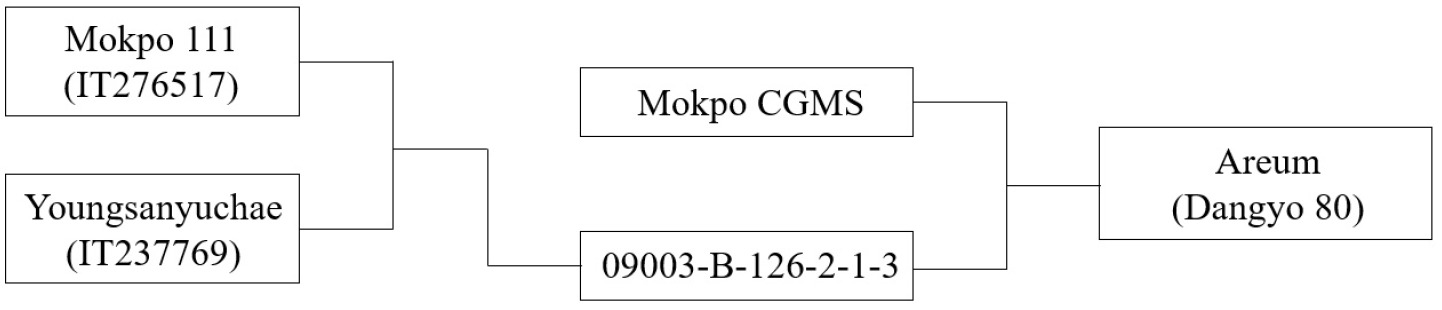
‘아름’은 2015년에 ‘목포 CGMS’를 모본으로, ‘09003-B-126-2-1-3’을 부본으로 하여 육성한 1대잡종 계통인 ‘단교 80호’이다(
Fig. 1). 2016년부터 2017년 동안 국립식량과학원 소득식량작물연구소(전라남도 무안군) 시험 포장에서 하이브리드 품종인 ‘선망’을 대조품종으로 하여 생산력검정시험을 수행하였다. 생산력검정 예비시험은 계통 당 2.7 m
2, 본 시험은 계통 당 5.4 m
2로 하여 조파 방식으로 파종하였다. 지역적응시험은 2018년부터 2020년까지 전라남도 무안, 경상남도 진주, 전라북도 익산(2018-2019년), 부안(2020년)에서 수행하였으며, 계통 당 5.4 m
2로 하여 조파 방식으로 파종하였다. 조간 간격은 40 cm였으며, 파종량은 10 a당 1,000 g로 설정하였다. 시비량은 기비로 10 a당 N-P
2O
5-K
2O를 10-40-43과 퇴비 1,000 kg을 시용하였고, 추비는 생육재생기인 2월 말에 10 a당 N 10 kg을 시용하였다. 병해충 관리와 기타 생육관리는 유채 표준재배법을 참고하여 진행하였다(RDA 2012).
지역적응시험 동안 유채 작물연구조사분석기준(RDA 2012)에 따라 생육 특성을 조사하였다. 고유 특성으로 초형, 잎 색, 잎 모양, 잎 결각, 꽃 색, 종피색을 조사하고, 농업 형질 특성으로는 개화기, 성숙기, 개체수, 초장, 경장, 분지수, 수당협수, 협당립수, 결실률, 천립중을 조사하였다. 도복 정도와 균핵병 발생 정도는 0-9의 척도로 조사하였으며, 수량성은 10 a당 수확된 종자 무게로 환산하여 평가하였다.
품질 특성 분석
지역적응시험에서 수확된 종자를 대상으로 조지방 및 지방산을 분석하였다. 조지방 함량은 조지방 분석기(Soxtec 2050, Foss, Denmark)를 이용한 Soxhlet 추출법으로 분석하였다(
Soxhlet 1879). 유채 종자 1.5 g(S)와 수기를 80℃에 18시간 건조한 후에, 수기는 무게를 측정하였고(W
0), 종자는 분말로 분쇄한 뒤, 80℃에서 30분간 더 건조하였다. 조지방 분석기를 이용하여 가열추출(30분), 냉추출(1시간 20분), 용매회수(20분) 조건 추출하였고, 에테르를 증발시킨 다음 수기의 무게를 측정한 뒤(W
1), 아래 식으로 조지방 함유량을 계산하였다.
조지방 함유량(%) = (W1-W0 / s)×100
W0: 빈 수기의 중량(g)
W1: 조지방 추출 후 수기의 중량(g)
S: 시료량(g)
지방산 조성은 GC-FAME (Gas chromatography analysis of fatty acid methyl esters) 분석법을 통해 분석하였다. 먼저, pear-shaped flask에 분쇄된 종자 1.5 g과 Methanol 15 ㎖, Sodium methoxide 30 wt.% 1 ㎖을 넣고 flask와 공냉관을 연결한 다음, 80℃ water bath에서 2시간 동안 메틸화하였다. 그 후 반응물을 2시간 동안 상온에서 냉각시킨 후, n-hexane 15 ㎖을 첨가하여 반응물을 분리하였고, 상층액을 필터링 하여 가스크로마토그래피(Agilent 7890A, Agilent, USA)로 분석하였다. 분석 컬럼은 HP-INNOWAX (30 m×0.32 ㎛×0.25 ㎛, Agilent 19091N-113, USA)을 사용하였고, 검출기는 flame ionization dector (FID, Agilent, USA)를 사용하였다. Inlet 온도는 200℃, split ratio는 10:1로 설정하고, Oven은 140℃에서 1분 유지 후 6.0℃/min으로 250℃까지 승온한 후 5분간 유지하여 지방산 조성을 분석하였다.
통계 분석
모든 통계 분석은 R (Version 4.4.1; R Core Team)에서 Rstudio (verson 4.4.1; Rstudio, PBC, Boston, MA, USA)를 사용하여 수행하였다. 모든 결과는 3반복의 평균 또는 평균±표준편차로 제시하였다. 처리구 간 평균 비교는 Student’s t-test로 수행하였으며, 유의수준은 p<0.05로 설정하였다.
결과 및 고찰
육성 경위
최근, 국내에서 유채는 꽃을 활용한 지역 축제, 경관보전직불금 수령과 밀원으로 활용함과 더불어, 종자를 수확해 유채유로 생산하는 면적이 증가하고 있다. 하지만, 국내에선 자가채종에 유리한 자연수분형 품종들이 주로 보급 및 재배되고 있다. 유채의 산업적 중요도가 증가함에 따라, 생육이 균일하며, 높은 수량을 가지는 하이브리드 품종 개발의 중요성은 점차 높아짐에 따라, 본 연구에서는 논 적응성이 높고 다수성인 신규 하이브리드 품종인 ‘아름’을 개발하였다.
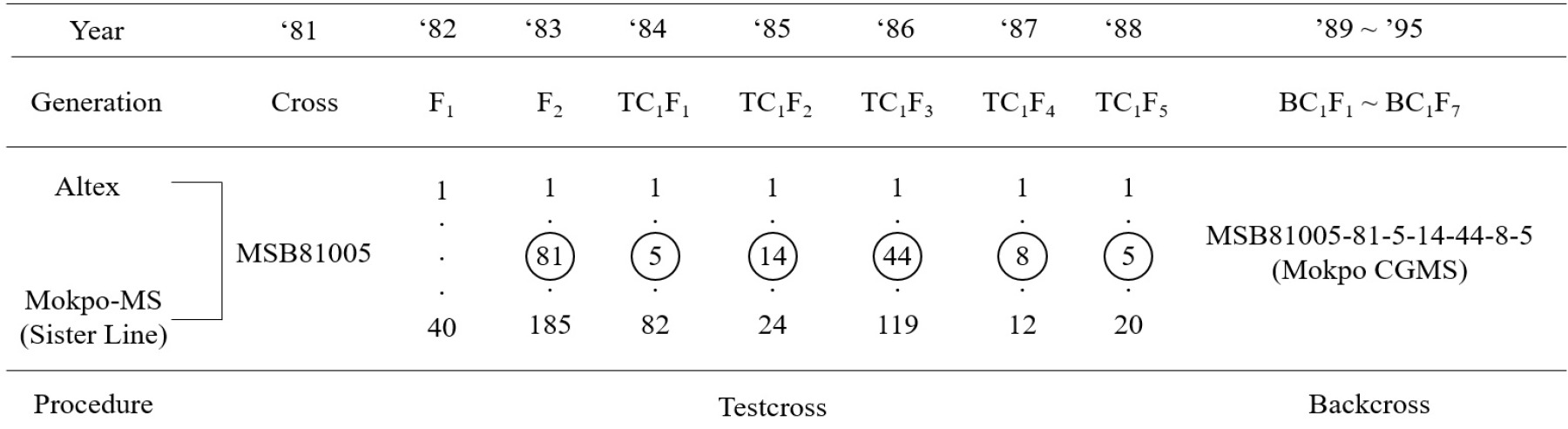
‘아름’의 모본인 ‘목포 CGMS’는 ‘Tower’ (♀)와 ‘Isuzu’ (♂)의 교배에서 유래되었으며, 초기에는 100% 불임을 유지하는 유지친(B-line) 확보가 어려웠다. 이를 해결하기 위해 1981년에 정상 세포질이며 FF 핵형을 가지는 ‘Altex’와 불임 세포질이며 FS 핵형을 가진 목포-CGMS 자매계통을 교배한 뒤, 개체별 시험 교배와 14회 여교배를 통해 교배시 100%가 불임으로 나타나는 완전 유지친을 확보하였다(
Jang et al. 2002a,
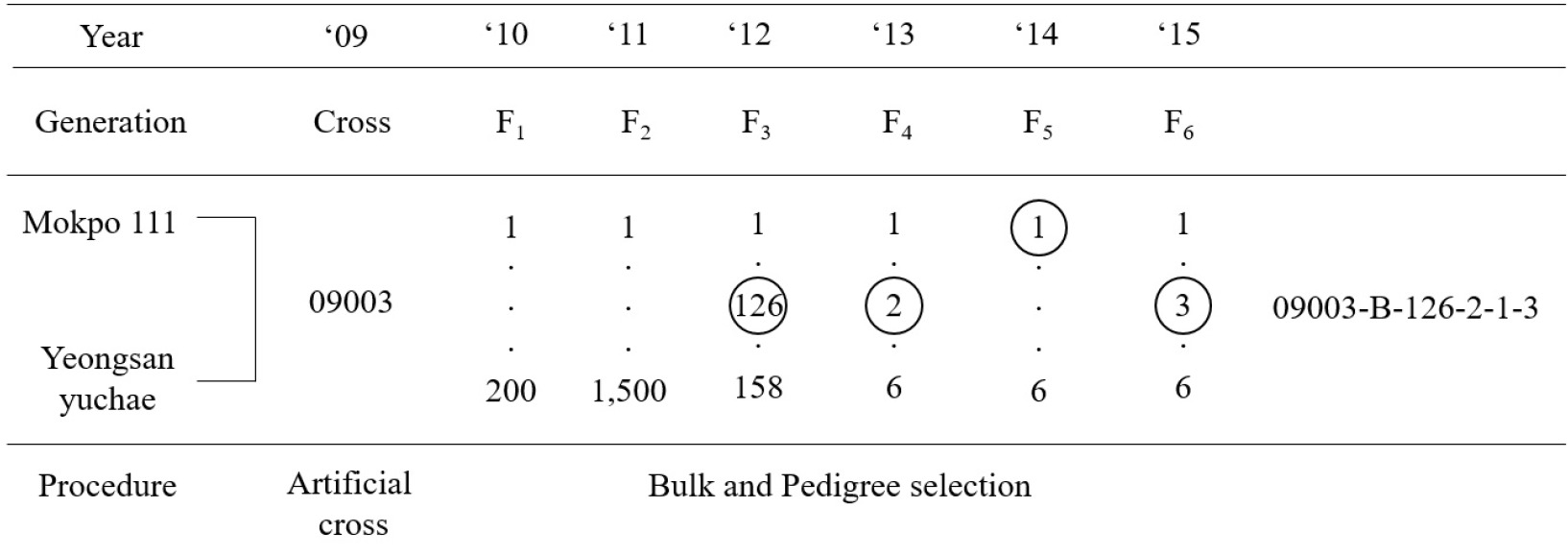
Fig. 2). 부본(화분친)은 2009년에 ‘목포 111호(중모 7001)’과 ‘영산유채’를 교배한 뒤, 계통육종법을 통해 선발을 진행하여 우수한 생육을 나타내는 ‘09003-B-126-2-1-3’를 육성하였다(
Fig. 3). 그 뒤, 2015년에 ‘목포CGMS’와 ‘09003-B-126-2-1-3’를 교배하여 ‘단교 80호’를 육성하였다(
Fig. 1). ‘단교 80호’는 생산력검정시험과 지역적응시험을 통해 우수한 생육을 나타내었으며, 안정성과 균일성을 갖춘 것으로 확인되었다. 그 후, 2020년에 직무육성신품종선정위원회의 심의를 거쳐 ‘아름’으로 명명되었고, 2021년에 품종 출원을 통해 국립종자원의 심사를 거쳐 2023년에 품종보호 등록(제9755호)되었다.
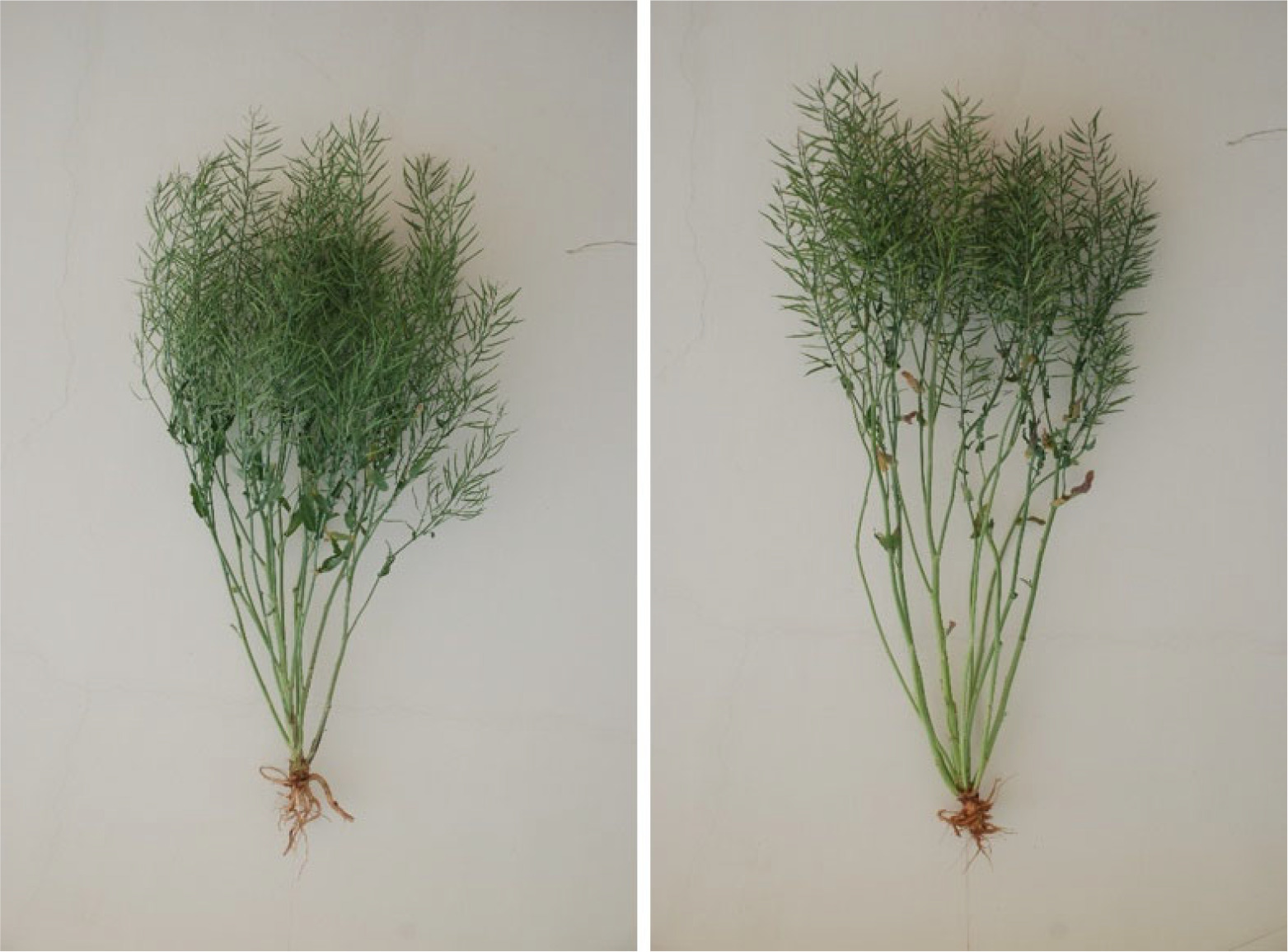
‘아름’의 초형은 Ⅳ형이며, 잎은 하부익상전렬로 결각은 약하고 녹색을 띤다(
Fig. 4). 꽃 색은 노란색이며, 종피색은 적갈색으로, 종피색이 흑색인 대비품종 ‘선망’과 구별된다(
Table 1).
‘아름’의 개화기와 성숙기는 각각 4월 3일과 6월 3일로, ‘선망’과 성숙기는 같으나 개화기는 1일 빠르다(
Table 2). 제곱미터당 개체수는 ‘아름’은 139주, ‘선망’은 121주로 유의적인 차이는 없으나 ‘아름’ 더 많았으며, 특히 논에서는 ‘아름’은 147주, ‘선망’은 120주로 차이는 더 크게 나타났다. 이는 논에서의 발아, 입모 및 적응성이 ‘아름’에서 더 우수함을 시사한다. 생육 특성인 초장, 주경장, 분지수와 꼬투리 및 종자 특성인 수당협수, 협당립수, 결실률, 천립중은 두 품종 간 유의차가 없었다(
Tables 2,
3).
‘아름’의 도복정도(0-9) 및 균핵병 발생 정도(0-9)는 각각 5.3과 1.0이며, ‘선망’은 각각 5.0과 1.7이었다. ‘아름’은 ‘선망’ 대비 도복에 상대적으로 취약하나, 균핵병에는 더 강한 저항성을 보였다(
Table 4). 대면적, 기계화 재배에서 내도복성과 균핵병 저항성은 수량 안정성에 핵심 요소이며, ‘아름’의 도복 취약성은 재식밀도 조절 등 재배기술로 보완할 필요가 있다.
생산력검정시험(2016-2017년) 결과, ‘아름’은 313 kg/10a의 수량을 나타내어 ‘선망’보다 4% 증수하였다(
Table 5). 3지역(전남⋅북, 경남)에서 실시한 지역적응시험(2018-2020년) 결과, ‘아름’의 수량은 통계적으로 유의한 차이는 없었으나 ‘선망’ 대비 평균 22% 높았으며, 특히 논에서의 수량 차이는 31%로 더 크게 나타났다(
Table 6). 이는, 논 조건에서 ‘아름’의 높은 개체수(입모)가 수량 차이에 기여했을 것으로 사료된다.
품질 특성에서 ‘아름’의 조지방 함량은 42.1%로 ‘선망’과 비슷한 수준을 나타냈다(
Table 7). 지방산 조성의 경우, 주요 불포화지방산인 올레산, 리놀레산, 리놀렌산은 ‘아름’이 각각 65%, 16%, 8%로 나타났으며, ‘선망’은 각각 60%, 20%, 7%로 나타났다. 올레산은 기름 특성에서는 높은 산화 안정성을, 건강 측면에서는 심혈관 질환 위험 감소 및 혈당 조절 이점을 제공한다고 보고되어, 최근 고올레산 품종 개발의 중요성이 높아지고 있다(
Coughlan et al. 2022,
Galassetti & Pontello 2006,
Salar et al. 2016). ‘아름’은 선망 대비 올레산이 5%p 높아 해당 이점을 기대할 수 있다. 에루스산은 십자화과 종자에 함유되어 있는 불포화 지방산으로, 과량 섭취 시 건강 위해가 보고되어 국제적으로 기준을 2% 이하로 제한하고 있다(
FAO 2023). 국내에서도 식품의약품안전처는 「식품의 기준 및 규격」 제2023-56호(2023.8.31.)를 신설하여 2025년부터 유채유 최종제품의 에루스산 함량이 2% 이하가 되도록 제조하여하 하는 제조기준을 신설하였다. ‘아름’과 ‘선망’의 에루스산 함량은 각각 0.95%, 1.35%로 나타나 모두 기준을 충족하였으며, ‘아름’은 ‘선망’보다 에루스산 함량이 더 낮아 안정성 측면에서 더 유리하다.
재배 적응 지역은 전남, 전북 및 경남 등 남부지방이다. 재배 시 입모확보 및 동해방지를 위해 9월 하순부터 10월 중순까지 파종하여야 하며, 11월이 넘어가지 않도록 주의하여야 한다. 배수가 양호한 토양에서 재배하여야 하며, 배수가 불량할 경우 배수로 관리를 철저히 해줘야 한다. 파종량은 기계 세조파로 10 a당 1,000 g, 재식밀도는 휴폭 40 cm×파폭 5 cm로 파종하며, 산파의 경우 파종량을 10 a당 1,500~2,000 g으로 늘려서 파종하여야 한다. 도복에 비교적 약한 품종으로 질소질 비료 과다시용을 지양하고, 재식밀도 조절 등 재배관리로 내도복성을 보완하여야 한다.
적요
F1 하이브리드 유채(Brassica napus L.)는 잡종강세를 통해 자연수분형(open pollinated) 품종 대비 수량 및 안정성과 균일성이 높아 대면적 재배에 적합하다. 국내에서는 경관과 밀원 중심 재배에서 벗어나 유채유 생산 확대가 이루어지고 있으며, 이에 따라 논 재배 적응형 하이브리드 수요가 증가하고 있다. 본 연구는 목포-CGMS와 화분친 ‘09003-B-126-2-1-3’을 이용해 ‘단교 80호’를 육성하였고, ‘선망’을 대조품종으로 한 수량 및 품질 특성 평가를 통해 뛰어난 특성이 입증되어 신품종으로 선정되어 ‘아름’으로 명명되었다. ‘아름’은 초형 Ⅳ형, 노란 화색과 적갈색 종피를 나타내며, 개화기와 성숙기는 ‘선망’과 비슷하다. 주요 생육지표는 품종 간 유의차가 없었으며, ‘아름’은 ‘선망’에 비해 도복은 다소 취약하나 균핵병 저항성은 높았다. 특히, 논에서 ‘아름’ 제곱미터당 개체수는 ‘선망’보다 높았으며, 수량은 31% 증수하였다. 지방산 조성에서 올레산 함량이 65%로 ‘선망’ 대비(60%) 높았으며, 에루스산은 0.95%로 ‘선망’(1.35%)보다 낮아 고품질 유채유 생산에 더 적합한 특성을 보였다.
사사
본 연구는 농촌진흥청 국립식량과학원 연구사업(과제명: 식용유 등 다용도 유채 신품종 지역적응연구 및 신품종 이용촉진사업, 과제번호: RS-2020-RD009008)의 지원으로 수행되었습니다.
Fig. 1Genealogical diagram of ‘Areum’.
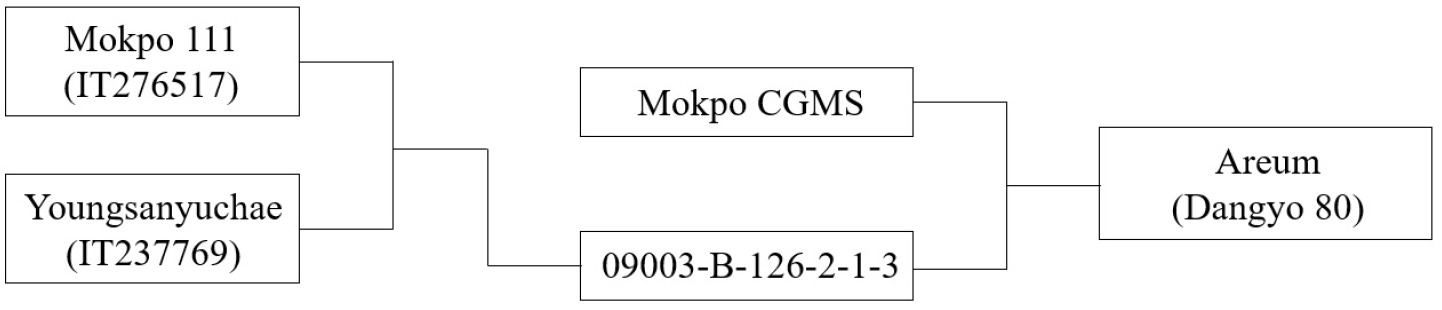
Fig. 2Pedigree diagram of ‘Mokpo CGMS’.
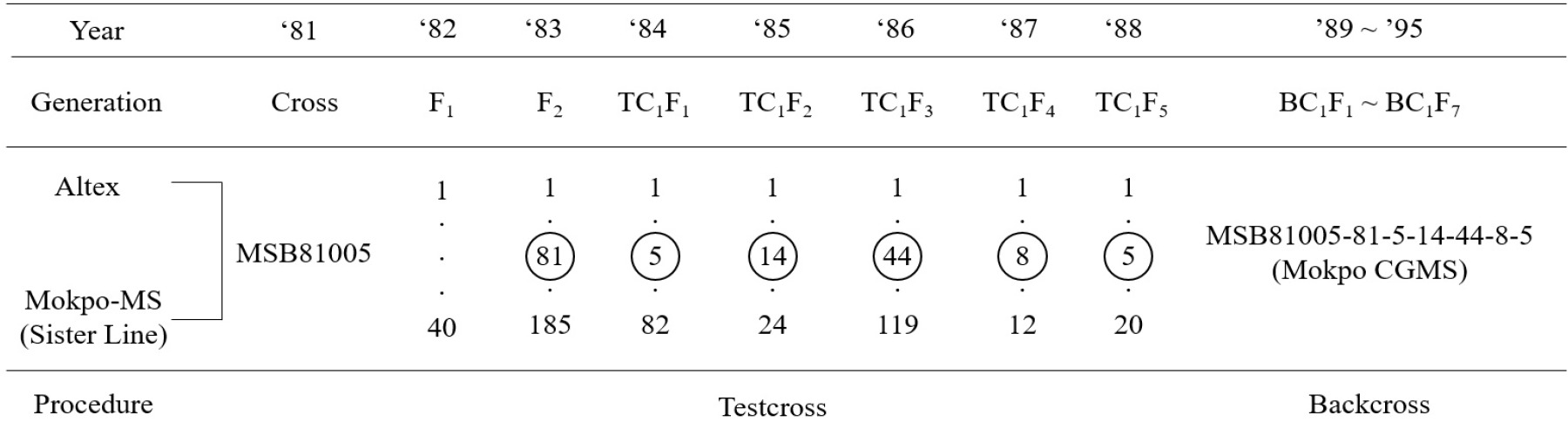
Fig. 3Pedigree diagram of ‘09003-B-126-2-1-3’.
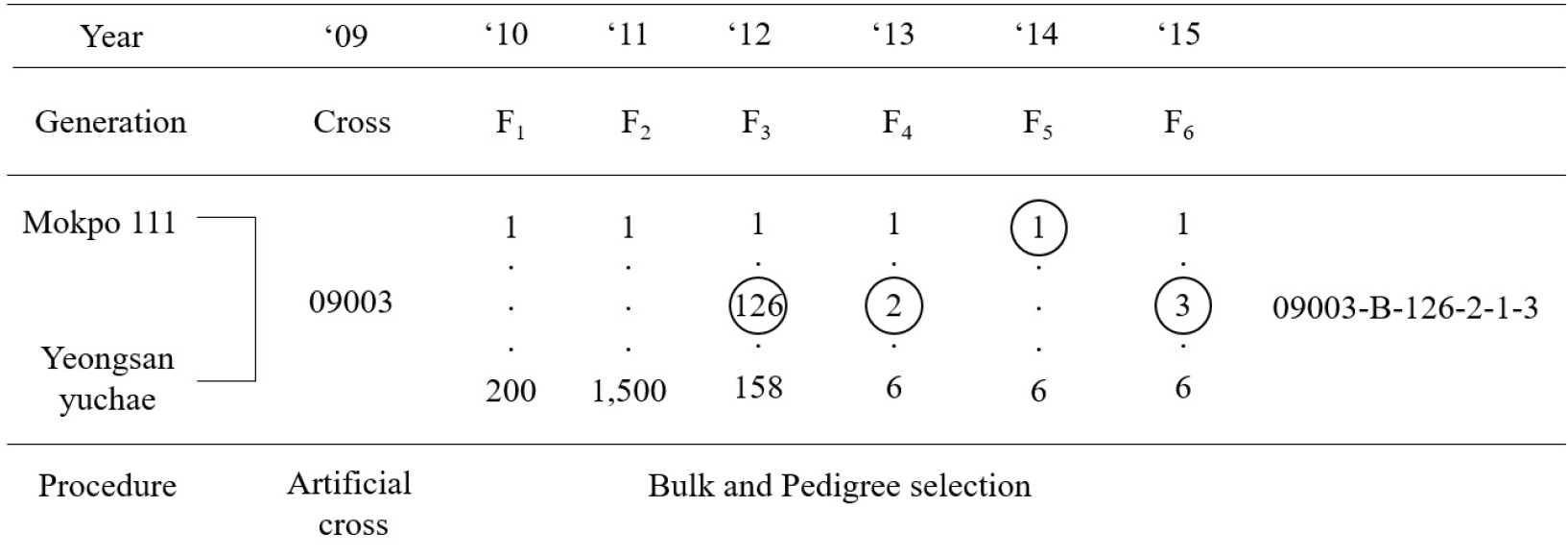
Fig. 4Plant of ‘Areum’ (left) and ‘Sunmang’ (right).
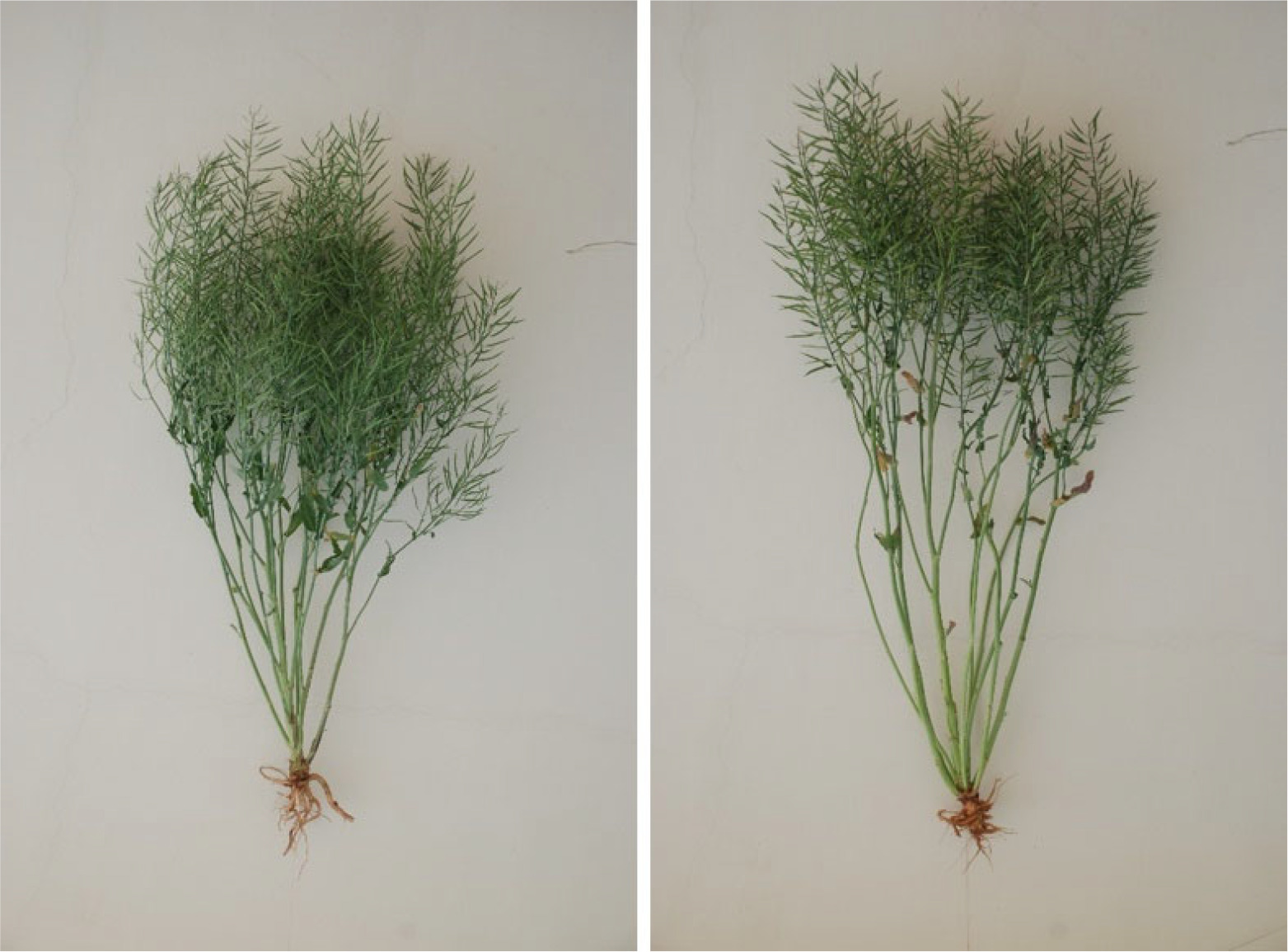
Table 1Inherent characteristics of ‘Areum’.
Table 1
|
Variety |
Plant Type |
Leaf color |
Leaf type |
Leaf serration |
Flower color |
Seed color |
|
Areum |
Ⅳ |
Green |
Pinnately lobed |
Weak |
Yellow |
Red |
|
Sunmang |
Ⅳ |
Green |
Pinnately lobed |
Intermediate |
Yellow |
Black |
Table 2Agronomic characteristics of ‘Areum’ (Regional Yield Trial, 2018-2020).
Table 2
|
Variety |
Cultivation
type |
Flowering date |
Ripening date |
Plant populations/m2
|
Plant height
(cm) |
Main inflorescence length (cm) |
No. of branches/Plant |
|
Areum |
Upland |
4.6 |
6.5 |
132±55.1ns
|
137±17.9ns
|
57±14.9ns
|
6.1±1.5ns
|
|
Paddy |
4.1 |
6.1 |
147±18.7 |
136±22.8 |
47±4.6 |
6.0±1.7 |
|
Average |
4.3 |
6.3 |
139±40.4ns
|
136±19.6ns
|
51.8±11.7ns
|
6.0±1.5ns
|
|
|
Sunmang |
Upland |
4.6 |
6.4 |
123±32.7ns
|
139±22.3ns
|
54±13.4ns
|
6.4±2.1ns
|
|
Paddy |
4.3 |
6.1 |
120±15.9 |
134±20.3 |
43±3.7 |
6.1±1.4 |
|
Average |
4.4 |
6.3 |
121±24.6 |
136±20.5 |
48±10.9 |
6.2±1.7 |
Table 3Pod and seed characteristics of ‘Areum’ (Regional Yield Trial, 2018-2020).
Table 3
|
Variety |
Cultivation type |
No. of pods/plant |
No. of seeds/Pods |
Seed set percentage (%) |
1000-seeds weight (g) |
|
Areum |
Upland |
52±12.5ns
|
22.6±1.7ns
|
88±1.9ns
|
3.5±0.4ns
|
|
Paddy |
79±37.1 |
19.8±2.4 |
90±5.2 |
3.8±0.4 |
|
Average |
66±29.7ns
|
21.2±2.5ns
|
89±3.9ns
|
3.7±0.4ns
|
|
|
Sunmang |
Upland |
53±16.8ns
|
22.0±3.2ns
|
87±3.8ns
|
3.6±0.4ns
|
|
Paddy |
86±52.7 |
19.6±2.8 |
88±5.8 |
3.7±0.4 |
|
Average |
69±41.7 |
20.9±3.7 |
87±4.7 |
3.6±0.4 |
Table 4Lodging tolerance and stem rot resistance of ‘Areum’ (Regional Yield Trial, 2018-2020).
Table 4
|
Variety |
Cultivation type |
Lodging tolerance (0~9)z
|
Stem rot resistance (0~9)y
|
|
Areum |
Upland |
4.2 |
1.7 |
|
Paddy |
6.3 |
0.3 |
|
Average |
5.3 |
1.0 |
|
|
Sunmang |
Upland |
3.7 |
2.3 |
|
Paddy |
6.3 |
1.0 |
|
Average |
5.0 |
1.7 |
Table 5Preliminary and advanced yield trial of ‘Areum’ (2016-2017).
Table 5
|
Variety |
Yield (kg/10a) |
Index |
|
|
2016 |
2017 |
Mean |
|
Areum |
330 |
296 |
313 |
104 |
|
Sunmang |
266 |
333 |
300 |
100 |
Table 6Regional yield trial of ‘Areum’ (2018-2020).
Table 6
|
Cultivation type |
Areum (kg/10a, A) |
Index
(A/B) |
Sunmang (kg/10a, B) |
|
|
|
2018 |
2019 |
2020 |
Mean |
2018 |
2019 |
2020 |
Mean |
|
Upland |
184 |
210 |
326 |
240 |
113ns
|
200 |
144 |
294 |
213 |
|
Paddy |
254 |
265 |
373 |
298 |
131ns
|
153 |
244 |
286 |
228 |
|
Mean |
219 |
238 |
350 |
269 |
122ns
|
177 |
194 |
290 |
220 |
Table 7Oil content and fatty acid composition of ‘Areum’ (2020).
Table 7
|
Variety |
Crude oil
contents (%) |
Fatty acid composition (%) |
|
Palmitic
acid |
Stearic
acid |
Oleic
acid |
Linoleic
acid |
Linolenic
acid |
Eicogenic
acid |
Erucic
acid |
ETC |
|
Areum |
42.1 |
4.24 |
1.89 |
65.06 |
16.52 |
8.16 |
2.36 |
0.95 |
0.83 |
|
Sunmang |
41.9 |
4.58 |
1.87 |
60.65 |
20.34 |
7.84 |
2.52 |
1.35 |
0.86 |
References
- 1. Coughlan R, Moane S, Larkin T. 2022. Variability of essential and nonessential fatty acids of Irish rapeseed oils as an indicator of nutritional quality. Int J Food Sci 2022: 7934565.
- 2. FAO.2023. Standard for named vegetable oils. CXS 210-1999.
- 3. Fu T, Yang G, Yang X. 1990. Studies on "Three line" polima cytoplasmic male sterility developed in Brassica napus. Plant Breeding 104: 115-120.
- 4. Galassetti P, Pontello A. 2006. Dietary effects on oxidation of low-density lipoprotein and atherogenesis. Curr Atheroscler Rep 8: 523-529.
- 5. Ge X, Chen J, Li O, Zou M, Tao B, Zhao L, Wen J, Yi B, Tu J, Shen J. 2025. ORF138 causes abnormal lipid metabolism in the tapetum that leads to ogu cytoplasmic male sterility in Brassica napus. Journal of Integrative Agriculture 24: 2080-2095.
- 6. Guo Y, Li B, Li M, Zhu H, Yang Q, Liu X, Qu L, Fan L, Wang T. 2022. Efficient marker-assisted breeding for clubroot resistance in elite Pol-CMS rapeseed varieties by updating the PbBa8.1 locus. Mol Breed 42: 41
- 7. Harker KN, O'Donovan JT, Blackshaw RE, Johnson EN, Lafond GP, May WE. 2012. Seeding depth and seeding speed effects on no-till canola emergence, maturity, yield and seed quality. Canadian Journal of Plant Science 92: 795-802.
- 8. Jang YS, Choi IH, Kim CW, Kwon BS, Oh YB, Jeong BC, Bang JK, Lee JI. 2002a. Development of maintainer and Mokpo-CGMS in oilseed rape (Brassica napus L.). Korean J Breed Sci 34: 163-167.
- 9. Jang YS, Jeong BC, Kim CW, Oh YB, Choi IH, Kim ST. 2002b. A new rapeseed hybrid (Brassica napus L.) with early maturity and high oil-yield, "Sunmang". Korean J Breed Sci 34: 365-366.
- 10. Kim KS, Lee YH, Lee JE, Cha YL, An DH, Shin WC. 2021. Early maturing rapeseed (Brassica napus L.) F1 hybrid cultivar 'Joan' with high yield and oleic acid content. Korean J Breed Sci 53: 305-310.
- 11. Lee YH, Kim KS, Jang YS, Cho HJ, Choi HG, Jang YG, Kang DS, Kang HS, Suh SJ. 2011. A new F1 hybrid variety of rapeseed, 'Suan' with early maturing and high oleic acid. Korean J Breed Sci 43: 172-176.
- 12. Liu H, Fu T, Yang X. 1987. Discovery and studies on polima CMS line. Proc 7th Int Rapeseed Cong Pozman. Poland: pp. 69-78.
- 13. Liu S, Snowdon R, Chalhoub B. 2018. The brassica napus genome. Springer International Publishing,
- 14. Longin CF, Mühleisen J, Maurer HP, Zhang H, Gowda M, Reif JC. 2012. Hybrid breeding in autogamous cereals. Theor Appl Genet 125: 1087-1096.
- 15. Ogura H. 1968. Studies on the new male-sterility in Japanese radish, with special reference to the utilization of this sterility towards the practical raising of hybrid seeds. Memoirs of the Faculty of Agriculture 6: 39-78.
- 16. Qian W, Sass O, Meng J, Li M, Frauen M, Jung C. 2007. Heterotic patterns in rapeseed (Brassica napus L.): I. Crosses between spring and Chinese semi-winter lines. Theoretical and Applied Genetics 115: 27-34.
- 17. Rahman H. 2013. Review: Breeding spring canola (Brassica napus L.) by the use of exotic germplasm. Canadian Journal of Plant Science 93: 363-373.
- 18. Rural Development Administration (RDA).2012. Criteria for agricultural research and investigation.
- 19. Salar A, Faghih S, Pishdad GR. 2016. Rice bran oil and canola oil improve blood lipids compared to sunflower oil in women with type 2 diabetes: A randomized, single-blind, controlled trial. J Clin Lipidol 10: 299-305.
- 20. Soxhlet FV. 1879. Die gewichtsanalytische bestimmung des milchfettes. Polytech J 232: 461-465.
- 21. Stahl A, Pfeifer M, Frisch M, Wittkop B, Snowdon RJ. 2017. Recent genetic gains in nitrogen use efficiency in oilseed rape. Frontiers in Plant Science 8: 963
- 22. Wang X, Liang X, Wang R, Gao Y, Li Y, Shi H, Gong W, Saleem S, Zou Q, Tao L, Kang Z, Yang J, Yu Q, Wu Q, Liu H, Fu S. 2025. A breeding method for Ogura CMS restorer line independent of restorer source in Brassica napus. Front Genet 15: 1521277.
- 23. Zhang H, Berger JD, Herrmann C. 2017. Yield stability and adaptability of canola (Brassica napus L.) in multiple environment trials. Euphytica 213: 155