적요
Developing a unique local variety that adapts well to the regional environment and consistently expresses its own characteristics provides a significant competitive advantage in the branded rice market. The aim of this study was to develop a Mid-Late Maturing Rice Cultivar with High Grain Quality adapted to the Chungnam Plain. ‘Daebang’ was developed by crossing ‘Haedamssal,’ a stable and high-yielding cultivar, with ‘Jinsumi,’ known for excellent grain appearance and eating quality, during the winter of 2013-2014. The F1 was grown in summer 2014 to produce F2 seeds, and promising lines were selected via the pedigree method. Under normal transplanting, ‘Daebang’ headed on August 19, about four days later than ‘Samkwang. ’ It had a culm length of 75 cm (9 cm shorter than ‘Samkwang’), indicating better lodging resistance. It had 84 spikelets per panicle, a 1,000-grain weight of 21.9 g, and a milled rice yield of 6.06 MT ha-1, which was numerically higher but not significantly different from that of ‘Samkwang.’ The head rice ratio was 95.9%, with a protein content of 5.4%, and glossiness value 78.5, indicating a superior grain quality. ‘Daebang’ also showed similar resistance to blast and bacterial leaf blight as ‘Samkwang.’ Therefore, ‘Daebang’ is expected to serve as a promising mid-late maturing cultivar for producing premium-branded rice in the Chungnam region because of its high grain quality, lodging tolerance, and stable yield (Registration No. 9169).
서언
쌀은 대한민국을 비롯한 아시아 지역에서 오랜 세월 주식으로 소비되어 온 가장 중요한 곡물로, 생산 안정성은 국가 식량안보와 직결된다. 그러나 최근 기후변화로 인한 불규칙한 기상과 예측하기 어려운 환경 변화는 쌀의 생육과 수량 안정성에 위협이 되고 있다.
기후온난화에 따른 평균기온 상승과 잦은 강우는 벼 주요 병해충의 발생을 촉진하고(
Jeong et al. 2014,
Kim et al. 2013), 출수기의 단축과 고온 등숙으로 인해 임실률, 등숙률과 천립중 저하가 수량 감소로 이어진다(Jeung et al. 2016,
Lee et al. 2015,
Shim et al. 2010). 작물모형(ORYZA2000, DSSAT)을 이용한 기후변화 시나리오에서도 이러한 원인에 따른 쌀 생산량 감소가 예측되고 있으며(
Jo et al. 2023,
Kim et al. 2012,
Lee et al. 2012), 등숙기 고온은 전분 합성 유전자(AGP, GBS, SSI)의 발현을 억제해 품질 저하까지 유발하게 된다(
Sang et al. 2018). 따라서 변화하는 환경에 적응하며 병해충 저항성과 내재해성을 갖춘 벼 품종을 개발하고 보급하는 것이 그 무엇보다 중요하다(
An et al. 2008,
An & Cho 2010,
Yang et al. 2001).
2003년에 농촌진흥청 국립식량과학원에서 중부지역을 중심으로 재배 적응성이 높고 수확량과 품질, 내병성 및 내재해성을 갖춘 벼 품종 ‘삼광’을 개발하였다(
Kim et al. 2007). ‘삼광’은 소비자 및 미곡종합처리장(Rice Processig Complex, RPC)의 선호도가 증가하며 충남지역에서 2007년부터 빠르게 확산되어, 2009년에는 충남 브랜드쌀 품종비율의 86%를 차지하게 되며 충남을 대표하는 품종으로 자리매김하였고(
Yun et al. 2010) 양곡유통시장에서 충남쌀의 가격경쟁력 제고에 크게 기여하였다. 그러나 ‘삼광’의 전국적 확산으로 인해 충남 대표 품종으로서의 차별성이 약화되었고, 이상기상으로 인한 도복 발생 위험 증가 등으로 충남지역 내 ‘삼광’ 재배면적은 2019년 43.1%(55,971 ha)에서 2024년 29.5%(38,192 ha)로 감소하였다. 최근 쌀 유통시장은 지역별 특화 브랜드화를 통해 소비자 기호에 맞춘 차별적 판매 전략이 활발히 전개되면서 브랜드쌀 간 경쟁이 심화되고 있다(
Cho 2009). 동시에 기후변화로 인한 재배환경의 불안정성이 커짐에 따라, 지역의 기상⋅토양 조건에 적응하면서도 재배안정성과 고품질을 겸비한 벼 품종 개발이 요구되고 있다. 따라서 충남지역의 환경에 적합하고, 고품질 브랜드쌀 생산에 기여할 수 있는 차별화된 신품종 개발을 통해 충남 쌀 산업의 경쟁력과 지속가능성을 강화할 필요가 있다(
Choi 2018,
Kim 2017,
Lee et al. 2016).
따라서 본 연구에서는 이러한 사회적⋅환경적 변화에 대응하고자, 충청남도농업기술원 쌀연구팀이 개발한 고품질 신품종 ‘대방’의 육성 경위와 주요 특성을 보고하고자 한다.
재료 및 방법
시험재료 및 재배방법
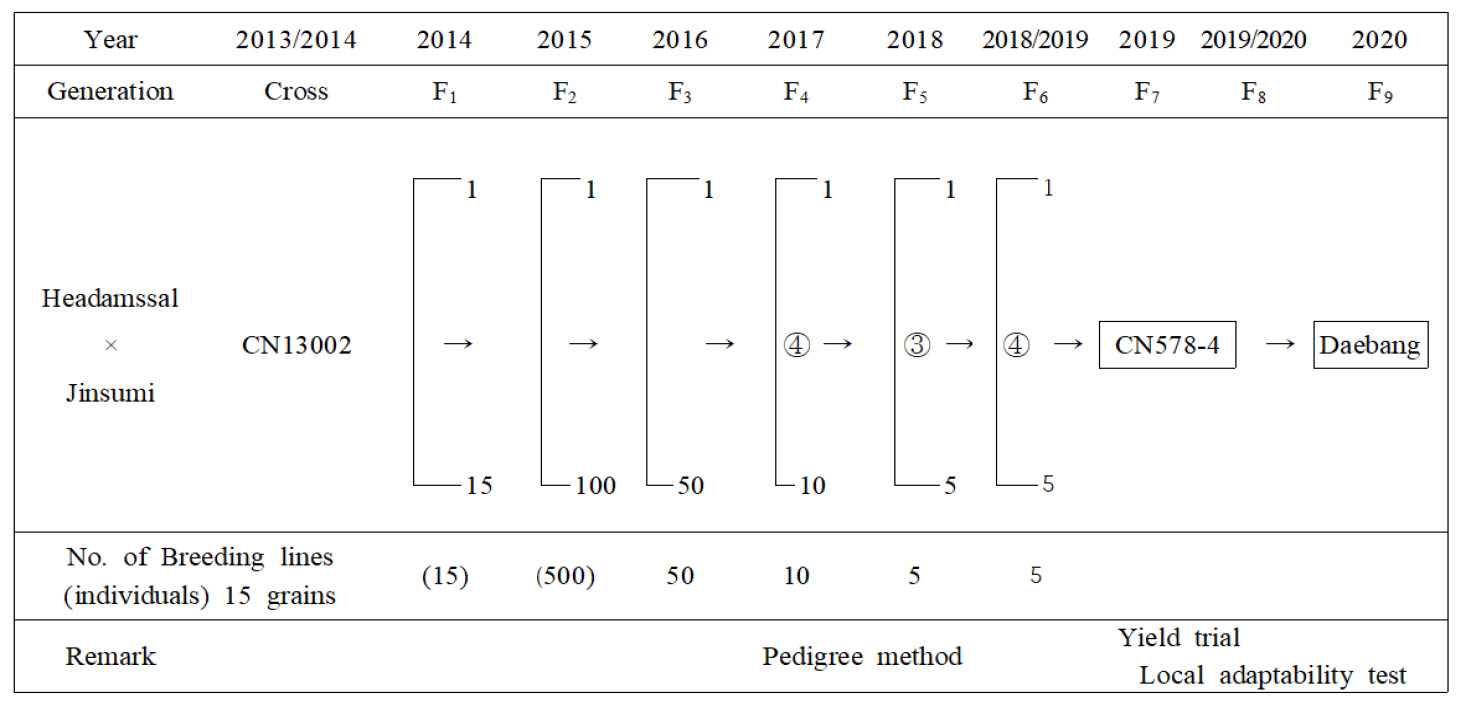
충남평야지 적응 고품질 밥쌀용 품종을 육종하기 위해 2013년 동계에 충남평야지에서 재배안정성과 수량성이 양호한 조생종 ‘해담쌀’을 모본으로, 외관품질과 밥맛이 우수한 중만생종 ‘진수미’를 부본으로 인공교배를 하였다. 2014년 하계에 F1 식물체로부터 얻은 F2 종자를 이용하여 2015년 집단으로 재배 후 2016년부터 계통육성을 통해 고정된 계통을 선발하였고 생산력검정시험을 2019년 하계와 동계에 2차례 수행하였다. 지역적응시험은 충남 주요 재배품종인 삼광을 대조 품종으로 하여 수행하였으며, 2019년에는 예산과 보령 2개 지역에서, 2020년에는 예산, 보령, 논산 3개 지역에서 실시하였다. 재배방법은 5월 상순 파종하여 다목적온실에서 육묘한 후 5월 하순에 30×15 cm의 재식거리로 주당 4-5본 이앙하였고 시비량은 N-P2O5-K2O=90-45-57 kg/ha로 재배 관리하였다.
주요 농업형질 및 수량 관련 형질조사
벼 품종육성을 위한 주요 농업적 특성은 농촌진흥청 농업과학기술 연구조사분석기준(
RDA 2012)에 준하여 조사를 실시하였다. 지역적응시험을 위해 각 지역에서 시험구별 벼 3주를 성숙기에 예취하여 등숙률 및 수당립수를 조사하였으며, 100주를 수확한 후 탈곡, 건조, 탈망 및 정선 과정을 거쳐 정조를 확보하였고, 정조의 수분을 측정한 후 무게를 조사하여 수량을 산출하였다. 제현율은 정조 500 g을 현미기(Ssangyong, SY88-TH, Korea)에 넣어 왕겨를 제거한 뒤 현미의 무게를 측정하여 정조에 대한 현미의 비율을 계산하였다. 현백율은 숙련된 도정 작업자가 현미 200 g을 10분도로 설정된 정미기(MC-90A, Toyo, Japan)에 투입하여 미강의 상태를 확인하면서 도정 작업을 추가적으로 진행한 후 가공된 백미의 무게를 측정하여 현미에 대한 백미의 비율을 계산하였다. 1 ha당 쌀수량은 정조를 수분함량 15% 기준으로 보정 후 제현율과 현백율을 적용하여 계산하였다.
쌀의 외관품질은 품위분석기(Cevitec 1625 Grain Inspector, Foss, Sweden), 단백질함량은 성분분석기(Infratec1241 Grain analyzer, Foss, Sweden), 취반윤기치는 토요식미기(MA-90B, Toyo, Japan)를 이용하여 각 분석기기의 분석매뉴얼에 따라 측정을 진행하였다. 아밀로스함량은 쌀 100 g을 분쇄기(Cyclotec 1093, Foss, Sweden)로 분쇄 후 100 mesh 체를 통과시켜 균일한 시료 100 mg을 정량하여
Perez & Juliano (1978) 비색정량법에 따라 전처리를 진행하였고 분광광도계(Libra S12, Biochrom, UK)로 620 nm 파장에서 흡광도를 측정하여 계산하였다.
잎도열병 밭못자리 저항성 검정은 질소다비 조건의 밭못자리 상태에서 6월 하순에 늦게 파종하여 잎도열병을 유발시키는 밭못자리 검정법을 이용하여 수행하였다. 시비량은 성분량으로 N-P
2O
5-K
2O를 240-80-120 kg/ha로 주었고, 발병을 촉진시키기 위한 이병성 품종(spreader)으로 ‘호평’을 이용하였다. 파종 후 30일 이후에 발병 최성기를 중심으로 조사하며 잎도열병 저항성 검정 기준은 0: 무발병, 1: 바늘머리 크기의 갈색 병반, 2: 다소 큰 갈색 병반, 3: 직경 1-2 mm의 원형회색병반, 4: 직경 1-2 mm의 전형적병반으로 엽면적의 2% 이하 발병, 5: 전형적인 병반이 엽면적의 3-10%, 6: 11-25%, 7: 26-50%, 8: 51-75%, 9: 76% 이상 등 0-9단계로 발병을 구분하였다(
Baek et al. 2019). 시험포장에서의 잎도열병, 목도열병, 흰잎마름병, 줄무늬잎마름병, 잎집무늬마름병 피해 정도는 벼 지역적응시험 포장에서 생육 전반기에 걸쳐 달관으로 농촌진흥청 농업과학기술 연구조사분석기준(
RDA 2012)에 따라 조사를 진행하였다.
통계분석을 위해 R 통계프로그램(The R Project for Statistical Computing Version 4.3.1, Austria)을 사용하였으며, 본 실험의 모든 형질의 값은 3반복으로 조사되었고 대조 품종과의 비교를 위해 t-test를 진행하였다.
결과 및 고찰
육성경위
충남특화 브랜드화를 사업을 추진하기 위한 충남지역에 적응하는 고품질 중만생종 품종을 육성하기 위해 재배안정성이 양호한 ‘해담쌀’을 모본으로, 외관품질과 밥맛이 우수한 중만생종 ‘진수미’를 부본으로 인공교배하여 F
1을 양성하였다. F
2에서는 단간이며 출수기가 중만생종이고 이삭과 초형이 우수한 계통을 선발하였고, F
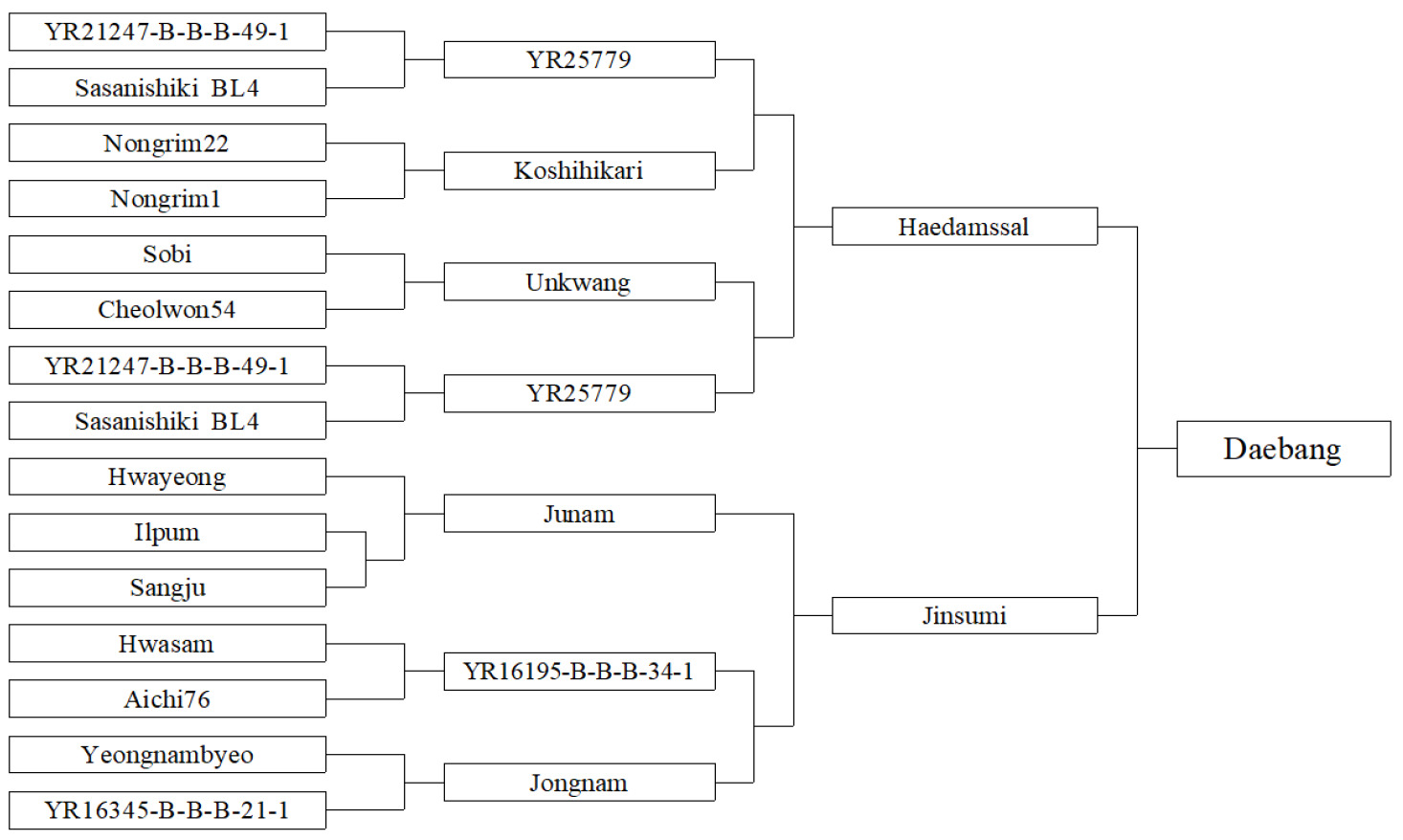
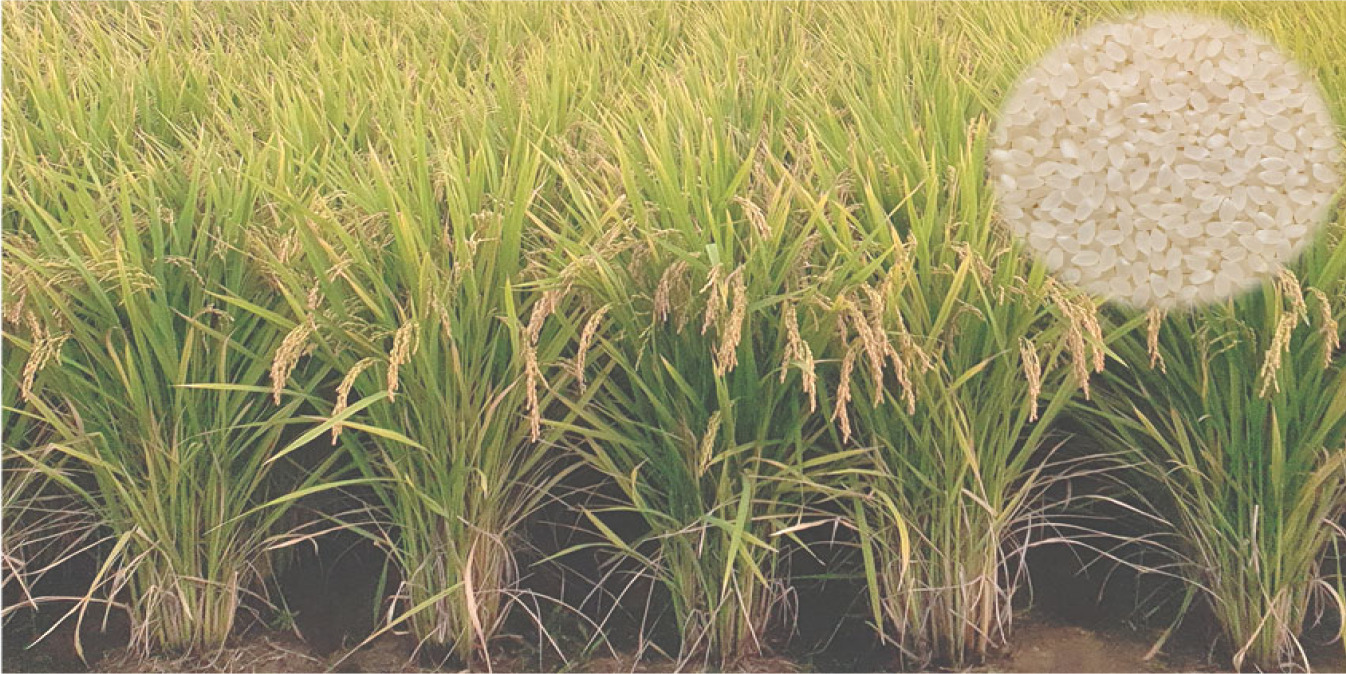
3 이후부터 계통육종법으로 선발하였다. 세대 진전시 주요 병해충 발생과 품질검사를 실시하면서 우량계통을 육성하였다. 2017년 초형과 수량성이 우수한 5계통을 선발하였고, 2018년 동계 재배를 통해 우수한 최종 1계통을 선발하여 ‘충남9호’로 계통명을 부여하였다. 생산력검정은 2019년 하계와 동계재배로 2차례 수행하였고 2019년~2020년 지역적응시험에서 수량 및 품질 우수성이 인정되어 2020년 ‘충청남도농업기술원 신품종선정위원회’에서 벼 신품종으로 선정되었고, 품종명은 ‘대방’으로 명명하였다(
Figs. 1,
2,
3).
1. 출수기
충남평야지에서 5월 하순 보통기 이앙시 ‘대방’의 출수기는 시험지역별 차이를 보였고, 평균 출수기는 8월 19일로 삼광보다 4일 정도 늦었다(
Table 1).
2. 잎과 줄기 특성
‘대방’은 반직립성 초형으로 분얼개도는 보통이며, 잎은 녹색을 띠었다. 잎의 길이와 너비, 줄기의 굵기와 강도는 ‘삼광’과 유사하였고, 간장은 75 cm로 ‘삼광’보다 약 9 cm 짧았다. 이러한 초형적 특성으로 도복에 대한 저항성이 우수하였으며, 도복지수는 1로 ‘삼광’보다 강한 도복 저항성을 보였다(
Table 2).
3. 이삭과 벼알 특성
‘대방’의 이삭길이는 19 cm로 ‘삼광’보다 1 cm 작았으며, 이삭의 착립밀도는 보통, 이삭 추출도는 양호하였다. 벼 알은 까락이 없고 탈립은 되지 않는 편이며, 부선색은 연노랑색이고 영색은 황갈색으로 ‘삼광’과 비슷하였다(
Table 3).
4. 수량 및 수량구성요소
‘대방’의 주당수수는 19개로 ‘삼광’보다 3개 많으며 수당립수는 84개로 ‘삼광’보다 17개 적었다. 등숙비율은 89.1%로 ‘삼광’보다 2.6% 낮았으며, 현미 천립중은 21.9 g으로 ‘삼광’보다 0.8 g 무거웠다(
Table 4). 지역적응시험 결과, ‘대방’의 평균 쌀수량은 6.06 MT/ha로 ‘삼광’보다 0.09 MT/ha 높았으나, 통계적으로 유의하지는 않았다(
Table 5).
1. 가공 및 현미 특성
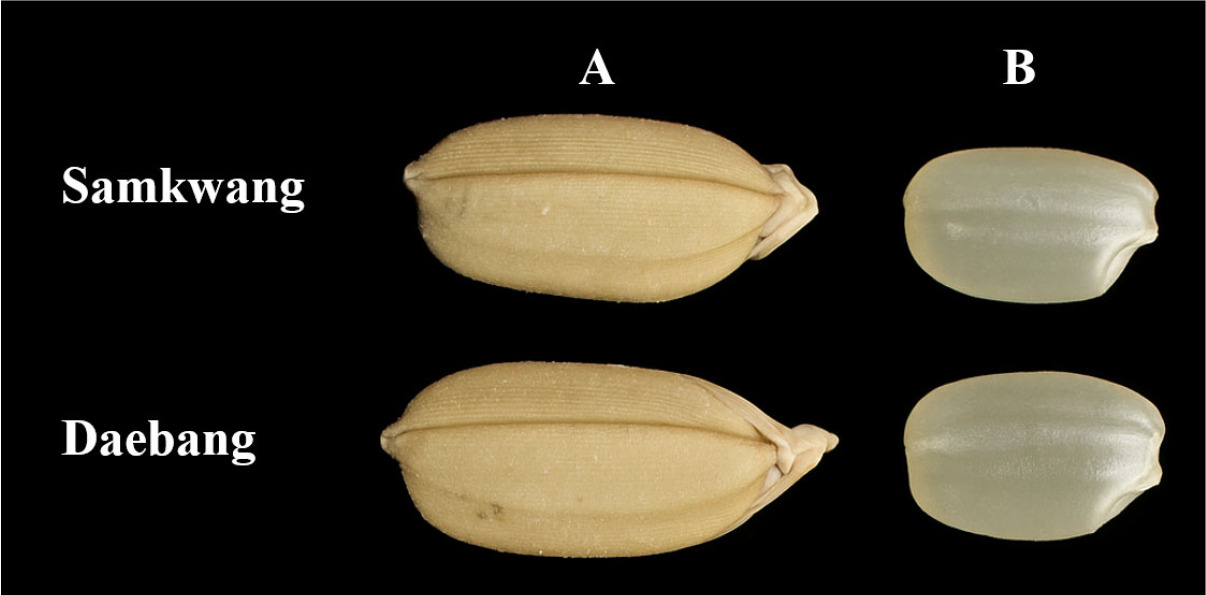
‘대방’의 제현율은 84.5%로 ‘삼광’보다 0.5%, 현백율은 90.7%로 ‘삼광’보다 0.2% 낮았지만 통계적 유의성은 없었다. ‘대방’의 도정율은 76.6%로 ‘삼광’보다 0.7% 낮았지만 완전립비율을 고려한 완전미도정수율은 73.4%로 ‘삼광’보다 0.2% 높은 결과를 보였다. ‘대방’의 현미 길이는 5.32 mm, 폭은 3.03 mm, 두께는 2.19 mm, 장폭비는 1.75로 ‘삼광’과 비슷한 특성을 보였다(
Table 6,
Fig. 4).
2. 쌀 품질특성
‘대방’의 완전립비율은 95.9%로 ‘삼광’보다 1.2% 높았고 분상질립 비율은 약간 높았지만 통계적으로 차이가 없었으며, 싸라기와 피해립 비율은 삼광과 비슷하거나 낮은 경향을 보였다. 단백질함량은 5.4%로 ‘삼광’에 비해 0.3% 낮았으며, 아밀로스함량과 알칼리붕괴도는 두 품종 간 통계적으로 유의한 차이가 없었다. 반면 취반된 쌀의 표면에서 반사되는 윤기치를 통해 식미를 나타내는 지표는 ‘삼광’보다 4.4 높은 78.5로 나타났다.(
Table 7).
밭못자리 검정결과, ‘대방’은 대조품종 삼광과 동일하게 잎도열병이 발병되지 않았다. 또한 지역적응시험포장에서 달관조사로 주요 병해충 검정을 조사한 결과에서도 잎도열병과 이삭목도열병, 줄무늬잎마름병 피해는 발생하지 않았다, 하지만 흰잎마름병과 잎집무늬마름병은 각각 1%와 10% 미만 수준에서 발병하였으며, 이는 복합내병성 품종인 ‘삼광’과 유사한 수준이었다(
Table 8).
적요
충남특화 고품질 브랜드쌀 육성을 위한 차별화된 품종 개발을 하고자 본 연구를 수행하게 되었다. 인공교배는 충남지역에서 재배안정성과 수량성이 양호한 조생종 ‘해담쌀’을 모본으로 외관품질과 밥맛이 우수한 ‘진수미’를 부본으로 활용하였다. 이후 계통육종법으로 전개하며 도복에 안정적이며 초형과 품질이 양호하고 병해충에 강한 개체를 선발하여 ‘충남9호’를 육성하였다. 생산력검정은 2019년 하계와 동계재배로 2차례 수행하였고, 지역적응시험은 2019년부터 2020년까지 2년간 추진하였다. 충남지역에서 보통기 재배 시 ‘대방’의 출수기는 ‘삼광’보다 4일 늦은 8월 19일로 중만생종이며, 간장은 ‘삼광’보다 9 cm 작아 도복에 안정적이었다. ‘대방’의 이삭 당 벼알수는 84개, 현미 천립중은 21.9 g이며, 평균 쌀 수량은 6.06 MT/ha로 ‘삼광’보다 0.09 MT/ha 높았으나, 통계적으로 유의하지는 않았다. 쌀 품질특성에서 ‘대방’의 단백질함량은 5.4%로 ‘삼광’보다 0.3% 낮았으며, 완전립비율은 95.9%로 1.2% 높았고, 취반된 쌀의 표면에서 반사되는 윤기치를 통해 식미를 나타내는 지표는 4.4점 높은 78.5점으로 품질이 양호하였다. 벼 신품종 ‘대방’은 충남지역의 대표 품종인 ‘삼광’과 더불어 새로운 충남 특화 브랜드쌀에 활용될 주요 품종으로 자리매김할 수 있을 것으로 기대된다.
사사
본 논문은 충청남도농업기술원 시험연구사업(과제명: 충남 특화 브랜드쌀 우량 품종 육성, 과제번호: LP0042932019)의 지원으로 수행된 결과의 일부입니다.
Fig. 1Genealogical diagram of ‘Daebang’.
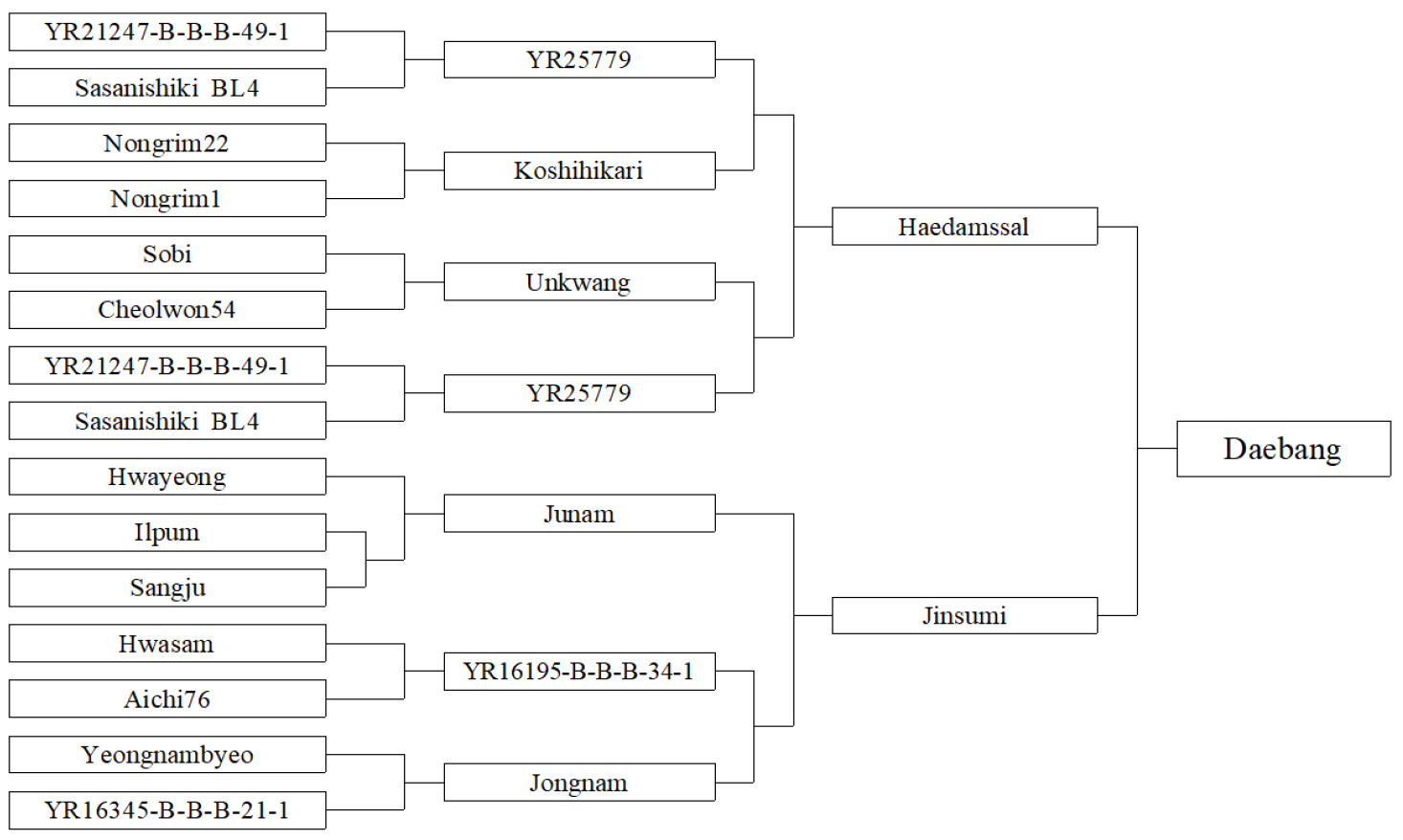
Fig. 2Pedigree diagram of ‘Daebang’.
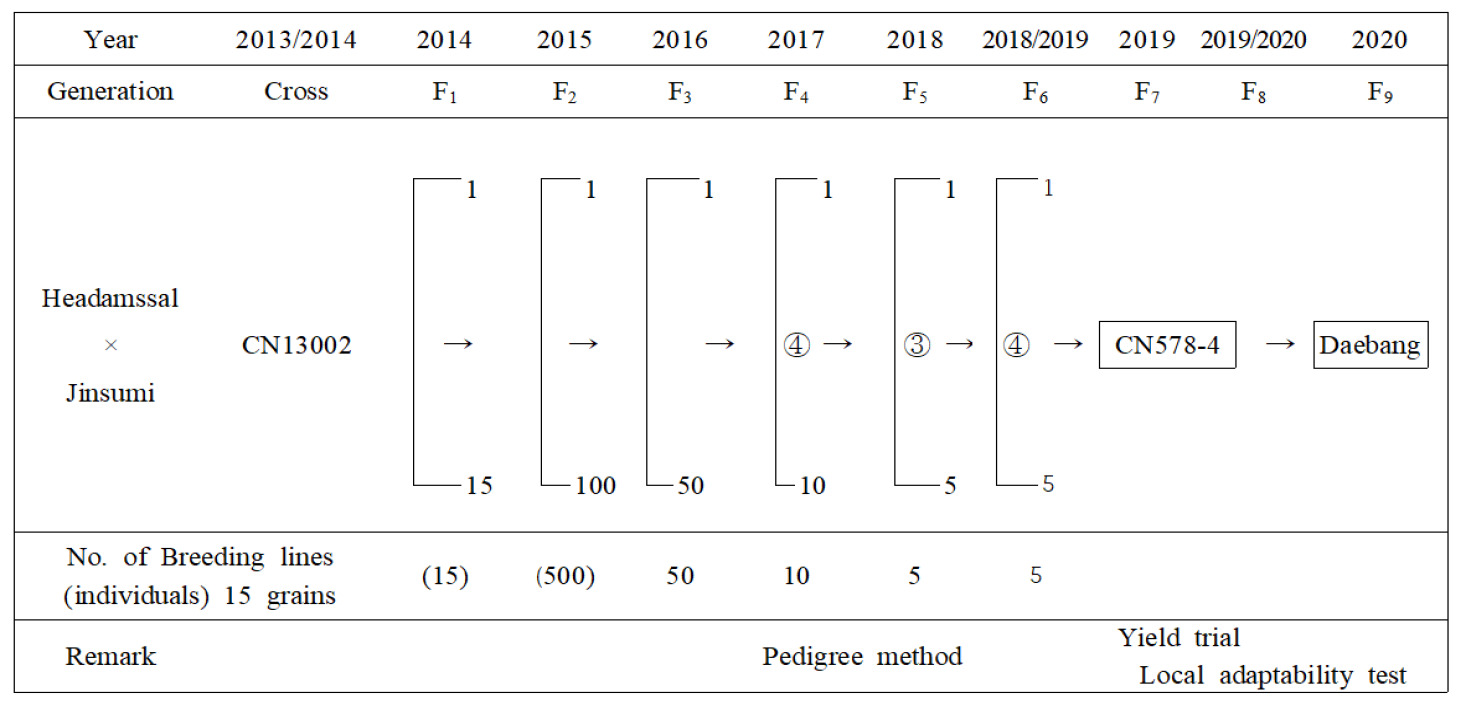
Fig. 3Appearance of ‘Daebang’ at the maturing stage in the paddy field.
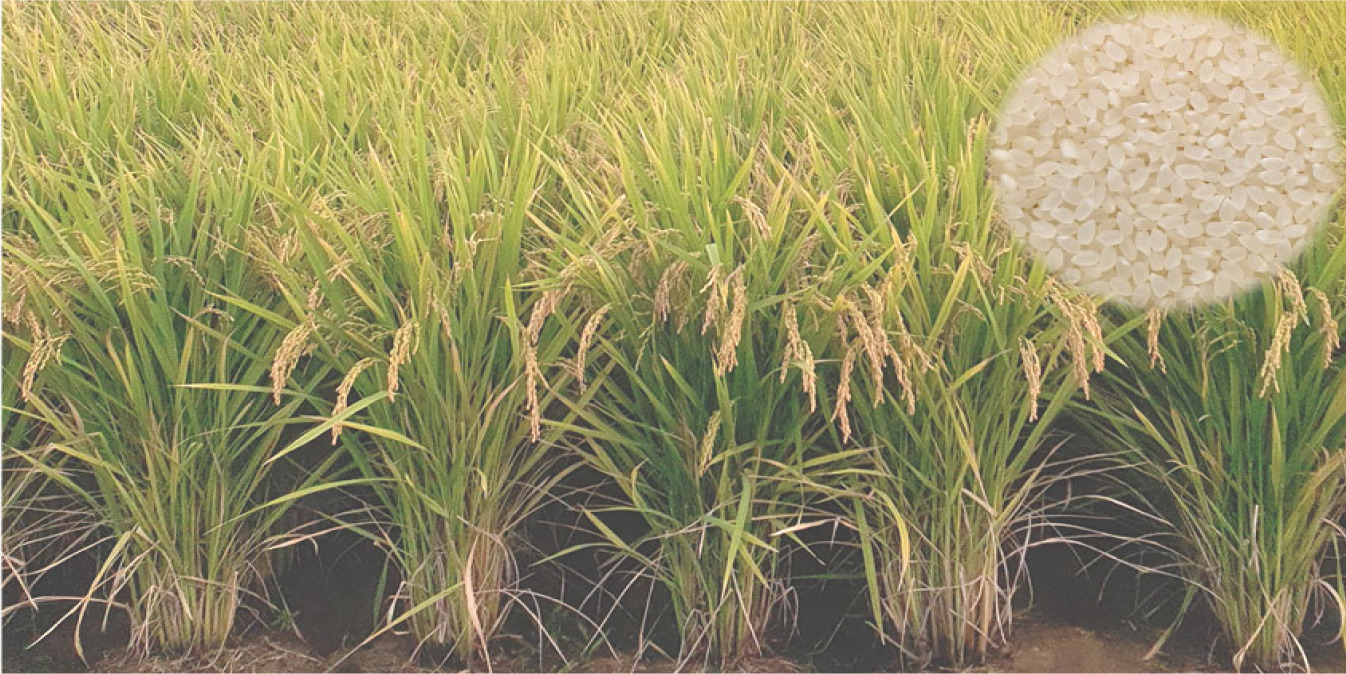
Fig. 4Comparison of grain between two cultivars. A (Rough rice), B (Brown rice).
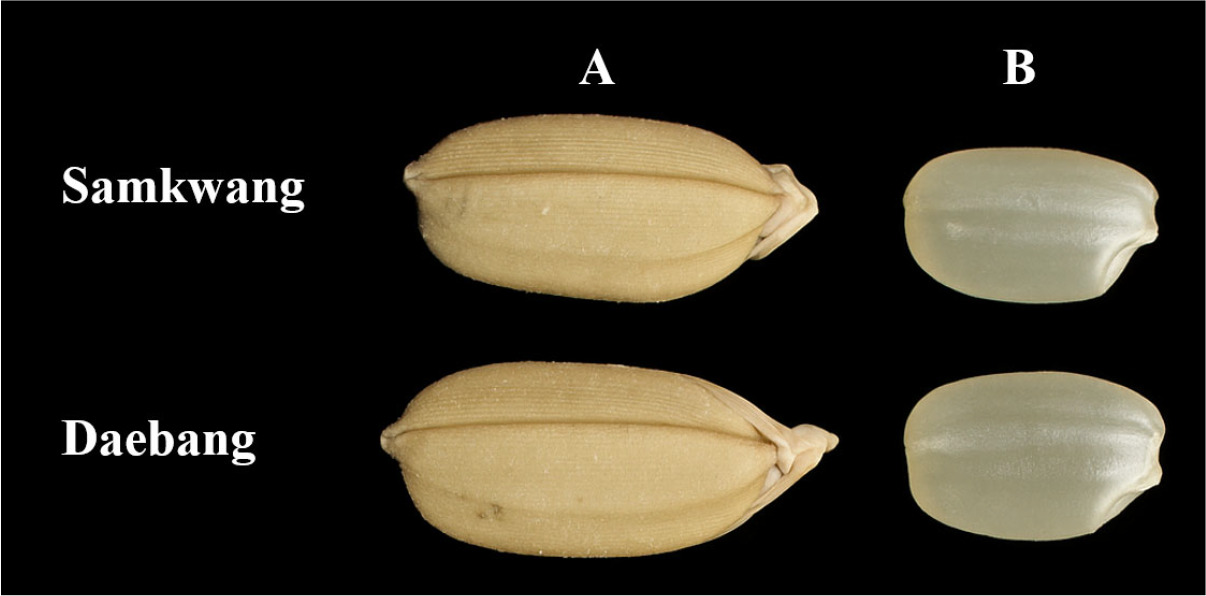
Table 1Heading date summary of local adaptability test.
Table 1
|
Location |
Transplanting date |
Heading date |
|
|
Samkwang |
|
Daebang |
|
|
|
'19 |
'20 |
'19 |
'20 |
Mean |
'19 |
'20 |
Mean |
|
Yesan |
May 27 |
May 27 |
Aug. 13 |
Aug. 15 |
Aug. 14 |
|
Aug. 17 |
Aug. 18 |
Aug. 18 |
|
Boryeong |
May 20 |
May 20 |
Aug. 15 |
Aug. 17 |
Aug. 16 |
|
Aug. 16 |
Aug. 17 |
Aug. 17 |
|
Nonsan |
- |
May 29 |
- |
Aug. 15 |
Aug. 15 |
|
- |
Aug. 21 |
Aug. 21 |
|
Mean |
May 24 |
May 25 |
Aug. 14 |
Aug. 16 |
Aug. 15 |
|
Aug. 17 |
Aug. 19 |
Aug. 19 |
Table 2Characteristics of leaf and culm.
Table 2
|
Cultivar |
Flag leaf |
|
Culm |
Lodging index
(1-9) |
|
|
|
Color |
Length |
Width |
Erectness |
Length (cm) |
Thickness |
Stiffiness |
|
Daebang |
Green |
Medium |
Medium |
Erect |
|
75**
|
Thick |
Strong |
1 |
|
Samkwang |
Green |
Medium |
Medium |
Erect |
|
84 |
Medium |
Medium |
3 |
Table 3Characteristics of grain and panicle.
Table 3
|
Cultivar |
Panicle
length
(cm) |
Spikelets
density |
Shattering |
Panicle
exertion |
Awn |
Spikelets
color |
|
Daebang |
19ns
|
Intermediate |
Hard |
Good |
None |
Yellowish white |
|
Samkwang |
20 |
Intermediate |
Hard |
Good |
None |
Yellowish white |
Table 4Characteristics of yield components.
Table 4
|
Cutivar |
No. of
panicle/hill |
No. of
spikelet/panicle |
Ripened grain ratio
(%) |
Brown rice (g) |
|
|
wt./ℓ |
1,000 grains |
|
Daebang |
19**
|
84**
|
89.1ns
|
840ns
|
21.9ns
|
|
Samkwang |
16 |
101 |
91.7 |
857 |
21.1 |
Table 5Yield summary of local adaptability test.
Table 5
|
Region |
Yield of milled rice (MT/ha) |
|
|
Samkwang |
|
Daebang |
|
|
|
2019 |
2020 |
Mean |
2019 |
2020 |
Mean |
Index |
|
Yesan |
6.08 |
5.82 |
5.95 |
|
6.24 |
5.72 |
5.98 |
101 |
|
Boryeong |
6.27 |
5.98 |
6.13 |
|
6.31 |
6.36 |
6.34 |
103 |
|
Nonsan |
- |
5.82 |
5.82 |
|
- |
5.87 |
5.87 |
101 |
|
|
Mean |
6.18 |
5.87 |
5.97 |
|
6.28 |
5.98 |
6.06ns
|
102 |
Table 6Characteristics of milling properties and grain shape.
Table 6
|
Cultivar |
Milling recovery ratio (%) |
HRMRRz
|
Brown rice |
|
|
Brown/
Rough |
Milled/
Brown |
Milled/
Rough |
Length
(mm) |
Width
(mm) |
Thickness
(mm) |
L/W
ratio |
|
Daebang |
84.5ns
|
90.7ns
|
76.6ns
|
73.4ns
|
5.32ns
|
3.03ns
|
2.19ns
|
1.75ns
|
|
Samkwang |
85.0 |
90.9 |
77.3 |
73.2 |
5.28 |
3.02 |
2.09 |
1.75 |
Table 7Appearance and quality properties related to eating quality.
Table 7
|
Cultivar |
Rice appearance (%) |
Protein
(%) |
Amylose
(%) |
Alkali digestion value (1-7) |
Glossiness of cooked rice |
|
|
Head |
Chalky |
Broken |
Damaged |
|
Daebang |
95.9*
|
2.9ns
|
1.0*
|
0.2ns
|
5.4ns
|
18.5ns
|
6.5ns
|
78.5ns
|
|
Samkwang |
94.7 |
2.7 |
2.4 |
0.2 |
5.7 |
18.3 |
6.2 |
74.1 |
Table 8Reastion to major disease of ‘Daebang’.
Table 8
|
Cultivar |
Blast nursery |
|
Experimental field |
|
|
Leaf blast
(0-9) |
Leaf blast
(0-9) |
Neck blast
(0-9) |
Bacterial leaf blight
(0-9) |
Stripe virus
(0-9) |
Sheath blight
(0-9) |
|
Daebang |
0 |
|
0 |
0 |
3 |
0 |
1 |
|
Samkwang |
0 |
|
0 |
0 |
3 |
0 |
1 |
References
- 1. An DJ, Won JG, Kim SJ, Choi CD, Lee SC. 2008. Selection of rice cultivars adaptable to top rice cultivaion region in southern part of Korea. Korean J Crop Sci 53(S):53-57.
- 2. An JB, Cho JW. 2010. Meteorological response against yield and yield component of rice in Chungnam and Daejeon area. J Agric Sci 37: 177-189.
- 3. Baek MK, Park HS, Nam JK, Cho YC, Kim KY, Kim JJ, Kim WJ, Shin WC, Jeung JU, Kim CS, Jeong JM, Lee KM, Park SG, Lee CM, Suh JP, Lee JH. 2019. High grain quality mid-late maturing rice cultivar 'Yechan' with lodging tolerance and multiple disease resistance. Korean J Breed Sci 51: 504-514.
- 4. Cho ED. 2009. A study on brand equality and consumer awareness of brand rice. J Commun Des 30: 1-9.
- 5. Choi SY. 2018. A study on the design of rice brand design with regional characteristics-focused on Sumsumokmi rice brand of shinan-gun. J Korea Soc Basic Des Art 19: 401-416.
- 6. Jeong HK, Kim CG, Moon DH. 2014. An analysis of impacts of climate change on rice damage occurrence by insect pests and disease. Korean J Environ Agric 33: 52-56.
- 7. Jeong JU, Shin YS, Choi IS, Chang JK, Kim MK, Lee JH, Park HM, Yang CI, Jeon YH, Suh JP, Choi IB, Jeong JM, Sung NS, Lee JH, Yoon MR, Kim CK. 2016. Blast resistant early maturing rice 'Jungmo 1024' with high temperature tolerance during grain filling stage. Korean J Breed Sci 48: 72-84.
- 8. Jo SR, Kim YS, Hur JN, Lee JL, Kim ES, Shim KM, Kang MG. 2023. Climate yield potential changes under climate change over Korean peninsula using 1 km high resolution SSP-RCP scenarios. Korean J Agric For Meteorol 25: 284-301.
- 9. Kim DJ, Kim SO, Moon KH, Yun JI. 2012. An outlook on cereal grains production in south korea based on crop growth simulation under the RCP 8.5 climate condition. Korean J Agric For Meteorol 14: 132-141.
- 10. Kim KH. 2017. Chungnam rice consumption promotion plan. Chungnam Institue Research Report. pp. 1-23..
- 11. Kim MH, Bang HS, Na YE, Kim MR, Oh YJ, Kang KK, Cho KJ. 2013. Vulnerability assessment of rice production by main disease and pest of rice plant to climate change. J Korean Env Res Tech 16: 147-157.
- 12. Kim YG, Hong HC, Hwang HG, Choi IS, Cho YC, Baek MK, Choi YH, Kang KH, Shin YS, Lee JH, Kim HY, Yea JD, Ryu HY, Jeong EK, Yang CI, Jung KH, Jeong OY, Jeon YH. 2007. A mid-late maturing, multi-disease resistant and good-quality rice variety "SamKwangbyeo". Korean J Breed Sci 39: 582-583.
- 13. Lee CK, Kim JW, Shon JY, Yang YH, Yoon YH, Choi KJ, Kim KS. 2012. Impacts of climate change on rice production and adaptation method in Korea as evaluated by simulation study. Korean J Agric For Meteorol 14: 207-221.
- 14. Lee HS, Lim GH, We OG. 2016. A study on the repurchase intentions of rice Gomatnaroo: Focusing on the comparing with other high-quality brands of rice in Chungcheong. Korean Rev Corp Manag 7: 69-92.
- 15. Lee KJ, Nguyen DN, Choi DH, Ban HY, Lee BW. 2015. Effects of elevated air temperature on yield and yield components of rice. Korean J Agric For Meteorol 17: 156-164.
- 16. Perez CM, Juliano BO. 1978. Modification of the simplified amylose test for milled rice. Starch 30: 424-426.
- 17. Rural Development Administration (RDA).2012. Standard of analysis and survey for agricultural research. pp. 315-338.
- 18. Sang WG, Cho HS, Kim JH, Shin P, Baek JK, Lee YH, Cho JI, Seo MC. 2018. The change of grain quality and starch assimilation of rice under future climate conditions according to RCP 8.5 scenario. Korean J Agric For Meteorol 20: 296-304.
- 19. Shim KM, Roh KA, So KH, Kim GY, Jeong HC, Lee DB. 2010. Assessing impacts of global warming on rice growth and production in Korea. J Climate Change Res 1: 121-131.
- 20. Yang CI, Yang SJ, Jeoung YP, Choi HC, Shin YB. 2001. Genotype×environment interaction of rice yield in multi-location trials. Korean J Crop Sci 46: 453-458.
- 21. Yun YT, Chung CT, Min YG, Hong KH, Lee JC, Choi HG, Sung YG, Lee YS. 2010. A study on quality evaluation of Chungnam's distributed brand rice. Chungcheongnam-do Agricultural Research and Extension Services Research Report. pp. 101-109.
Citations
Citations to this article as recorded by