적요
The intermediate breeding material ‘JJ625LG’ was developed to diversify the grain shape characteristics of Korean japonica rice cultivars. ‘JJ625LG’ was derived from a cross between ‘HR30198-AC33 (DGS79),’ a japonica breeding material with extra-long and spindle-shaped grains, and ‘Boramchan,’ a high-yielding japonica cultivar with excellent cultivation stability and medium-short and semi-round grains. By employing both bulk and pedigree breeding methods, strong selection pressure was applied to eliminate undesirable traits inherited from ‘DGS79,’ such as very late heading, long awns, and susceptibility to lodging. Consequently, elite lines with long spindle-shaped grains on a japonica background were selected. These lines subsequently underwent yield performance and local adaptability tests, during which their agronomic traits were comprehensively evaluated, leading to the final selection of ‘JJ625LG.’ The heading date of ‘JJ625LG’ was August 16th, three days later than that of ‘Nampyeong’. Its culm length was similar to ‘Nampyeong.’ ‘JJ625LG’ exhibited a higher number of spikelets per panicle, fewer panicles per plant, and heavier 1,000-grain weight than brown rice. Additionally, it showed strong resistance to bacterial blight (races K1, K2, and K3) but was susceptible to viral diseases and insect pests, indicating the need for further improvement in these areas. Its grain yield was comparable to that of ‘Nampyeong.’ With a brown rice grain length of 6.34 mm, ‘JJ625LG’ was classified as a long-grain type and had a grain length-to-width ratio of 2.64, reflecting a spindle-shaped morphology. It carried the GW2-gs3-qSW5 allele combination associated with grain shape, which is a genetic profile not found in existing Korean japonica cultivars. Although its milling recovery rate was similar to that of ‘Nampyeong,’ the presence of many broken rice due to its long grain shape resulted in a lower percentage of head rice. The eating quality of ‘JJ625LG’ was excellent, with its grains exhibiting the sticky and soft texture typical of japonica rice and receiving high scores in sensory evaluation. As the first intermediate breeding material in Korea with long and spindle-shaped grains in a japonica background, ‘JJ625LG’ is expected to contribute significantly to diversifying the traditionally narrow grain shape spectrum of Korean japonica rice cultivars (Registration No. 10166).
서언
벼 낟알의 크기와 형태는 수량과 품질에 중요한 역할을 하는 형질이다. 낟알의 크기와 형태를 나타내는 입형 특성은 낟알의 길이, 너비, 너비에 대한 길이의 비인 장폭비와 두께에 의해 결정된다(
Zuo & Li 2014). 인종, 문화, 성별 및 연령에 따라 선호하는 입형 특성이 다르며 사회 요구와 시대 흐름에 따라 육종의 목표 형질과 그 중요성이 변화하게 된다(
Park et al. 2017). 우리나라, 일본, 중국 동북지역의 사람들은 대부분 쌀이 짧고 둥근 형태를 선호하는 반면, 동남아시아, 중국 남부, 아메리카, 유럽 지역의 사람들은 길고 얇은 형태의 쌀을 선호한다(
Calingacion et al. 2014). 재배벼(
Oryza sativa L.)는 주로 인디카와 자포니카의 아종으로 분류되는데 인디카 벼는 낟알의 길이가 길고 너비가 얇은 장립종의 세장형 입형 특성을 나타내는 것이 많으며 자포니카 벼는 낟알이 길이가 짧고 형태가 둥근 단립종의 단원형 입형 특성을 가지는 것이 많다(
Glaszmann 1987,
Juliano 1979). 우리나라에서 주식으로 이용되고 있는 자포니카 쌀의 경우 밥을 지었을 때 윤기가 나고 찰성이 있고 부드러운 식감을 나타내는 반면 인디카 쌀은 윤기가 적고 찰기가 상대적으로 떨어지고 푸석푸석한 느낌을 가지는 경우가 많다(
Choi 2010,
Kang et al. 2006). 이러한 자포니카와 인디카의 입형과 식미의 차이는 우리나라에서 쌀알이 짧고 둥근 입형 특성을 가진 자포니카 위주의 벼 품종 개발과 쌀 산업 구조의 발달을 가져왔다(
Park et al. 2018).
우리나라 자포니카 벼 품종들은 협소한 입형 특성을 가지고 있다(
Park et al. 2017). 국내 육성 자포니카 225품종, 흑미 14품종, 통일형 33품종 등 272품종에 대한 입형 특성 분석에서 자포니카 품종들은 평균적으로 중단립종에 단원형을 나타냈으며 중단립종보다 길이가 긴 품종은 ‘대립벼1호’(현미길이 6.66 mm), ‘백설찰’(6.19 mm) 등 7품종(전체의 3.1%)이며, 단원형보다 갸름한 품종은 ‘아로미’(현미장폭비 2.39, 중원형) 1품종(0.4%)으로 대부분의 품종들이 중단립종 이하로 낟알의 길이가 짧고 단원형의 둥근 형태를 나타냈다(
Lee et al. 2020). 협소한 유전적 배경으로 인하여 새롭게 개발되는 육성 계통이나 품종들의 입형은 중단립종 단원형 위주로 고착화되었다(
Park et al. 2018). 자포니카 벼의 정체되어 있는 수량성 장벽과 기후변화에 따른 품질저하 극복을 위한 기반연구와 더불어 새로운 품질에 대한 소비자의 요구 충족과 쌀 산업 발전을 견인하기 위해서는 우리나라 자포니카 벼 품종의 입형 특성을 다양화해야 한다(
Park et al. 2017). 이를 위해 자포니카 대립형 유전자원인 ‘Jizi1560’과 ‘Jizi1581’을 우리나라 자포니카 초다수 품종인 ‘보람찬’과 ‘드래찬’과 교배하여 약배양을 통해 자포니카 ‘입형 다양화 육종소재’를 개발하였고 이를 육종사업에 활용 중에 있다.
우리나라 쌀의 구조적 공급과잉을 해소하기 위한 적극적 방안 중 하나는 남는 밥쌀용 쌀을 해외로 수출하는 것이다. 기존 우리나라 수출용 쌀은 국내 소비 밥쌀용과 같은 중단립종 단원형 쌀로 해외 유통쌀의 가격 하락 등 국제 쌀 시장의 여건 변화 시 내수용으로 회귀하는 문제점을 안고 있다. 수출 여건 변화 시 국내 판매로 전환되는 것을 방지할 수 있도록 육안으로도 내수용 쌀과 쉽게 구분할 수 있는 장립종의 장원형 입형 특성을 가지고, 자포니카의 찰진 밥맛을 보유하여 인디카와 차별화할 수 있는 품종을 수출 전용으로 활용할 경우 가격 경쟁력을 확보할 수 있을 것이다.
농촌진흥청 국립식량과학원 벼 육종팀은 자포니카의 찰지고 부드러운 밥맛을 가지고 있으면서 인디카와 같이 장립종 장원형 입형 특성을 가지고 있는 품종을 개발하여 수출용으로 활용하기 위한 육종사업을 수행하였다. 이를 위해 자포니카형 입형 다양화 육종소재인 ‘DGS79’와 자포니카 초다수 품종 ‘보람찬’을 교배모본으로 활용하여 ‘DSG79’가 가지고 있는 열악형질 제거를 위해 강한 선발압을 적용하여 장립종에 장원형 입형 특성을 보유한 자포니카 중간모본 ‘제이제이625엘지’(이하 JJ625LG)를 개발하였다. 이에 ‘JJ625LG’의 육성경위와 주요특성을 보고하는 바이다.
재료 및 방법
시험재료 및 재배방법
교배모본으로 자포니카 입형 다양화 육종소재 ‘HR30198-AC33’ (DGS79)를 모본으로 하고 자포니카 초다수 품종인 ‘보람찬’을 부본으로 이용하였다. 육종사업을 통해 선발된 고정 계통에 대해서 2017-2018년 ‘남평’을 비교품종으로 생산력 검정시험을 수행하였다. 공시 재료를 국립식량과학원 벼 포장에 4월 30일 파종하여 5월 30일에 재식거리 30×15 cm로 주당 3본씩 구당 150주를 3반복으로 보통기 재배하였다. 시비량은 N-P
2O
5-K
2O를 90-45-57 kg/ha으로 질소는 기비:분얼비:수비를 50:20:30 비율로 분시하였고, 인산은 전량 기비로, 칼륨은 기비:수비를 70:30 비율로 분시하였다. 기타 재배관리는 농촌진흥청 표준 재배법에 준하여 실시하였다. 지역적응성 검정시험은 보통기 보비 재배시험을 호남평야지(전주, 익산, 논산), 서남부해안지(계화) 등 총 4개소에서 2018-2020년 3년 동안 중만생 표준품종 ‘남평’을 대비품종으로 하여 수행하였다. 재배방법에 따른 시험지별 파종 및 이앙시기, 재식밀도와 주당묘수, 시비량 및 분시방법 등과 농업형질 및 수량구성요소, 생리장해 및 병해충 저항성, 도정특성 조사는 농촌진흥청 신품종개발공동연구사업 과제수행계획서의 조사기준과 농업과학기술 연구조사분석기준에 준하여 실시하였다(
RDA 2012,
2018,
2019,
2020).
지역적응성 검정시험에 공시된 재료의 출수기를 조사하고, 성숙기에 평균이 되는 20개체에 대해서 간장, 수장, 수수를 측정하였다. 성숙기에 3주를 예취하여 등숙률 및 수당립수를 조사하였고 100주를 3반복 예취하여 정조중을 측정하였다. 수확한 정조 1 kg을 수량조사현미기(LST, Gwangyang, Korea)로 제영하여 정현비율을 측정하고, 정조수량에 정현비율을 곱하여 현미수량을 구한 다음 10 a당 수량으로 환산하였다. 현미수량에 일반적 현백률인 0.92를 곱하여 백미수량을 구하였고, 제현된 현미를 이용하여 천립중을 측정하였다.
생리장해 저항성 검정
위조와 성숙기 하엽노화는 완전낙수 이후 한발해나 하엽노화가 이루어지는 지를 달관조사하여 평가하였다. 내냉성 검정은 국립식량과학원 춘천출장소 내냉성 검정 시험포장에서 실시하였다. 유묘 내냉성 검정은 3엽기부터 수온 13℃로 10일간 처리하여 1: 엽색 농록, 3: 엽 선단부 담록, 5: 1/3 엽색 황변, 7: 2/3 엽색 갈변, 9: 고사 등 1-9의 질적등급으로 구분하였다. 성숙기 내냉성 검정은 이앙 후 20일부터 등숙기까지 수온 17℃, 수심 5 cm로 냉수처리 후 출수지연일, 임실률 등을 조사하였다. 출수지연일은 냉수를 처리하지 않은 대조구 대비 냉수 처리구 간의 출수지연일수로 구하였고, 임실률은 성숙기에 냉수 처리구의 주간 3이삭을 채취하여 측정하였다. 저온발아율은 100립 3반복으로 13℃ 항온기에서 15일간 치상하여 발아율을 조사하여 측정하였다. 수발아 검정은 출수 후 40일에 주간의 3 이삭을 채취하여 25℃ 포화습도에서 7일간 치상 후 발아율을 조사하여 측정하였다. 도복저항성 검정은 출수 후 20일에 평균적 인 3개체를 골라 실시하였다. 좌절중은 간기부에서 10 cm 절간 중앙부에 하중을 걸어 부러질 때의 무게로 인장강도 시험기(DTG-5, Digitech Co. Ltd., Osaka, Japan)를 이용하여 측정하였다. 도복의 전체적 정도를 나타내는 도복지수는 [모멘트(g⋅cm)/ 좌절중(g)]×100의 공식을 이용하여 구하였으며, 모멘트는 주간 간장과 수장을 더한 값을 총 생체중으로 곱한 값이다.
병해충 저항성 검정
잎도열병 저항성 검정은 국립식량과학원, 도농업기술원 등 전국 11개 지역에서 질소다비 조건의 밭못자리 상태에서 6월 하순에서 7월 상순에 늦게 파종하여 잎도열병을 유발시키는 밭못자리 검정법을 이용하여 수행되었다. 검정포 시비량은 성분량으로 N-P
2O
5-K
2O를 240-80-120 kg/ha로 주었고, 발병을 촉진시키기 위한 이병성 품종(spreader)으로 ‘호평’을 이용하였다. 파종 후 30일 이후에 발병 최성기를 중심으로 조사하며 잎도열병 저항성 검정 기준은 0: 무 발병, 1: 바늘머리 크기의 갈색 병반, 2: 다소 큰 갈색 병반, 3: 직경 1-2 mm의 원형회색병반, 4: 직경 1-2 mm의 전형적 병반으로 엽면적의 2% 이하 발병, 5: 전형적인 병반이 엽면적의 3-10%, 6: 11-25%, 7: 26-50%, 8: 51-75%, 9: 76% 이상 등 0-9단계로 발병을 구분하였다(
Baek et al. 2019). 우리나라 벼흰잎마름병 대표균계에 대한 저항성 반응을 HB1013 (K1 균계), HB1014 (K2), HB1015 (K3), HB1009 (K3a) 균주를 이용하여 검정하였다. 검정 계통에 대해서 최고분얼기에 균주 별로 2주씩 엽선단 3 cm 부위를 가위 절엽접종하였다(
Kauffman et al. 1973). 접종 후 3주 후에 각각의 개체에 가장 긴 병반을 조사하여 5 cm 이하는 저항성(R; resistant), 5-10 cm는 중도저항성(MR; moderately resistant), 10 cm 이상은 이병성(S; susceptible)으로 질적저항성을 구분하였다(
Park et al. 2019). 줄무늬잎마름병 검정은 망실을 이용한 대량 검정법으로 바이러스 보독충 방사 및 계대 사육으로 보독충이 충분히 유지된 망실에 검정 계통을 파종 후 이병성 품종인 ‘추청’이 병징을 나타낼 때 저항성과 감수성으로 판정하였다(
Kwak et al. 2007). 오갈병은 실내유묘검정을 통해서 보독충을 접종하여 바이러스병 저항성 여부를 이병성 품종 ‘추청’을 비교하여 검정하였다. 벼멸구 및 애멸구 저항성 검정은 파종 후 본엽 2-3엽기에 벼멸구와 애멸구를 접종하여 감수성 대비 품종인 ‘일품’과 ‘추청’이 고사한 후에 검정 계통을 저항성과 감수성으로 판정하였다.
지역적응성 검정시험의 현미 20립에 대해서 길이, 너비, 두께를 캘리퍼스(Caliper CD-15CP, Mitutoyo Corp., Japan)를 이용하여 조사하고 너비에 대한 길이의 비율로 현미 장폭비를 계산하였다. 투명도는 백미 20립을 달관조사하여 1: 쌀이 유리알 같이 맑은 것, 5: 중간, 9: 쌀이 불투명한 것으로 구분하였다. 심복백은 백미 20립에 대해서 달관 조사를 통하여 0: 심백 및 복백 무, 1: 쌀알 면적의 5% 이하, 3: 6-10%, 5: 11-20%, 7: 21-40%, 9: 41% 이상으로 구분하였다. 알칼리붕괴도는 백미 6립을 3반복으로 15 mL 용량의 사각 플라스크에 넣고 1.4% KOH 용액 10 mL씩 분주한 후 30℃ 항온기에서 23시간 정치 후, 퍼짐도(spreading)와 투명도(clearing)에 따라 1: 부풀지 않고 그대로 있음, 2: 모양 변화 없이 약간 부풀어 있음, 3: 금이 나게 부풀어 있고, 극히 미미한 퍼짐도 보임, 4: 부푼 쌀 너비 정도의 퍼짐도 보이나 투명화 현상 없음, 5: 심하게 갈라져 꽤 넓은 퍼짐도 보이고 투명화 현상 시작함, 6: 완전히 퍼지고 외곽은 거의 투명화됨, 7: 형태를 알 수 없게 퍼져서 투명화됨 등 7단계로 구분하였다(
Cheo & Heu 1975). 단백질 함량은
AOAC (2000) 방법에 의하여 Micro Kjeldahl법으로 자동 단백질 분석기(Kjeltec 2400 AUT, Foss Tecator, Mulgrave, Australia)로 측정하였다. 아밀로스 함량은
Juliano (1985)의 비색정량법에 따라 시료 100 mg에 95% 에탄올과 1 N sodium hydroxide를 가한 후 호화시킨 전분 호화액에 1 N acetic acid와 2% I
2-KI 용액을 첨가하여 요오드 정색반응 후 분광광도계를 이용하여 620 nm의 파장에서 흡광도를 측정하였다. 밥맛 검정은 전기밥솥에 밥을 취반하여 ‘삼광’의 취반미를 기준으로 하여 국립식량과학원 패널이 밥 모양(색깔 및 윤기), 냄새, 찰기, 질감, 밥맛 및 종합평가 등 6항목을 평가하였다. 평가는 기준밥인 ‘삼광’과 비교하여 비슷하면 보통(0), 기준보다 나쁜 쪽으로 3단계(-1, -2, -3), 좋은 쪽으로 3단계(+1, +2, +3)의 수준으로 평가하고 밥맛 평균값을 식미치로 이용하였다. 도정 특성 검정은 정선된 정조 1 kg을 로울러식 시험용 제현기를 이용하여 현미를 제조한 후 정조에 대한 현미의 중량비로 정현비율을 구하였으며, 현백율은 현미 500 g을 시험용 정미기에 5-6회 반복 도정한 후 얻어진 백미를 1.7 mm 체로 쳐서 쇄미를 분리하고 남은 백미중량을 현미의 중량에 대한 백분율로 나타냈고 도정률은 정현비율에 현백율을 곱한 다음 100으로 나눈 수치로 표시하였다(
Lee et al. 2009). 백미 완전미율은 도정 후 얻어진 백미를 50 g씩 3반복으로 취하여 숙련된 사람이 육안으로 완전미를 분리하였고 완전미의 무게를 재어 원료 쌀의 중량에 대한 백분율로 표시하였다. 완전미 도정수율은 도정률에 백미 완전미율을 곱한 다음 100으로 나눈 수치로 표시하였다.
육성품종의 입형에 관여하는 유전자를 확인하기 위하여 교배 모부분에 대한 유전자형 분석을 수행하였다. Genomic DNA 추출은 BioSprint 96 (Qiagen Co., Düren, Germany)을 이용하였다. 샘플을 TissueLyserⅡ (Qiagen Co., Düren, Germany)로 마쇄한 후 BioSprint 96 DNA Plant Kit (Qiagen Co., Düren, Germany)를 이용하여 DNA를 추출하였다. 입형 관련 유전자로 입형에 대한 기여도가 크고 특성이 자세히 밝혀진 주동유전자
GW2,
GS3,
qSW5을 대상으로 하였다(
Fan et al. 2006,
Shomura et al. 2008,
Song et al. 2007). PCR 반응 및 전기영동 등 분자표지를 이용한 입형 관련 유전자 확인은 기존의 연구결과와 같은 방법을 이용하였다(
Park et al. 2018).
통계분석은 R (Version 4.3.1, The R Foundation for Statistical Computing Platform)을 이용하였다. 각 형질의 평균 등 기술통계, t-test를 이용한 육성품종과 비교품종간의 비교를 agricolae 패키지를 이용하여 수행하였다.
결과 및 고찰
육성 경위
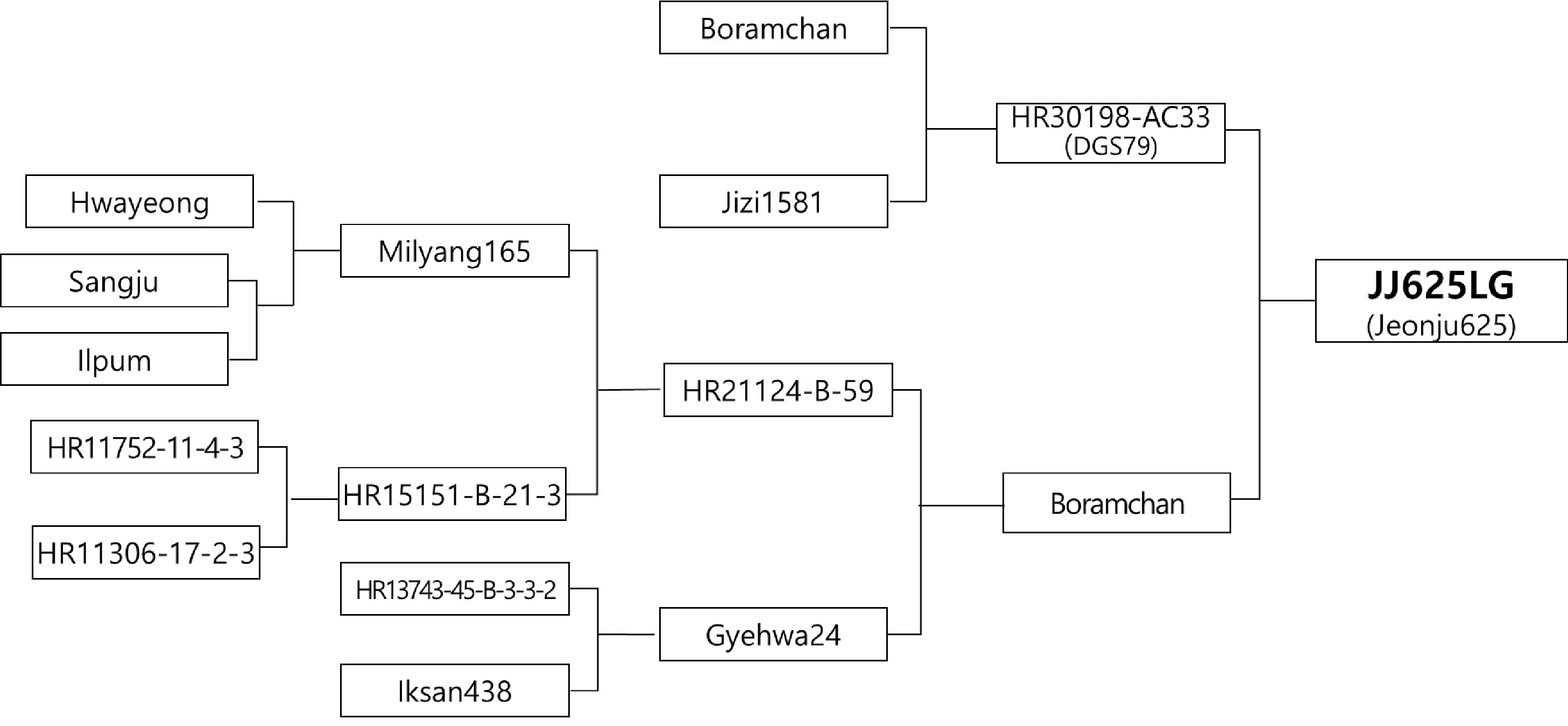
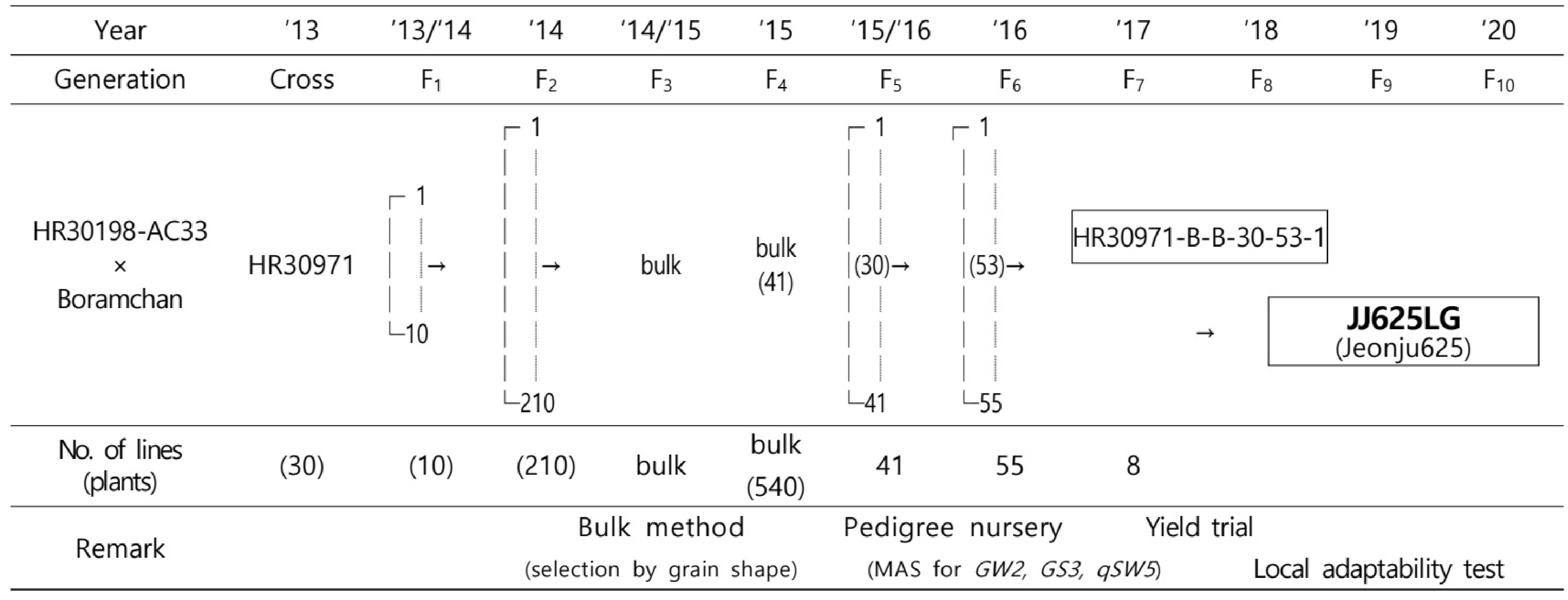
‘JJ625LG’는 우리나라 자포니카 벼 품종의 협소한 입형 특성을 다양화하기 위하여 개발되었다. 2013년 하계에 초장립종 장원형 입형 특성을 가지고 있는 자포니카 입형 다양화 육종소재 ‘HR30198-AC33’ (DGS79)를 모본으로 하고 자포니카 초다수 품종으로 중단립종 단원형 입형 특성을 가지고 있으면서 재배안정성이 우수한 ‘보람찬’을 부본으로 하여 2013년 단교잡 인공교배하였다(
Figs. 1,
2). ‘DGS79’는 ‘보람찬’을 모본으로 하고 자포니카 극대립 유전자원인 ‘Jizi1581’ (IT251541)를 교배하여 약배양을 통해 육성된 입형 다양화 육종소재로서 입형 관련 주동유전자
GW2,
GS3,
qSW5 중
GS3만 기능상실 돌연변이형인
GW2-gs3-qSW5 대립유전자형 조합으로 현미 길이 7.52 mm의 초장립종이며 장폭비 2.78의 장원형으로 자포니카 장립종 계통 육성을 위한 교배모본으로 활용가치가 있다 하였다(
Park et al. 2017). 하지만 ‘DGS79’는 등숙이 정상적으로 이루어지지 않을 정도로 늦은 출수기, 장간, 긴 까락, 쳐진 지엽, 도복에 약한 특성 등 열악형질을 수반하고 있어 이를 교배모본으로 활용하여 실질적인 재배품종을 개발하기 위해서는 열악형질이 제거되어야 한다(
Park et al. 2018). ‘DGS79’와 ‘보람찬’의 단교잡 F
2 분리집단에서는 형질 특성이 열악한 개체들이 대부분이었다. 집단 내 210개 개체 중 입형에 대해서만 선발압을 가하여 66개 개체를 이삭 선발하였고 이를 혼합하여 집단육종법으로 F
3 세대를 진전하였으며 F
4 세대에서 540개 개체로 이루어진 집단을 전개하였다(
Fig. 2). F
4 분리세대에서도 대부분의 개체들이 늦은 출수기, 장간, 낀 까락, 쳐진 지엽, 도복 등 열악형질을 수반하는 경우가 많았다. 하지만 이 중 유독 1개체(이후 LG30으로 명명)가 장립종 장원형의 목표 입형 특성을 갖추고 있으면서 출수기가 남평에 비해 7일 가량 늦지만 ‘DGS79’보다 2주 가량 빨라 등숙에 문제가 없으며 간장이 적당하고 짙은 녹색의 넓고 긴 잎을 가지고 있으면 서 직립형태의 수광태세가 좋은 초형으로 강한 내도복성을 갖춘 다수성의 농업형질 특성을 나타냈다. 집단 내 열악형질이 많이 발현되어 우량 개체 선발에 어려움이 있었으나 ‘LG30’과 같이 육종목표에 부합되는 개체를 선발할 수 있었던 것은 입형에 대한 선발압과 함께 출수기 및 초형 등 농업형질에 대한 표현형 선발에 기반을 둔 포장육종에 중점을 둔 육종사업을 수행하여 재조합과정 중 양호한 형질특성이 조합된 개체를 발견할 수 있었기 때문으로 생각된다(
Park et al. 2018). 좀 더 형질 특성을 가다듬기 위해 F
5 세대 계통선발과 F
6 세대 예비선발시험을 통해 ‘LG30’ 유래 자매계통 중 형질 특성이 가장 우수한 3 계통을 선발하여 생산력 검정시험을 수행하였다. 이들 자매 계통은 고세대 이후 분리된 계통으로 형질 특성이 유사하였으나 이 중 간장이 작고 수당립수는 다소 적으나 등숙률이 높고 형질특성이 안정적인 ‘HR30971-B-B-30-53-1’를 선발하여 ‘전주625호’로 계통명을 부여하였다(
Fig. 2). ‘전주625호’는 2018-2020년 3년간의 지역적응성 검정시험을 통해 온대 자포니카이면서 장립종 장원형 입형을 특성을 나타내는 국내 최초의 우량계통임이 확인되었다. ‘전주625호’는 농촌진흥청 직무육성 신품종 선정위원회에서 도복에 강하고 출수기를 만생종에서 중만생종으로 당기는 등 모본인 ‘DSG79’가 가지고 있는 열악형질을 상당수준 개선하였고 우수한 밥맛 특성이 인정되었으나, 성숙후기에 옆노화가 발생하고 종실의 숙색이 불량하여 재배품종으로는 다소 부족하다는 판단 하에 우리나라 자포니카 밥쌀용 품종의 입형 특성을 다양화하기 위한 중간모본으로 선정되었고 ‘JJ625LG’로 품종명이 명명되었다.
‘JJ625LG’는 호남평야지 및 서남부해안지 보통기 보비재배에서 평균 출수기가 8월 16일로 비교품종인 ‘남평’보다 3일 느린 중만생종이다(
Table 1). 잎은 ‘남평’보다 진한 녹색으로 길이가 길고 너비가 넓은 편이며 직립성으로 초형이 양호하다(
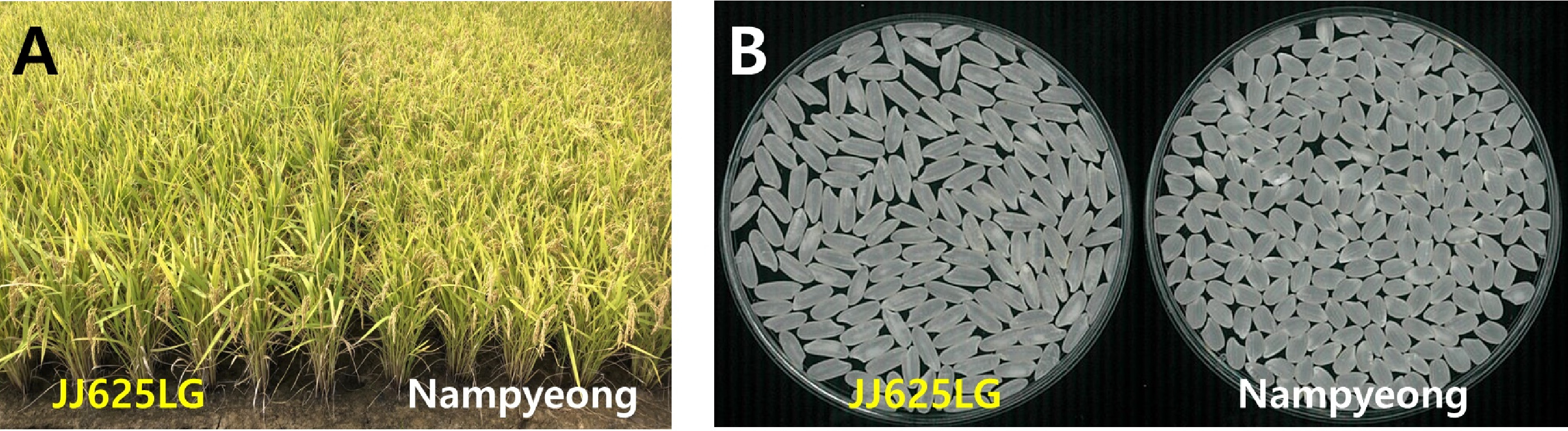
Fig. 3A). 줄기의 굵기는 ‘남평’에 비해 굵은 편이며 강도가 강하고 분얼개도는 다소 밀집한 형태이다. 이삭은 추출이 다소 안되는 편으로 착립밀도가 높고 벼알은 까락이 발생하는 편이다. 간장이 72 cm로 ‘남평’(71 cm)과 비슷한 단간이며 수장은 23 cm로 ‘남평’(21 cm)보다 길고 주당수수는 11개로 ‘남평’(13개)보다 적었다(
Table 1). 수당립수는 118개로 ‘남평’(97개)보다 많았고, 등숙비율은 86.9%로 ‘남평’(88.3%)보다 낮았으나 통계적 유의성은 없었다(
Table 1). 현미천립중 25.3 g으로 ‘남평’(20.4 g)에 비해 무거웠다.
‘JJ625LG’는 생육 중후기에 위조현상이 없었으나, 성숙기에 하엽이 일반적인 자포니카 품종들이 보이는 잎의 노화보다 붉게 변하는 현상이 나타나 유전적 요인에 의한 것인지에 대한 추가 분석이 필요할 것으로 생각된다(
Table 2). 내냉성 검정 결과 ‘남평’에 비해 출수지연일수가 3일 길었으나 임실률과 저온발아율이 높았고 성숙기 종합 내냉성 정도가 높은 편이었다(
Table 2). 도복 저항성과 관련하여 ‘JJ625LG’는 줄기의 기부에 하중을 걸어 부러질 때의 무게를 측정하는 좌절중이 1,384 g으로 ‘남평’(1,013 g)보다 무거웠으나 벼키(간장+수장)가 크고 생체중이 무거워 도복의 전체적 정도를 나타내는 도복지수는 172로 ‘남평’(121)에 비해 높은 특성을 나타냈다(
Table 2). ‘남평’은 단간에 도복에 강한 품종으로 알려져 있다(
Shin et al. 1998). ‘JJ625LG’가 ‘남평’에 비해 도복지수는 높았으나 줄기의 굵기가 굵고 좌절중이 무거웠으며 모본인 ‘DGS79’가 장간이면서 도복에 취약한 특성을 나타냈던 것과 비교했을 때 도복 특성이 개선되었으며 이러한 특성은 단간 내도복 특성을 가지고 있는 부본 ‘보람찬’에서 유래한 것으로 판단된다(
Ha et al. 2012). 수발아율은 17.1%로 ‘남평’(2.3%)에 비해 높았으나 통계적 유의성은 없었다(
Table 2).
‘JJ625LG’는 잎도열병밭못자리 검정 결과 11개소에서 평균 4.1의 저항성 반응을 나타내 비교품종인 ‘남평’(3.4)에 비해 약한 반응을 나타냈다(
Table 3). 우리나라 벼흰잎마름병 대표균계 중 K1, K2, K3에는 저항성 반응을 나타냈으나 K3a에 대한 저항성은 없었고, 바이러스병인 줄무늬잎마름병과 오갈병에 이병성이며, 벼멸구와 애멸구에 약해 전반적인 내병충성이 부족한 것으로 판단된다(
Tables 3,
4). 우리나라 품종의 입형 다양화를 위해 자포니카 장립종 장원형인 ‘JJ625LG’를 이용할 경우 내병충성 확보된 자원을 교배모본으로 활용하여 병해충 저항성을 강화하는 것이 필요할 것으로 생각된다.
‘JJ625LG’의 입형 특성은 현미 길이, 너비, 두께가 6.34 mm, 2.40 mm, 2.07 mm로 ‘남평’(4.86 mm, 2.78 mm, 2.05 mm)에 비해 길이가 길고 너비는 좁았으며 두께는 비슷하였다(
Table 5). 우리나라에서는 현미 길이를 기준으로 5.00 mm 이하 단립종(S, short), 5.01-5.50 mm 중단립종(MS, medium-short), 5.51-6.00 mm 중립종(M, medium), 6.01-7.00 mm 장립종(L, long), 7.01 mm 이상 초장립종(EL, extra long)으로 구분하며, 국제식물신품종보호동맹(International Union for the Protection of New Varieites of Plants; UPOV) 기준을 따라 현미의 형태를 장폭비 1.5 이하 원형(round), 1.50-1.99 단원형(semi-round), 2.00-2.49 중원형(half spindle-shaped), 2.50-2.99 장원형(spindle-shaped), 3.00 이상 세장형(long spindle-shaped)으로 구분한다(
Park et al. 2018). ‘JJ625LG’는 현미 길이가 6.00 mm를 넘는 장립종이면서 장폭비가 2.64로 장원형의 입형 특성을 나타냈다. 우리나라 자포니카 225, 흑미 14, 통일형 생태종 33품종 등 272품종에 대한 입형 특성 분석에서 평균적으로 자포니카 품종들은 중단립종에 단원형, 흑미와 통일형 품종은 중립종에 중원형 특성을 나타냈다(
Lee et al. 2020). 장립종이면서 장원형 입형 특성을 나타내는 것은 자포니카와 흑미 품종에서는 없었고, 인디카와 교배를 통해 개발된 통일형에서도 13개 대립유전자형 조합 중 CT4 (향미벼1호, 2호 등 4품종)와 CT13 (한강찰)에만 존재할 정도로 희소한 것으로 보고되었다(
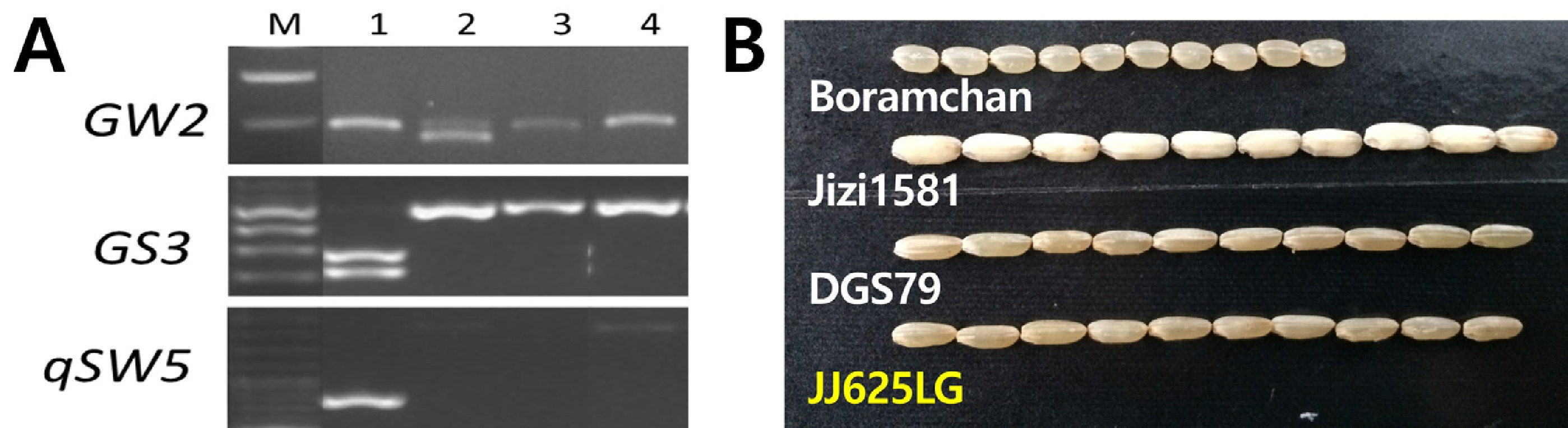
Lee et al. 2020). 이를 통해 ‘JJ625LG’는 자포니카 생태종이면서 장립종 장원형 입형 특성을 나타내는 우리나라 최초의 중간모본으로 확인되었다. ‘JJ625LG’의 입형 관련 유전자형을 확인하기 위하여 교배모부본을 대상으로 주동 유전자
GW2,
GS3,
qSW5에 대한 대립유전자형을 분석한 결과 ‘JJ625LG’는
GW2-gs3-qSW5의 대립유전자형 조합을 나타냈다(
Fig. 4). 우리나라 자포니카 품종들은 부본인 ‘보람찬’과 같이
GW2-GS3-qsw5 대립유전자형 조합을 나타내거나 ‘신동진’과 같은 일부 중대립 품종에서 확인되는
GW2-gs3-qsw5형을 나타내는 등 대부분 종실의 너비와 크기가 커지는
qsw5 대립유전자를 보유하고 있다(
Lee et al. 2020). 이에 반해 ‘JJ625LG’는 중대립 품종들이 가지고 있는
gs3와 우리나라 자포니카 밥쌀용 품종에서 존재하지 않던 종실 너비가 좁아지는 새로운 대립유전자형
qSW5를 함께 보유하고 있어 길이가 길어지면서 너비가 좁아짐으로써 장립종의 장원형 입형 특성을 나타내며, 이러한 특성은 모본인 ‘DGS79’와 그 선대인 ‘Jizi1581’에서 유래한 것으로 확인되었다(
Fig. 4). ‘JJ625LG’가 보유하고 있는
GW2-gs3-qSW5 대립유전자형 조합은 우리나라 자포니카 품종의 협소한 입형 특성을 다양화하기 위한 새로운 유용 조합으로 육종사업에서 그 활용가치가 클 것으로 판단된다.
‘JJ625LG’의 쌀은 투명하였으며 복백이 있어 ‘남평’보다 외관품위가 다소 떨어지고 알칼리붕괴도가 6.8로 ‘남평’(6.6)보다 높았다(
Table 5). 알칼리붕괴도는 호화개시온도와 관련이 있는 형질로 일반적으로 값이 높을수록 호화개시온도가 낮고, 인디카와 통일형은 자포니카벼에 비해 호화개시온도가 높고 자포니카 벼 중 식미가 양호한 품종들이 호화개시온도가 낮은 것으로 알려져 있다(
Lee et al. 2008,
Yoon et al. 2007,
Yoon et al. 2009). 이전 보고에서 ‘전주625호’(JJ625LG)는 호화개시온도가 통일형인 ‘한아름2호’에 비해 낮은 뿐 아니라 다른 자포니카 품종인 ‘남평’과 ‘보람찬’에 비해서도 낮은 것으로 보고되었다(
Park et al. 2018). 이를 통해 ‘JJ625LG’는 식미가 양호한 자포니카의 호화점도 특성을 보유하고 있는 것으로 판단된다. ‘JJ625LG’는 아밀로스 함량이 19.4%로 ‘남평’(19.3%)과 비슷하였으나 단백질 함량이 5.4%로 ‘남평’(6.2%)보다 낮아 밥맛에 좋은 특성을 나타냈고, 식미 관능평가에서도 0.18로 ‘남평’(0.05)보다 높으면서 밥의 윤기가 우수하고 찰지며 부드러운 밥맛을 나타냈다(
Table 5). ‘JJ625LG’의 도정특성은 제현율이 83.9%로 ‘남평’(82.5%)보다 높았고 현백률이 89.8%로 ‘남평’(90.2%)과 비슷하여 도정률이 75.4%로 ‘남평’(74.4%)보다 양호하였다(
Table 6). 하지만 싸라기가 많이 발생하여 백미완전립률이 83.1%로 ‘남평’(97.8%)보다 낮아 완전미 도정수율이 62.7%로 ‘남평’(72.7%)보다 낮았다(
Table 6). ‘JJ625LG’는 우리나라 최초로 자포니카이면서 장립종에 장원형 입형 특성을 나타내는 중간모본으로 우수한 밥맛 특성을 보유하고 있어 우리나라 밥쌀용 품종의 입형 특성을 다양화하기 위한 유용한 자원으로 판단된다. 하지만 장립종 입형 특성으로 인한 싸라기 발생은 개선되어야 할 사항으로 판단된다.
‘JJ625LG’의 백미 수량은 2018-2020년 3년간 실시한 지역적응성 검정시험 보통기 보비 재배시험에서 평균 쌀수량이 532 kg/10a로 ‘남평’(529 kg/10a)과 비슷한 수준이었다(
Table 7).
‘JJ625LG’는 직무육성 신품종 선정심의위원회에서 국내 자포니카 벼의 입형 다양화를 위한 중간모본으로 선정되었다. ‘JJ625LG’는 자포니카 생태종이면서 장립종에 장원형 입형을 가진 최초의 중간모본으로 신품종 육성을 위한 교배모본과 입형 다양화 시험연구를 위한 육종소재 등으로 활용되고 있다. 파종 전 주의사항으로 키다리병 방제를 위하여 철저한 종자소독을 하여야 한다. 질소질 비료 과다사용 시 품질저하, 등숙저하, 숙색불량 및 병해충 발생 등이 우려되므로 표준재배법을 준수하여야 한다. 내냉성이 약하므로 중산간 고랭지 지역 재배는 삼가야 하며, 수확기 강우에 의한 수발아 피해가 우려되므로 적기수확 하여야 한다. ‘JJ625LG’는 벼흰잎마름병(K1~K3, K3a)에는 강하나 도열병과 바이러스병 및 해충에 대한 저항성이 없으므로 적기 기본방제를 하여야 한다.
적요
‘JJ625LG’는 농촌진흥청 국립식량과학원에서 우리나라 자포니카 벼 품종의 입형 특성을 다양화하기 위하여 개발된 중간모본이다(전주625호, long grain). 초장립종 장원형 입형 특성을 가지고 있는 자포니카 입형 다양화 육종소재 ‘HR30198-AC33’ (DGS79)를 모본으로 하고 자포니카 초다수 품종으로 중단립종 단원형 입형 특성을 가지고 있으면서 재배안정성이 우수한 ‘보람찬’을 부본으로 단교잡 인공교배하여 육성되었다. 집단육종법과 계통육종법을 병행하여 모본인 ‘DGS79’가 가지고 있는 늦은 출수기, 낀 까락, 도복에 약한 특성 등 열악형질을 제거하기 위한 강한 선발압을 적용하여 자포니카 생태종이면서 장립종에 장원형 입형 특성을 가진 우량계통을 선발하였다. 이후 생산력 검정시험과 지역적응성 검정시험을 거쳐 농업 관련 형질에 대한 특성을 정밀 검토하였고 ‘JJ625LG’가 선발되었다. ‘JJ625LG’는 보통기 보비재배에서 평균 출수기 8월 16일로 ‘남평’에 비해 3일 늦은 중만생종이다. ‘JJ625LG’는 ‘남평’과 비슷한 단간이며 수당립수가 많고 수수가 적은 편이며 현미천립중이 무거웠다. ‘JJ625LG’는 벼흰잎마름병(K1, K2, K3 레이스)에는 강하나 바이러스병과 해충에 약해 이에 대한 개선이 필요하며 수량성은 ‘남평’과 비슷한 수준이다. ‘JJ625LG’는 현미길이가 6.34 mm로 장립종에 속하며 장폭비가 2.64인 장원형으로 기존 우리나라 자포니카 품종들이 가지고 있지 않는 입형 관련 대립유전자형 조합인 GW2-gs3-qSW5을 보유하고 있다. 도정률은 ‘남평’과 비슷하나 장립종으로 싸라기 발생이 많아 완전미 도정수율은 낮다. 밥맛은 자포니카의 차지고 부드러운 식감을 나타내며 식미관능검정 성적이 우수하였다. ‘JJ625LG’는 우리나라 최초의 자포니카 장립종의 중원형 입형 특성을 가진 중간모본으로 우리나라 자포니카 벼 품종의 협소한 입형 특성을 다양화하는데 기여할 것으로 기대된다.
사사
본 논문은 농촌진흥청 작물시험연구사업(수출쌀 생산용 입형 다양화 벼 품종 개발 및 형질 개선 연구(1주관), 과제번호: PJ01428001)의 지원으로 수행된 결과의 일부입니다. 품종을 육성함에 있어 협력하여 주신 농촌진흥청 국립식량과학원, 연구정책국, 농촌지원국 및 각도 농업기술원 관계관께 깊은 감사를 드립니다.
Fig. 1Genealogical diagram of ‘JJ625LG’.
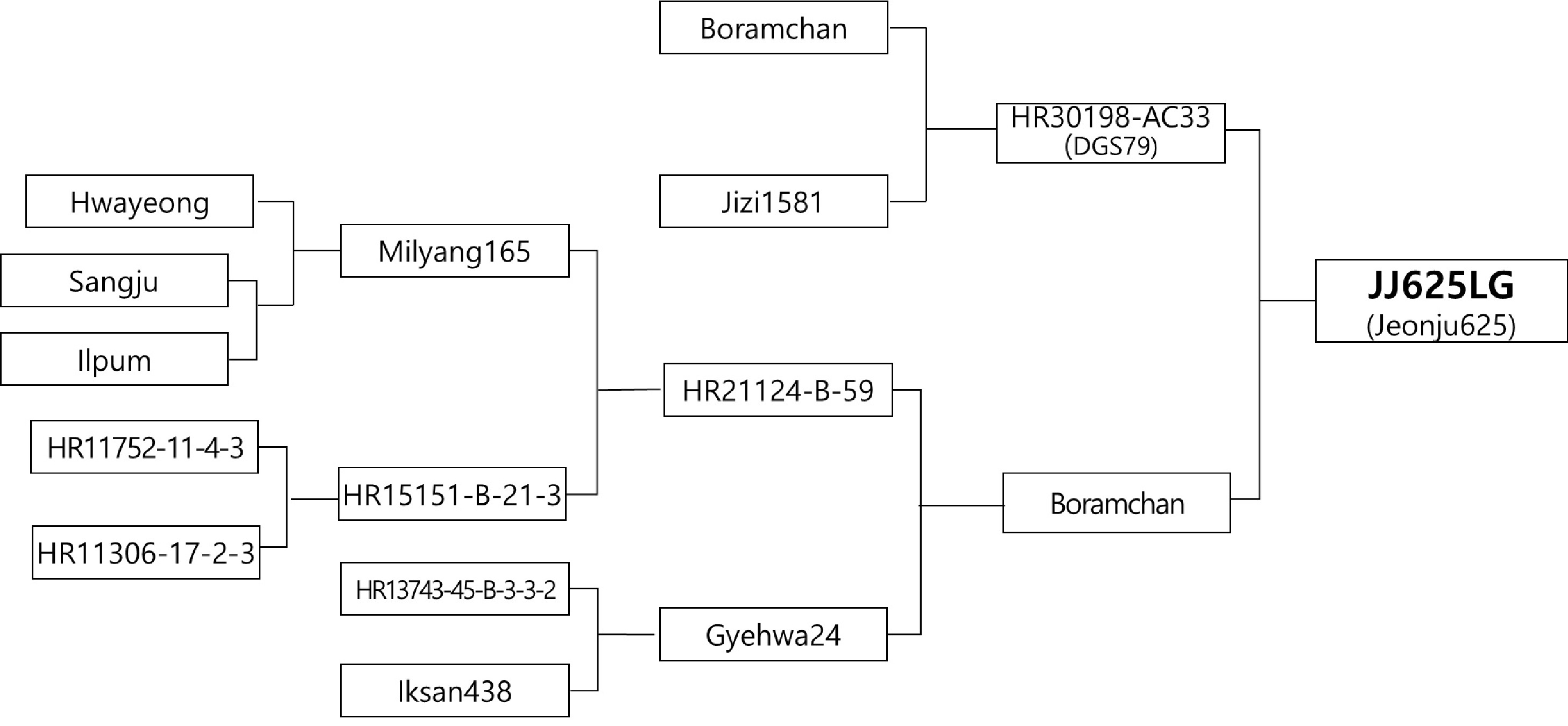
Fig. 2Pedigree diagram of ‘JJ625LG’.
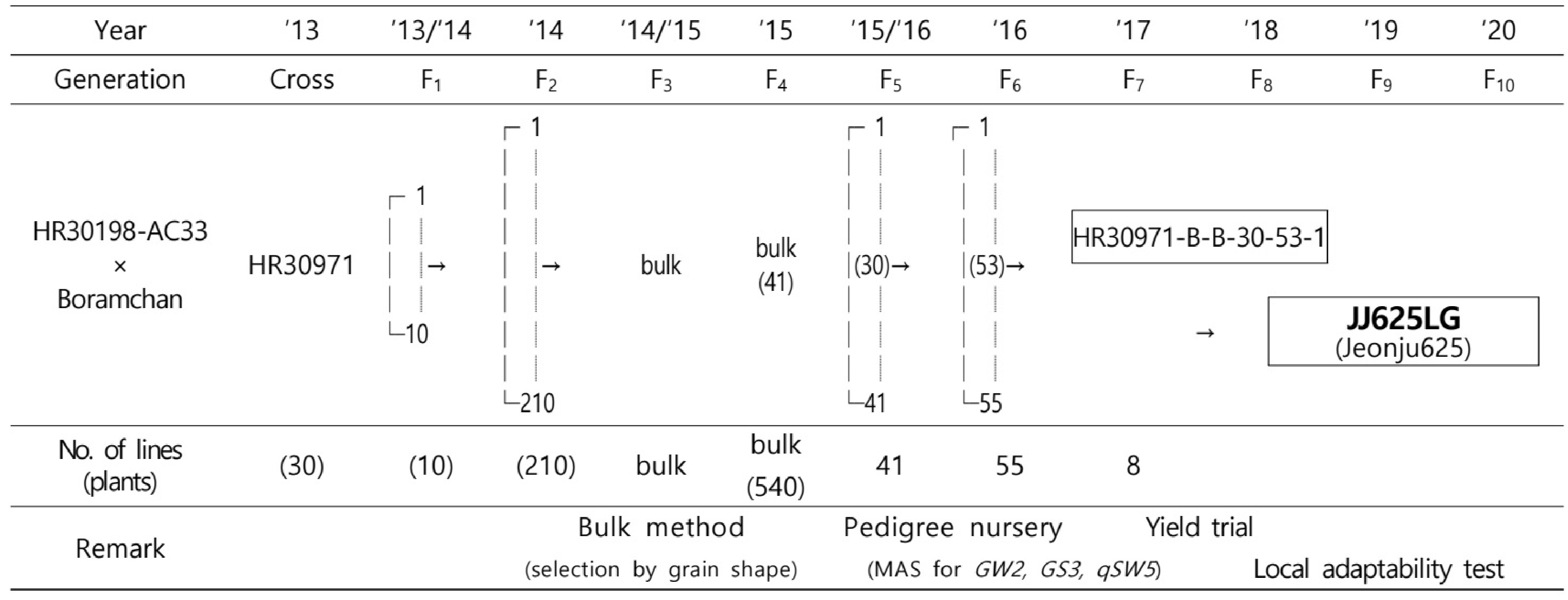
Fig. 3Plant type at maturing stage A and grain shape of milled rice B.
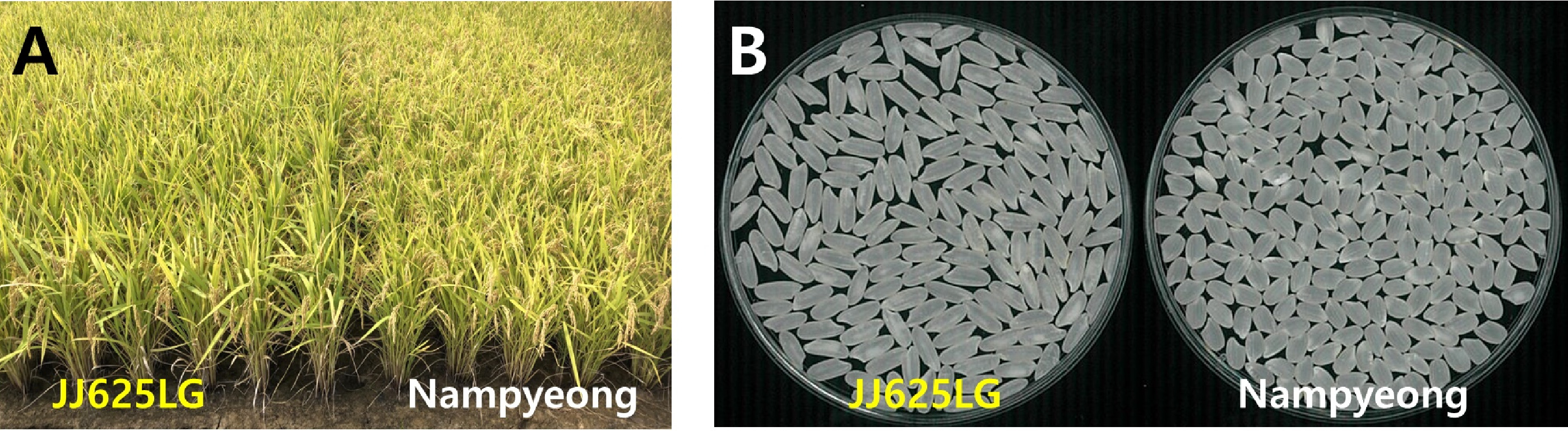
Fig. 4PCR analysis to confirm the allele types of ‘JJ625LG’ involved in the pedigree using gene specific DNA markers (A). M: size marker 1: Boramchan, 2: Jizi1581, 3: DGS79, 4: JJ625LG. Image of brown rice of ‘JJ625LG’ and its ancestral parents (B).
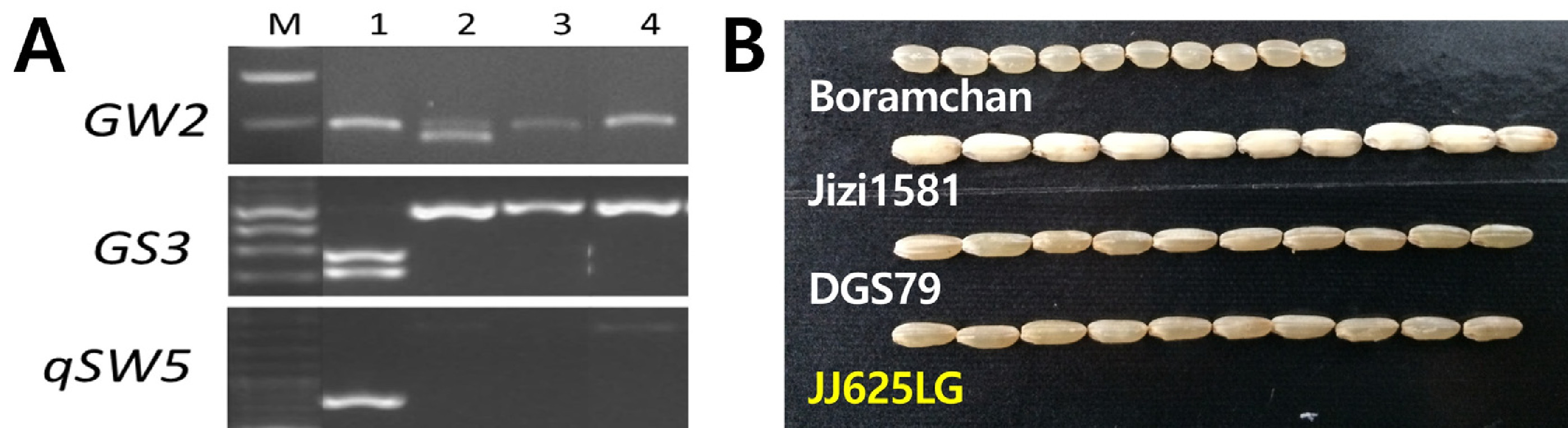
Table 1Major agronomic traits and yield components.
Table 1
|
Cultivar |
Heading date
(mm.dd) |
Culm length
(cm) |
Panicle length
(cm) |
No. of
panicles
per hill |
No. of
spikelets
per panicle |
Ratio of ripened grain
(%) |
1,000-grain weight of brown rice (g) |
|
JJ625LG |
8.16**
|
72ns
|
23ns
|
11ns
|
118**
|
86.9ns
|
25.3*
|
|
Nampyeong |
8.13 |
71 |
21 |
13 |
97 |
88.3 |
20.4 |
Table 2Response to physiological and abiotic stresses.
Table 2
|
Cultivar |
Occurrence of wilting |
Leaf senescence at maturing |
Cold tolerancez
|
Low tem. germinationy (%) |
Lodging |
Pre-harvest sproutingx (%) |
|
|
|
Seedling stage (1-9) |
Heading delay (day) |
Grain fertility (%) |
Phenotypic acceptability (1-9) |
Breaking strength (g) |
Index |
|
JJ625LG |
Tolerance |
Fast |
4ns
|
12ns
|
59.9*
|
5**
|
76.3**
|
1,384**
|
172**
|
17.1ns
|
|
Nampyeong |
Tolerance |
Late |
4 |
9 |
23.9 |
8 |
41.9 |
1,013 |
121 |
2.3 |
Table 3Resistance reaction to blast disease.
Table 3
|
Cultivar |
Reaction to leaf blast at upland blast nursery |
|
Reaction to bacterial blight |
|
|
|
No. of tested sites (11) |
Race |
Field |
|
|
|
Rz
|
M |
S |
Mean |
K1 |
K2 |
K3 |
K3a |
|
JJ625LG |
0 |
11 |
0 |
4.1 |
|
R |
R |
R |
S |
M |
|
Nampyeng |
5 |
6 |
0 |
3.4 |
|
S |
S |
S |
S |
S |
Table 4Reaction to virus disease and insect pests.
Table 4
|
Cultivar |
Virus diseases |
|
Resistance to insects |
|
|
|
Stripe |
Dwarf |
BPHz
|
SBPH |
|
JJ625LG |
Sy
|
S |
|
S |
S |
|
Nampyeng |
R |
S |
|
S |
S |
Table 5Characteristics related to grain shape and grain quality.
Table 5
|
Cultivar |
Brown rice |
Translucency (1-9) |
White core/belly |
Alkali digestive value (1-7) |
Protein content (%) |
Amylose content (%) |
Palatability of cooked rice (-3-+3) |
|
|
Length (mm) |
Width (mm) |
Thickness (mm) |
L/W ratio |
|
JJ625LG |
6.34**
|
2.40**
|
2.07ns
|
2.64**
|
1ns
|
0/1 |
6.8ns
|
5.4*
|
19.4ns
|
0.18 |
|
Nampyeng |
4.86 |
2.78 |
2.05 |
1.75 |
1 |
0/0 |
6.6 |
6.2 |
19.3 |
0.05 |
Table 6Characteristics related to milling quality.
Table 6
|
Cultivar |
Milling recovery ratio (%) |
Head rice milling recovery ratio (%) |
|
|
Brown/rough |
Milled/brown |
Milled/rough |
Head rice |
|
JJ625LG |
83.9 |
89.8 |
75.4 |
83.1 |
62.7 |
|
Nampyeng |
82.5 |
90.2 |
74.4 |
97.8 |
72.7 |
Table 7Yield summary of local adaptability test.
Table 7
|
Culture season |
Region |
No. of tested sites |
Milled rice (kg/a) |
|
Index |
|
|
|
JJ625LG (A) |
Nampyeong (B) |
A/B |
Ordinary
planting |
Honam plain |
3 |
545 |
533 |
|
102 |
|
West-southern coast |
1 |
494 |
514 |
|
96 |
|
|
Mean |
4 |
532 |
529 |
|
101ns
|
References
- 1. Association of Official Analytical Chemists (AOAC).2000. Official methods for analysis. 17th ed. 17th ed. Association of official analytical chemists, Washington DC. USA..
- 2. Baek MK, Park HS, Nam JK, Cho YC, Kim KY, Kim JJ, Kim WJ, Shin WC, Jeung JU, Kim CS, Jeong JM, Lee KM, Park SG, Lee CM, Suh JP, Lee JH. 2019. High grain quality mid-late maturing rice cultivar 'Yechan' with lodging tolerance and multiple disease resistance. Korean J Breed Sci 51: 504-514.
- 3. Calingacion M, Laborte A, Nelson A, Resurreccion A, Concepcion JC, Daygon VD, Mumm R, Reinke R, Dipti S, Bassinello PZ. 2014. Diversity of global rice markets and the science required for consumer-targeted rice breeding. PloS One 9: e85106.
- 4. Cheo ZR, Heu MH. 1975. Optimum conditions for alkali digestivity test in rice. Korean J Crop Sci 19: 7-13.
- 5. Choi ID. 2010. Physicochemical properties of rice cultivars with different amylose contents. J Korean Soc Food Sci Nutr 39: 1313-1319.
- 6. Fan C, Xing Y, Mao H, Lu T, Han B, Xu C, Li X, Zhang Q. 2006. GS3, a major QTL for grain length and weight and minor QTL for grain width and thickness in rice, encodes a putative transmembrane protein. Theoretical and Applied Genetics 112: 1164-1171.
- 7. Glaszmann J. 1987. Isozymes and classification of Asian rice varieties. Theor Appl Genet 74: 21-30.
- 8. Ha KY, Ko JK, Nam JK, Ko JC, Kim KY, Kang HJ, Shin MS, Baek MK, Kim BK, Kim WJ, Shin WC, Park HS. 2012. A new medium-late japonica rice cultivar, Boramchan with super high yield. Korean J Breed Sci 44: 346-350.
- 9. Juliano BO. 1979. The chemical basis of rice grain quality. In: Proceedings of the workshop on chemical aspects of rice grain quality. International Rice Research Institute, Los Banos, Philippines. pp. 69-90.
- 10. Juliano BO. 1985. Polysaccharide, proteins, and lipids of rice. In Rice Chemistry and Technology. The American Association of Cereal Chemists. St. Paul MN, USA. pp. 59-120..
- 11. Kang HJ, Hwang IK, Kim KS, Choi HC. 2006. Comparison of the physicochemical properties and ultrastructure of japonica and indica rice grains. J Agri Food Chem 54: 4833-4838.
- 12. Kauffman HE, Reddy APK, Hsieh SPY, Merca SD. 1973. An improved technique for evaluating resistance of rice varieties to Xanthomonas oryzae. Plant Dis Rep 57: 537-541.
- 13. KSVS.2005. The guidelines of characteristics for application and registration on new varieties in rice.
- 14. Kwak DY, Yeo US, Lee JH, Oh BG, Shin MS, Ku YC. 2007. Mass screening method for rice virus resistance using screen house. Korean J Crop Sci 52: 129-133.
- 15. Lee CK, Kim JT, Choi YH, Lee JE, Seo JH, Kim MJ, Jeong EG, Kim CK. 2009. Optimum sieve-slit width for effective removal of immature kernels based on virietal chracteristics of rice to improve milling efficiency. Korean J Crop Sci 54: 357-365.
- 16. Lee CK, Youn JT, Kim SL, Kim DS, Kim JH, Jeong EG, Song J. 2008. Relationship among alkali digestive value, amylopectin fine structure and physical properties of cooked rice. J Crop Sci 53: 320-325.
- 17. Lee CM, Lee KM, Baek MK, Kim WJ, Suh JP, Jeong OY, Cho YC, Park HS, Kim SM. 2020. Characterization of traits related to grain shape in Korean rice varieties. Korean J Crop Sci 65: 199-213.
- 18. Park HS, Baek MK, Nam JK, Shin WC, Jeong JM, Lee GM, Park SG, Kim CS, Cho YC, Kim BK. 2017. Development and characterization of breeding materials with diverse grain size and shape in japonica rice. Korean J Breed Sci 49: 369-389.
- 19. Park HS, Baek MK, Nam JK, Shin WC, Lee GM, Park SG, Lee CM, Kim CS, Cho YC. 2018. Development and characterization of japonica rice line with long and spindle-shaped grain. Korean J Breed Sci 50: 116-130.
- 20. Park HS, Kim KY, Baek MK, Cho YC, Kim BK, Nam JK, Shin WC, Kim WJ, Ko JC, Kim JJ, Jeong JM, Jeung JU, Lee KM, Park SG, Lee CM, Kim CS, Suh JP, Lee JH. 2019. Bacterial blight resistance genes pyramided in mid-late maturing rice cultivar 'Sinjinbaek' with high grain quality. Korean J Breed Sci 51: 263-276.
- 21. Rural Development Administration (RDA).2012. Standard of analysis and survey for agricultural research. pp. 315-338.
- 22. Rural Development Administration (RDA).2018. Project plant for collaborative research program to develop new variety summer crop. pp. 1-46.
- 23. Rural Development Administration (RDA).2019. Project plant for collaborative research program to develop new variety summer crop. pp. 3-50.
- 24. Rural Development Administration (RDA).2020. Project plant for collaborative research program to develop new variety summer crop. pp. 3-50.
- 25. Shin MS, Ko JK, Kim BK, Lee KS, Lee JK, Ha KY, Yang BK, Shin HT, Lee SY, Cho SY, Noh TH, Kim YD, Joung JI, Oh YH. 1998. A new high yielding and good quality rice cultivar adaptable to double cropping and late planting, "Nampyeongbyeo". Korean J Breed Sci 30: 384.
- 26. Shomura A, Izawa T, Ebana K, Ebitani T, Kanegae H, Konishi S, Yano M. 2008. Deletion in a gene associated with grain size increased yields during rice domestication. Nature Gent 40: 1023-1028.
- 27. Song XJ, Huang W, Shi M, Zhu MZ, Lin HX. 2007. A QTL for rice grain width and weight encodes a previously unknown RING-type E3 ubiquitin ligase. Nature Genetics 39: 623-630.
- 28. Yoon MR, Kim CE, Koh HJ, Kang MY. 2007. Physicochemical properties of rice kernels affected by palatability. Korean J Crop Sci 52: 45-50.
- 29. Yoon MR, Koh HJ, Kang MY. 2009. Pasting and amylose component characteristics of seven rice cultivars. J Korean Soc Appl Biol Chem 52: 63-69.
- 30. Zuo J, Li J. 2014. Molecular genetic dissection of quantitative trait loci regulating rice grain size. Ann Rev Gent 48: 99-118.